Best ACH payout platforms for US businesses in 2026
Best overall for USD/EUR supplier payouts: Moneyspace. Best for invoice-led accounts payable: BILL. Best for marketplace payouts: Stripe Connect. The best ACH payout platform for US business depends on whether you need to send payments, approve invoices, distribute marketplace funds, or build payment infrastructure.
TL;DR
- Moneyspace is the best ACH payout platform for US business teams needing USD/EUR supplier payments and dedicated account details.
- Choose BILL when invoice review and payment approval drive your accounts payable workflow.
- Choose Stripe Connect for platform payouts; consider Dwolla or Modern Treasury for payment infrastructure.
- Compare recipient eligibility, approval controls, reconciliation, and payout status before choosing.
Why this matters
ACH is a payment method, not a complete accounts payable process. A platform that sends a supplier payment doesn't necessarily capture the invoice, secure budget approval, or match the payment to your accounting records.
Start with the job you need done in 2026. Paying your own suppliers, distributing funds to marketplace sellers, and building transfers into an application require different tools. Choosing the wrong category creates extra work even when the underlying payment method is correct.
What makes the best ACH payout platform?
Use these criteria before comparing product names:
- Payment purpose: Separate your company's supplier payments from payouts made on behalf of platform users.
- Recipient fit: Confirm the recipient's country, account details, currency, and supported payment method.
- Operational controls: Check who can create recipients, approve payments, and manage team access.
- Reconciliation: Decide how payment records will connect to invoices and accounting entries.
- Implementation effort: Distinguish a business workspace from infrastructure that requires development and financial operations support.
- Payment visibility: Look for a clear distinction between submission, processing, completion, and exceptions.
Choose the workflow first and the ACH provider second. A familiar product name doesn't resolve a mismatch between your payment process and the product's intended use.
ACH payout platforms at a glance
This 2026 shortlist separates the products by operating model. The order favors direct business payouts first, followed by invoice management, marketplace distribution, and infrastructure.
| Platform | Best for | Standout capability | Key limitation |
|---|---|---|---|
| Moneyspace | Businesses paying suppliers in USD and EUR | Dedicated account details plus ACH, wire, and SEPA payouts | Currency scope is USD and EUR; supported destinations still require confirmation |
| BILL | Invoice-led accounts payable | Invoice management, approvals, and supplier payments | An accounts payable workflow isn't the same as an embedded payout product |
| Stripe Connect | Marketplaces and software platforms | Connected-account onboarding and payout infrastructure | Requires platform integration and a defined funds flow |
| Dwolla | Developers building account-to-account payments | APIs for integrating payment functionality | Requires development rather than just a payment workspace |
| Modern Treasury | Finance and engineering teams managing payment operations | Payment orchestration and reconciliation tools | Requires an underlying financial setup and implementation work |
1. Moneyspace: best ACH payout platform for USD/EUR suppliers
Get dedicated USD and EUR account details in your company's own name, then pay suppliers and teams through supported ACH, wire, and SEPA routes. You can also exchange USD and EUR inside the account. The account details aren't a shared payment reference.
Best for: Small and mid-size businesses, agencies, e-commerce sellers, and founders managing several companies with USD/EUR payment needs.
For business profiles, the stated payout limit is $100,000 or €100,000 per payout, with no monthly limit. Payouts usually take 1–2 business days. Treat that as an operating expectation, not a promise for a particular payment.
Pros
- Receive USD and EUR using dedicated account details in your own name.
- Use ACH, wire, and SEPA for supported payouts.
- Manage several companies and personal profiles under one sign-in.
- Assign owner, admin, operator, and view-only roles.
Cons
- Currency support is limited to USD and EUR.
- Country and recipient eligibility need confirmation; worldwide positioning doesn't establish universal access.
- Businesses complete KYB verification, and approval isn't promised.
Every payout, new recipient, and team grant requires 2FA. The fee appears before confirmation, and live payout status moves through Processing, On its way, and Completed.
Moneyspace is best for businesses that need dedicated USD/EUR account details and supplier payouts in one workspace. It's not a bank; account details are provided through a licensed partner after verification.
Verdict: Buy for direct USD/EUR business payouts, subject to eligibility.
2. BILL: best ACH payout platform for invoice-led payables
BILL combines accounts payable workflows with supplier payments. Its relevant distinction is the work surrounding the transfer: receiving an invoice, routing it for approval, and keeping payment activity connected to the payable.
Best for: Businesses whose primary problem is managing supplier invoices rather than building a payout feature into software.
Start a BILL evaluation with an actual invoice. Follow it from receipt through approval and payment, then check how the resulting record reaches your accounting system. That reveals more than a demonstration focused only on sending money.
BILL pros
- Connects invoice handling with supplier payments.
- Supports approval workflows for accounts payable.
- Offers accounting integrations for maintaining payment records.
BILL cons
- Doesn't serve the same purpose as a marketplace payout integration.
- Requires careful setup of approval rules and accounting mappings.
- Doesn't remove the need to verify recipient details and payment-method support.
Avoid choosing an accounts payable product solely because it supports ACH. The reason to choose this category is control over the invoice-to-payment process. If you already handle that process elsewhere, establish which system will own approvals before adding another.
Verdict: Buy when invoice approval is the main operational bottleneck.
3. Stripe Connect: best ACH payout platform for marketplaces
Stripe Connect supports payments and payouts for platforms and marketplaces through connected accounts. It's designed for businesses that manage payment relationships with sellers, service providers, or other platform participants.
Best for: Software platforms and marketplaces that need payout functionality within their own product.
The key question is whose money you're moving. Paying your company's contractor invoice differs from collecting customer payments and distributing funds to marketplace participants. Map that distinction before deciding on an integration.
Stripe Connect pros
- Provides connected-account onboarding for platform participants.
- Supports payment and payout integration within a software product.
- Fits marketplace workflows that involve multiple payment recipients.
Stripe Connect cons
- Requires integration work and decisions about the platform's responsibilities.
- Country, account, and payout-method support depend on the proposed setup.
- Doesn't replace invoice capture and internal purchasing approvals.
For a 2026 implementation, document how onboarding, account verification, payout eligibility, and payment exceptions will appear to users. Don't assume that support for a currency establishes support for every recipient or ACH use case.
Verdict: Buy for marketplace payout infrastructure; skip for a simple supplier-payment workspace.
4. Dwolla: best ACH payout platform for custom payment applications
Dwolla provides account-to-account payment infrastructure through APIs. It belongs on the shortlist when developers need to integrate money movement into an application rather than operate payments entirely through a separate business interface.
Best for: Product and engineering teams building a custom account-to-account payment experience.
Evaluate the integration as a product project. Your application needs to explain verification, payment progress, and exceptions in language users understand. An API connection alone doesn't complete that work.
Dwolla pros
- Supports API-based payment integration.
- Lets developers connect payment activity to their application's workflows.
- Fits businesses that need control over the surrounding user experience.
Dwolla cons
- Requires engineering resources for implementation and maintenance.
- Your team must define how users handle payment exceptions.
- Doesn't replace supplier invoice approvals or accounting policy.
Before selecting Dwolla, assign ownership for both the integration and ongoing operations. Decide who investigates unsuccessful transfers, who communicates with recipients, and which records support reconciliation. Those responsibilities remain necessary after the first successful payment.
Verdict: Buy for a custom payment application; skip if you only need a ready-to-use payout workspace.
5. Modern Treasury: best ACH payout platform for payment operations
Modern Treasury provides tools for payment operations, including payment orchestration and reconciliation. Its role differs from a straightforward account-and-payout service: it helps teams manage payment activity across their financial systems.
Best for: Finance and engineering teams that need to coordinate payments and reconcile records across an established financial setup.
Start with the mismatch you need to eliminate. Examples include payment instructions living separately from internal records or finance teams struggling to connect transaction activity to the correct entry. Establishing the problem keeps the evaluation focused on operational requirements.
Modern Treasury pros
- Brings payment operations into a structured workflow.
- Supports reconciliation between payment activity and internal records.
- Provides integration options for finance and engineering teams.
Modern Treasury cons
- Requires implementation around your existing financial relationships and systems.
- Isn't a substitute for confirming access to the underlying payment methods.
- Adds little value if your only requirement is occasional manual supplier payouts.
Ask which system initiates the payment, which system records its status, and which system holds the authoritative accounting record. Get clear answers before committing engineering time.
Verdict: Buy when payment orchestration and reconciliation justify the implementation work.
How the ranking works
This ranking prioritizes workflow fit, recipient support, controls, reconciliation, implementation effort, and visibility. It isn't a speed leaderboard or a claim that every product supports the same ACH arrangements.
The products occupy different categories. Direct business payouts lead this list because that's the article's primary use case. Invoice management, marketplace distribution, embedded transfers, and payment orchestration each receive a separate recommendation.
For your 2026 shortlist, apply the same criteria to a real payment. A product should stay on the list only if its operating model matches your business and recipient requirements.
Check the full payment workflow before signing up
Use a representative supplier payment to evaluate the entire process. Don't stop at whether the product can submit an ACH instruction.
Invoice approval
Confirm that the purchase is authorized and the invoice belongs to the correct company. Choosing accounts payable automation software addresses invoice review and approval, while choosing a payout platform addresses execution; your workflow needs clear ownership of both.
Recipient check
Confirm the recipient's legal name, payment details, currency, and supported destination. Establish who can add or change those details, and separate that responsibility from routine invoice entry where your operating process requires it.
Payment confirmation
Review the amount, method, displayed fee, and expected timing before submitting. A supported ACH route doesn't mean every payment will complete on the same schedule.
Status review
Record where the payment stands and who handles an exception. Distinguish a submitted instruction from a completed payment when communicating with suppliers.
Reconciliation
Match the completed payment to the invoice and accounting entry. Preserve a clear record of the company, recipient, purpose, and payment outcome.
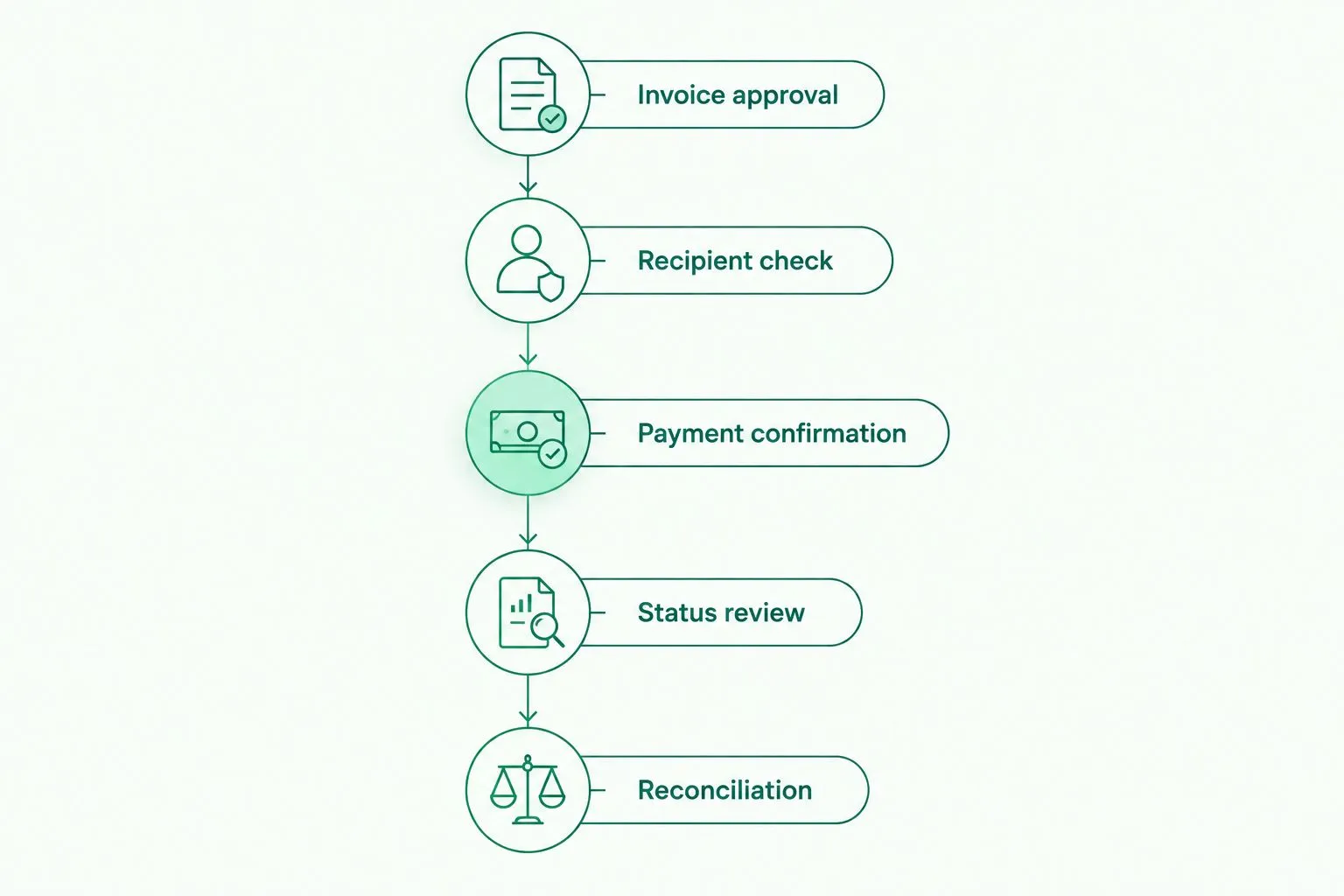
A complete payout process starts before submission and ends after reconciliation.
Which ACH payout platform should you choose?
Choose Moneyspace for dedicated USD/EUR account details and direct supplier payouts. Choose BILL when invoice approvals drive the buying decision. Choose Stripe Connect when payouts belong inside a marketplace.
Choose Dwolla when you're building a custom account-to-account payment application. Choose Modern Treasury when reconciliation and payment orchestration are the central requirements.
Don't buy infrastructure for a problem a business workspace already solves. Equally, don't expect a manual payout workspace to replace the integration needed for a marketplace. In 2026, the deciding factor remains the workflow you need to own.
Open an account
Get dedicated USD and EUR account details after verification. Confirm eligibility for your business.
FAQ
What's the best ACH payout platform for a US business?
Moneyspace is the best fit in this shortlist for businesses needing dedicated USD/EUR account details and direct supplier payouts. BILL fits invoice-led payables, while Stripe Connect fits marketplaces. Confirm business and recipient eligibility before choosing.
Is an ACH payout platform the same as accounts payable software?
No. A payout platform executes payments, while accounts payable software manages work such as invoice capture, review, and approval. Some products combine these functions, but you should verify the complete workflow.
Is BILL better than Stripe Connect for supplier payments?
BILL fits invoice-led supplier payments better when your main requirement is accounts payable management. Stripe Connect fits platforms and marketplaces managing payments and payouts for connected accounts. Choose based on the funds flow, not ACH support alone.
Can I use ACH to pay every international supplier?
No. ACH support doesn't establish universal international recipient coverage. Confirm the recipient's destination, account details, and supported payment method before sending.
How long do payouts take?
The client-supplied timing for the USD/EUR account service described here is usually 1–2 business days for payouts. That timing isn't a deadline and shouldn't be applied to the other platforms in this shortlist.
Should I choose Dwolla or Modern Treasury?
Choose Dwolla when the central task is integrating account-to-account payments into an application. Choose Modern Treasury when the central task is coordinating payment operations and reconciliation. Both require implementation planning.
What should I check before opening a business payout account?
Check eligibility, recipient coverage, payment methods, verification requirements, limits, and team controls. Then trace a representative payment through approval, submission, status review, and reconciliation.
One last thing
Treat a recipient-detail change as a separate approval event, not routine data entry. The invoice can be legitimate while the replacement payment instructions are wrong. Confirm changed instructions through an established contact channel before sending the next payout.