Best bank accounts for international students in 2026
Best overall: a local student checking account for everyday spending, if you meet its opening requirements. Best for separate USD and EUR payments: Moneyspace, subject to verification and eligibility. Best for campus support: a credit union account with convenient local access. This 2026 guide compares account setups by what you need them to do, rather than treating every international payment account as a replacement for local checking.
TL;DR
- The best bank account for international students starts with local checking that meets your everyday spending needs.
- Moneyspace suits students receiving eligible freelance payments in USD and EUR; it isn't a bank.
- Compare debit access, opening requirements, incoming payments and transfer costs before choosing.
- Keep an existing account during the transition until your new payment setup works.
Why this matters
Your tuition payment, rent, groceries and freelance income don't necessarily use the same payment method. Start with the payments you must make, then choose an account that supports them. A set of USD account details doesn't establish that you'll get a debit card, cash access or acceptance by your university.
For your 2026 move, separate two decisions: where you'll handle daily spending and how you'll receive money across borders. Combining those jobs in one account is convenient only when the account actually supports both.
Choose local checking for daily life; add a separate payment account only for a specific receiving or payout need. Don't open another account simply because its name includes “international.”
What makes the best account for international students?
Use these criteria before comparing provider names:
- Opening requirements: Confirm whether your residence, identity documents, student status and local address meet the provider's requirements. Ask which documents it accepts before applying.
- Everyday access: Check debit purchases, cash withdrawals and the payment methods your landlord accepts. Receiving account details alone don't answer these questions.
- Incoming payments: Match the account to the sender's currency and payment method. Distinguish ACH, wire and SEPA instead of treating them as interchangeable.
- Total transaction cost: Compare receiving, exchange, withdrawal and outgoing payment charges. Include applicable minimums, not just a percentage.
- Practical support: Check how you'll resolve a blocked payment, replace access credentials or update your address after moving.
- Account purpose and status: Establish whether you're opening local checking, joining a credit union or using a nonbank payment service. Read the applicable legal disclosures.
Student account options at a glance
The order below reflects the jobs most students need to solve first. It isn't a ranking of individual institutions or an assertion that every option accepts international students.
| Rank and option | Best for | Standout reason to consider it | Key limitation |
|---|---|---|---|
| 1. Local student checking | Everyday spending in your study destination | A local setup selected around rent, purchases and cash access | Opening requirements and account features differ |
| 2. Moneyspace | Separate USD and EUR payment needs | Dedicated account details in your own name, with ACH, wire and SEPA services | Not a bank; eligibility and supported destinations require confirmation |
| 3. Campus-accessible credit union account | Students who value accessible local support | A membership-based option to evaluate near your university | Membership eligibility and practical access need checking |
| 4. Existing home-country account | Maintaining payment continuity during your move | Keeps an established receiving route while you arrange local access | Foreign use, address changes and payment compatibility need review |
1. Local student checking: best for everyday spending
A local student checking account is the default starting point when you need one account for daily life in your study destination. Choose it around the payments you'll actually make: rent, groceries, transport and university charges. Confirm each required feature with the institution rather than assuming a student label includes it.
Before applying, ask for the exact opening checklist. Confirm how the institution handles your student status, identity documents, address and tax information. Requirements differ, so use the institution's current 2026 instructions rather than another student's experience.
Local student checking pros:
- Gives you a clear account category to evaluate for everyday purchases.
- Lets you prioritize local payment compatibility over international marketing claims.
- Allows you to compare nearby support and cash access before committing.
Local student checking cons:
- Eligibility isn't established merely because you're enrolled at a university.
- A suitable daily-spending account isn't automatically suitable for incoming international payments.
- Student conditions require review when your circumstances change.
Best for: Students who need their first everyday account in their study destination.
Ask whether your landlord's payment method works before redirecting your rent money. Check your university's payment instructions separately; don't assume the same route serves both.
Verdict: Hold until the institution confirms your eligibility and essential payment features; then make this your primary everyday account.
2. Moneyspace: best for separate USD and EUR payment needs
Moneyspace is best for international students with eligible freelance or contractor payments in USD and EUR who need separate payment account details. It provides dedicated USD details, including a routing and account number, and EUR details, including IBAN and BIC, in the customer's own name. Receiving methods include ACH, wire and SEPA.
This is a payment-account recommendation, not a substitute for checking whether you need local spending access. The service supports USD/EUR exchange and payouts through supported ACH, wire and SEPA routes. The fee appears before confirmation, and payout status progresses through Processing, On its way and Completed.
Payment account pros:
- Dedicated account details use your own name rather than a shared reference.
- One online verification process opens access to USD and EUR, subject to approval.
- Live payout status helps you follow a transfer after sending.
- Every payout and new recipient requires two-factor authentication.
Payment account cons:
- Moneyspace isn't a bank; account details are provided through a licensed partner after verification.
- Currency support is limited to USD and EUR.
- Country eligibility and destination support need confirmation before you rely on the account.
Pricing: Opening, verification and the monthly fee are free. Incoming ACH, wire and SEPA payments cost 0.5%. Outgoing ACH costs 0.5%, minimum $2; outgoing wire costs 0.5%, minimum $15; outgoing SEPA costs 0.5%, minimum €2. USD/EUR exchange costs 0.5%, minimum $1.
For individuals, the payout limit is $10,000/€10,000 per payout and $50,000/€50,000 per month. Incoming ACH usually takes 1–3 business days. Incoming wire and SEPA usually arrive within a business day; payouts usually take 1–2 business days.
These capabilities and terms reflect client-supplied information dated October 26, 2026. Check the applicable terms before applying or transferring.
Best for: Eligible students receiving USD or EUR freelance payments who already have a plan for everyday spending.
Verdict: Hold until eligibility, sender compatibility and your intended payout destination are confirmed.
3. Campus-accessible credit union: best for local support
A credit union account belongs on your shortlist when you want an accessible place to ask questions near campus. Start with membership eligibility, then evaluate the specific account. Proximity alone doesn't establish that you qualify or that its payment features suit you.
Ask your university's international student office which institutions provide current opening instructions for international students. Treat that information as a starting point, not an endorsement or an approval decision. The institution makes the account-opening decision.
Campus-accessible credit union pros:
- Lets you prioritize in-person help when comparing local options.
- Gives you an alternative to evaluating only large retail institutions.
- Encourages a practical check of branch and cash access around your actual routine.
Campus-accessible credit union cons:
- Membership requirements create an additional eligibility question.
- Convenient campus access doesn't establish convenient access during travel.
- International receiving and outgoing payment capabilities need separate confirmation.
Best for: Students who value accessible local assistance and meet membership requirements.
Before choosing, map the locations you'll actually use. Check opening hours against your class schedule and ask how support works when you're away from campus. If you'll leave the country during breaks, include that situation in your questions.
Verdict: Hold until membership, everyday payment features and support access fit your needs.
4. Existing home-country account: best for payment continuity
Keeping an existing account during your move preserves a familiar receiving route while you establish your new setup. That makes it a transition option, not an automatic choice for daily spending abroad. Review its terms before changing your residence or relying on overseas access.
Check how you'll authenticate payments after changing your phone number. Also confirm whether the provider needs your new address and whether your planned use remains permitted. Solve access questions before departure rather than during a rent payment.
Existing home-country account pros:
- Preserves an established account while you arrange local access.
- Avoids redirecting every incoming payment at once.
- Gives you a separate route to evaluate for family support and existing obligations.
Existing home-country account cons:
- Foreign spending, withdrawals and transfers need a fresh cost review.
- A changed address or phone number requires attention to access and account requirements.
- Your university or landlord might require a different payment route; confirm acceptance directly.
Best for: Students managing the transition between departure and a working local setup.
Don't close the account merely because a new application has been submitted. First confirm that you can receive money, authenticate access and make the payments you need through the replacement setup.
Verdict: Hold the existing account through the transition, then review whether it still has a useful role.
How the options are ranked
This ranking prioritizes everyday payment coverage first, a distinct cross-border payment need second, local support third and transition continuity fourth. Those priorities explain why local checking comes before a specialist payment account.
The comparison doesn't assign scores or claim hands-on testing. It separates account types by purpose and uses the supplied product facts for the named payment service. Your destination, documents and payment requirements determine the final choice.
For 2026, use the same criteria with each institution you consider. An account that fails an essential payment requirement shouldn't win because another feature looks attractive.
Set up your payments before redirecting income
Follow this sequence to avoid confusing an approved application with a working payment arrangement:
- List payments. Write down rent, tuition, daily purchases and expected incoming transfers. Record the currency and accepted method for each.
- Check eligibility. Confirm your residence, documents and account purpose with the provider. Submit only the information requested through its official process.
- Confirm details. Check the recipient name, account details and payment method against the sender's instructions. Resolve mismatches before sending.
- Review charges. Read the transaction fee, applicable minimum and exchange charge before confirmation. Include separate charges disclosed by other parties involved.
- Redirect income. Update your payer only after you understand the receiving process and have working account access.
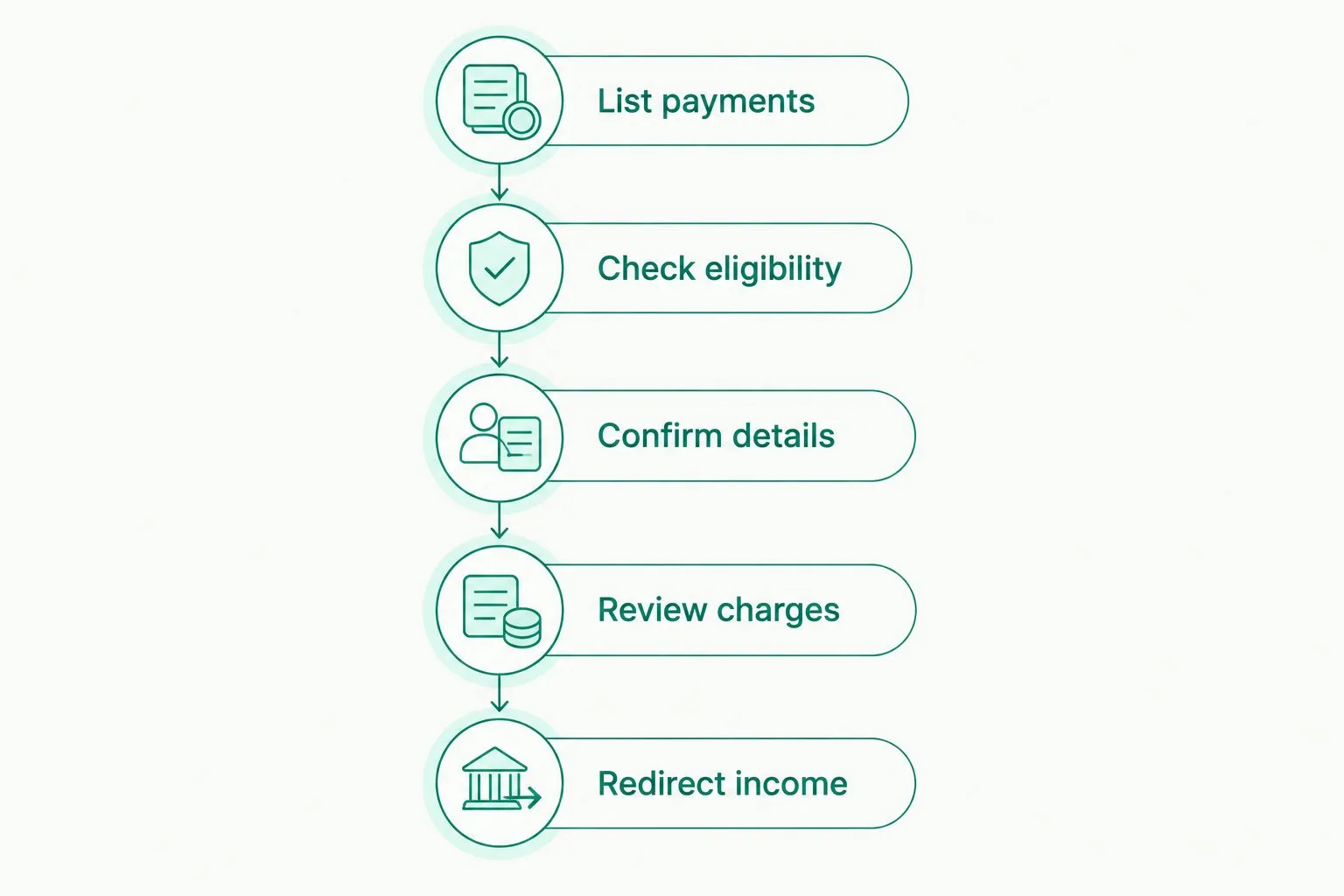
Confirm eligibility, payment details and charges before redirecting income.
Keep payment records with your account documents. If a university, landlord or client provides specific instructions, compare those instructions with the receiving account before initiating a transfer. Don't substitute a different payment method simply because the account supports it.
Which account should you choose?
Start with local student checking if your main need is everyday spending. Evaluate a campus-accessible credit union when local support matters and you meet its membership requirements. Keep your existing account during the transition until the replacement setup works.
Add Moneyspace only when dedicated USD and EUR payment account details solve a separate, confirmed need. For a student doing freelance work in 2026, that means checking the client's sending method, your eligibility and the supported payout destination before redirecting payments.
Open an account
Get dedicated USD and EUR account details after verification, subject to eligibility.
FAQ
What's the best account for an international student?
A local student checking account is the starting point for everyday spending if you meet its requirements. Confirm rent payments, debit access and cash access before choosing; evaluate international receiving separately.
Can I open an account before arriving at university?
Pre-arrival opening depends on the provider's eligibility and document requirements. Ask whether your current residence and available documents qualify before submitting an application.
Is Moneyspace a replacement for a local student checking account?
Moneyspace is a separate USD and EUR payment account option, not a bank. It provides dedicated account details through a licensed partner after verification; confirm eligibility and your everyday spending arrangements separately.
Do international students need both USD and EUR account details?
You need both only when your actual receiving or payout requirements call for both currencies. Match account details to your clients, family transfers or other payers rather than opening currency accounts without a defined use.
How long do ACH, wire and SEPA payments take?
For the payment service described here, incoming ACH usually takes 1–3 business days, and incoming wire or SEPA usually arrives within a business day. Payouts usually take 1–2 business days; these are usual timings, not fixed arrival commitments.
Does a student account automatically support tuition payments?
No; confirm your university's accepted payment instructions before sending tuition. Check the recipient details, currency, transfer method and applicable limits against your chosen account.
Should I close my existing account when I move abroad?
Keep your existing account during the transition until your replacement payment setup works. Review residence requirements, authentication access and ongoing obligations before deciding whether to close it.
One last thing
Account details and a usable payment route aren't the same decision. Before your first important payment in 2026, confirm the recipient name, currency, method and destination support together. A correct account number doesn't resolve a mismatch elsewhere in the instructions.
Keep a short payment checklist with your documents. It gives you a repeatable way to check rent, tuition and incoming freelance payments without assuming that one successful transfer proves every other route works.