Best business accounts for offshore companies in 2026

Best overall for USD and EUR operations: Moneyspace, subject to business eligibility. Best for local obligations: a local operating account. Best for complex treasury needs: an international commercial account. Best for marketplace settlements: a platform-compatible payout account. The best business account for offshore company operations depends on your incorporation jurisdiction, owners, payment routes, and verification requirements—not the word offshore.
TL;DR
- Moneyspace suits offshore company payments in USD and EUR, subject to eligibility and business verification.
- The best business account for offshore company operations must match incorporation, ownership, and payment requirements.
- Choose a local operating account when local obligations require one; confirm those requirements before applying.
- Check marketplace acceptance separately from the provider’s business eligibility decision.
- Moneyspace is not a bank; account details come through a licensed partner after verification.
Why this matters
An offshore company is incorporated outside a jurisdiction relevant to its owners or operations. That label alone doesn't tell an account provider what your business does, where it trades, or where its money comes from. Your application needs to explain those details clearly.
For your 2026 shortlist, separate account access from account usefulness. A provider can support your incorporation jurisdiction without supporting the payment route your customers use. Likewise, suitable account details don't establish that a marketplace accepts them.
Choose an account for the transactions your company actually makes. Don't choose one because its marketing mentions international businesses.
What makes the best account for an offshore company?
Use these criteria before comparing account types:
- Business eligibility: Confirm the incorporation jurisdiction, owner residency, business activity, and ownership structure the provider accepts.
- Receiving details: Check the account holder name, currencies, and payment methods your customers need.
- Payout coverage: Confirm the recipient destinations and rails required for suppliers, contractors, and employees.
- Operational control: Look for suitable team permissions, approval controls, and transaction visibility.
- Transaction fit: Compare payout limits, usual processing times, and disclosed charges against your payment schedule.
- Legal fit: Understand the provider's legal status and whether separate local account requirements apply to your company.
Treat eligibility as a gate, not a scoring bonus. There's no useful feature comparison until the provider accepts your company and intended activity.
Offshore company accounts at a glance
These choices compare different operating needs, not interchangeable products. Moneyspace is the named provider below; the other entries describe account categories to evaluate against your requirements.
| Account option | Best for | Standout capability or selection requirement | Key limitation |
|---|---|---|---|
| Moneyspace | USD and EUR collections and payouts | Dedicated details in your company's name, with ACH, wire, and SEPA support | Only USD and EUR; eligibility requires confirmation |
| Local operating account | Documented local payment obligations | Acceptance by the relevant local authority or counterparty | Local acceptance doesn't establish international payment suitability |
| International commercial account | Complex treasury requirements | Assess advanced controls and services individually | The international label doesn't establish offshore eligibility |
| Platform-compatible payout account | Marketplace and platform settlements | Acceptance by the specific platform paying your company | Platform acceptance and provider approval are separate checks |
1. Moneyspace: best for USD and EUR company payments
Moneyspace provides dedicated USD and EUR account details in the customer's own name. Businesses can receive payments by ACH, wire, and SEPA, exchange USD/EUR inside the account, and send supported payouts through those rails.
Moneyspace is best for offshore company payments centered on USD and EUR, subject to business eligibility and verification. It is not a bank. Account details are provided through a licensed partner after verification.
The operational details matter for companies paying several counterparties. Team roles include owner, admin, operator, and view-only. Every payout, new recipient, and team grant requires 2FA, while several companies and personal profiles can sit under one sign-in.
Moneyspace pros:
- Receive using your own company account details rather than a shared reference.
- See the fee before confirming a transfer.
- Follow payout status through Processing, On its way, and Completed.
- Manage team access and several companies within one workspace.
Moneyspace cons:
- Currency support is limited to USD and EUR.
- No country-by-country eligibility list is supplied; confirm your company and owners qualify.
- Business payouts have a $100,000/€100,000 limit per payout.
Business accounts have no monthly payout limit. Incoming ACH usually takes 1–3 business days; incoming wire and SEPA usually arrive within a business day. Payouts usually take 1–2 business days, so build your payment schedule around those stated ranges rather than assuming immediate settlement.
Best for: Agencies, e-commerce sellers, service businesses, and founders whose collections and supplier payments use USD and EUR.
Verdict: Hold until your company’s eligibility and required destinations are confirmed; then choose it for the stated USD/EUR workflow.
2. Local operating account: best for local obligations
A local operating account deserves a place on your shortlist when a specific authority, customer, landlord, or payment arrangement requires it. Establish the requirement first. Incorporation alone doesn't prove that your company needs a particular local account.
Ask the relevant counterparty what it accepts: account location, account holder name, payment method, and supporting documentation. Get the answer in writing before opening an account solely to satisfy that obligation.
Local operating account pros:
- Lets you assess a defined local requirement directly.
- Keeps local collections and payments separate from international operations if that suits your accounting.
- Gives you a clear acceptance test: whether the relevant counterparty accepts the details.
Local operating account cons:
- Local suitability doesn't establish support for your international payment routes.
- An additional account creates another reconciliation and access-management task.
Best for: Companies with a documented local payment or account requirement.
For your 2026 application, distinguish a legal requirement from a preference expressed by a service provider. Ask your qualified adviser to confirm the former. Neither a sales page nor a general offshore-company checklist establishes your company's obligations.
Verdict: Hold until the local requirement is confirmed; don't open an extra account for an unverified assumption.
3. International commercial account: best for complex treasury needs
An international commercial account belongs on your shortlist when your requirements extend beyond receiving and paying in USD and EUR. Start with a written specification rather than assuming every international provider offers the same services.
Your specification can cover approval hierarchies, reporting exports, payment methods, currency requirements, and counterparty destinations. Ask each provider to confirm the exact combination it supports for your company.
International commercial account pros:
- Gives complex businesses a category to assess against a detailed treasury specification.
- Lets you evaluate collection, payout, reporting, and control requirements together.
- Supports a structured comparison of requirements that simpler account offerings don't address.
International commercial account cons:
- The category name doesn't establish any particular feature or eligibility policy.
- Comparing broad service menus takes more work than matching a defined payment workflow.
- A complex offering adds little value when your company only needs straightforward collections and payouts.
Best for: Companies with documented requirements beyond a focused USD/EUR payment account.
Separate essential functions from conveniences. If a missing feature would stop payroll or customer collections, make it an acceptance condition. If it would only save an occasional manual task, don't let it outweigh payment-route compatibility.
Verdict: Skip unless your documented treasury requirements justify a broader account search.
4. Platform-compatible payout account: best for marketplace settlements
A platform-compatible payout account is an account that your specific marketplace or commercial platform accepts for settlements. Treat compatibility as something to verify, not something inferred from having USD details or a EUR IBAN.
Check the platform's current payout requirements alongside the account provider's rules. Match the legal entity, account holder name, currency, account location requirements, and payment method before changing settlement instructions.
Platform-compatible payout account pros:
- Puts your actual source of revenue at the center of account selection.
- Creates a concrete checklist for validating settlement details.
- Helps you avoid choosing an account solely for unrelated payout features.
Platform-compatible payout account cons:
- Acceptance by one platform doesn't establish acceptance by another.
- Compatibility doesn't establish suitability for supplier payments or team access.
Best for: E-commerce sellers and businesses whose revenue depends on a particular platform's settlement process.
Keep the platform's written requirements with your account-selection records. For 2026 decisions, verify the current rules instead of relying on an older setup guide or another seller's experience.
Verdict: Hold until both the platform and account provider confirm the intended settlement arrangement.
Verify the company before moving payment instructions
Prepare a clear explanation of your business before submitting applications. Describe what you sell, who pays you, where your counterparties operate, and why the company needs the proposed account. Make the account's purpose easy to understand.
Confirm eligibility
Give the provider your incorporation jurisdiction, owner residency information, and business activity. Ask about your actual structure, including any corporate owners. Don't treat general worldwide positioning as confirmation that your company qualifies.
Prepare documents
Request the provider's document checklist before arranging translations or certifications. Depending on the recipient's instructions, translation, notarization, and other certification requirements are separate questions; notarized translation services only address the notarization requirement when the recipient specifically asks for it. Confirm the required language and document format before commissioning work.
Complete verification
Submit consistent company and ownership information. Business verification uses KYB, or know-your-business checks. Don't apply a timing statement about individual ID checks to a company's review.
Confirm payment details
After verification, check the issued account holder name and receiving instructions against the payer's requirements. Change customer or platform payment instructions only after that compatibility check.
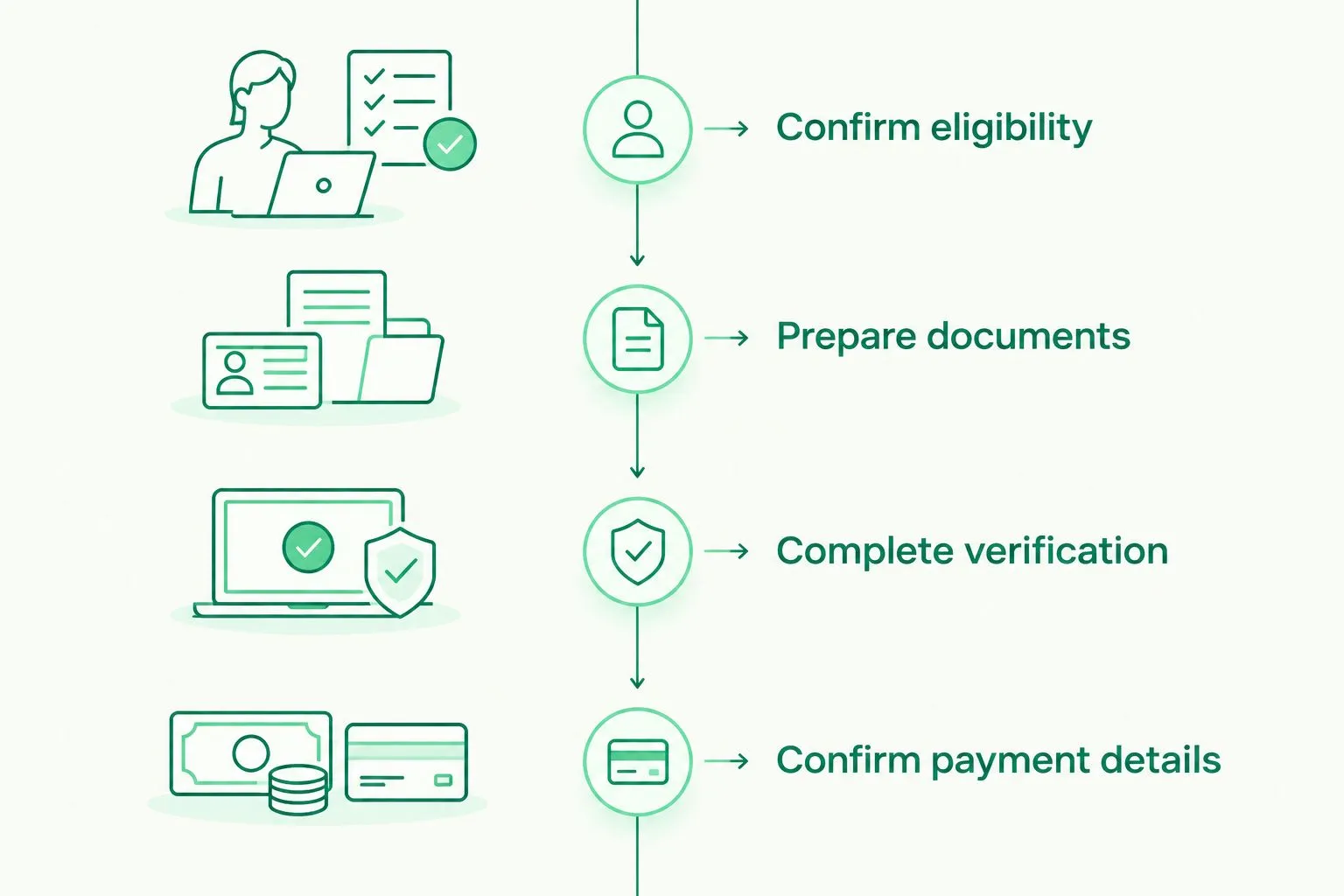
Confirm eligibility before changing customer payment instructions.
Match payment rails to your operating schedule
Write down how each important payer sends funds and how each recipient needs to receive them. ACH, wire, and SEPA are specific payment methods, not interchangeable labels for an international transfer. Match both ends of the transaction.
For example, a USD customer collection and a EUR supplier payout create separate receiving, exchange, and payout decisions. Check each step instead of judging the account only by its receiving details.
Use the ACH payout platform comparison when ACH is central to your supplier or contractor workflow. Compare recipient acceptance, controls, and timing—not just whether ACH appears in a feature list.
Build your 2026 payment checklist around:
- Receiving method: The rail and currency your customer or platform actually uses.
- Payout size: Whether each planned payment fits the provider's transaction limit.
- Processing window: The stated usual timing for that specific payment method.
- Recipient acceptance: Whether the destination and beneficiary details are supported.
- Confirmation: The fee and recipient information shown before you authorize payment.
Don't schedule supplier payments from an expected incoming transfer as though it has already arrived. Keep collection timing and payout timing separate in your cash-flow plan.
How the options are ranked
This ranking prioritizes eligibility, receiving details, payout coverage, operational controls, transaction fit, and legal fit. The default is a focused USD/EUR account for a company that needs those currencies and supported rails.
Local obligations move a local operating account to the top. Complex treasury requirements move an international commercial account higher. Dependence on marketplace revenue makes platform acceptance the first test.
This is a requirements-based ranking, not a claim that every provider accepts every offshore company. The winning account is the one that passes your company's eligibility and payment checks.
Which account should you choose?
Choose the USD/EUR option first if it matches your customers, suppliers, and team payments. Confirm business eligibility before signing up with the expectation of approval. Keep local obligations and platform acceptance as separate checks.
For a 2026 decision, write a short acceptance checklist and require a clear answer to every essential item. Don't move revenue collection to an account with unresolved compatibility questions.
Open an account
Get your own USD and EUR account details after verification, subject to eligibility.
FAQ
What's the best business account for an offshore company?
The best business account for an offshore company is one that accepts its jurisdiction, ownership, activity, and required payment routes. Moneyspace suits USD and EUR collections and payouts, subject to eligibility and business verification.
Can an offshore company get USD and EUR account details?
An offshore company needs provider confirmation that its structure and activity qualify. Dedicated USD and EUR details are offered through a licensed partner after verification; worldwide audience positioning doesn't establish universal eligibility.
Does an offshore company need a local operating account?
A local operating account is necessary when an applicable requirement calls for one. Confirm the specific obligation with a qualified adviser and ask the relevant authority or counterparty which account details it accepts.
How long does business verification take?
No fixed business verification deadline is stated here. Business KYB is separate from individual ID checks, so individual timing should not be applied to a company application.
What payout limits apply to business accounts?
Moneyspace business payouts have a limit of $100,000 or €100,000 per payout, with no monthly payout limit. Check that each planned payment fits the applicable currency limit.
How long do ACH, wire, and SEPA payments usually take?
Incoming ACH usually takes 1–3 business days, while incoming wire and SEPA usually arrive within a business day. Payouts usually take 1–2 business days; plan around the payment method you use.
Will a marketplace accept any account in my company's name?
An account in your company's name doesn't establish marketplace acceptance. Check the platform's currency, account location, payment-method, and entity-matching requirements before changing settlement details.
One last thing
Approval and payment compatibility are different decisions. Before moving your collections, ask your largest payer to confirm that the issued details meet its requirements. That check connects the account you've opened to the revenue you need it to receive.