Best crypto-friendly business bank accounts in 2026
Best for USD and EUR payment operations: Moneyspace. Best for banking tied to crypto activity: a business banking provider that explicitly accepts your business model. Best for conversion: an exchange business account. Best for direct wallet control: a self-custody business wallet. These options serve different jobs; don't treat them as interchangeable.
TL;DR
- Moneyspace fits USD and EUR business payments; don't assume that payment capabilities establish acceptance of crypto-related activity.
- Choose crypto-friendly business accounts by permitted activity, company eligibility, payment methods and custody arrangements.
- Use an exchange for conversion and a self-custody wallet for direct control, not as substitutes for business payment services.
- Confirm acceptance of your exact business model before directing customer receipts or exchange withdrawals to an account.
Why this matters
The best crypto-friendly business account in 2026 is the one that accepts your actual activity and supports the transactions your company needs. A business receiving occasional proceeds from its own holdings presents a different use case from a business exchanging assets for customers.
Separate three decisions: where your company receives USD and EUR, where it converts digital assets, and who controls its wallets. A provider's support for one function doesn't establish support for the others.
Moneyspace is best for businesses that need dedicated USD and EUR account details and ACH, wire and SEPA payments. That recommendation concerns payment operations, not permission to receive crypto-related funds.
What makes the best crypto-friendly business account
Use these criteria to assess a provider before submitting an application:
- Permitted activity: Get a clear answer about your company’s activities, including trading, customer payments, custody or exchange services.
- Company eligibility: Check the legal entity, incorporation jurisdiction, operating countries and ownership requirements.
- Payment compatibility: Match incoming and outgoing payment methods to customers, suppliers and exchange withdrawal requirements.
- Custody and legal status: Establish whether you're choosing banking services, payment services, exchange custody or direct wallet control.
- Operational controls: Check team permissions, transaction approval, payout tracking and accounting records.
- Transaction restrictions: Review limits, required documentation and restrictions on senders, recipients or counterparties.
For your 2026 shortlist, treat permitted activity as a pass-or-fail requirement. Useful payment features cannot compensate for a provider that doesn't accept your business model.
Business account options at a glance
This ranking separates operating needs rather than claiming that one provider covers every crypto-related use case. Only the named payment provider has client-supplied product details in this guide; the other entries describe account types to evaluate.
| Rank and option | Best for | Standout capability | Key limitation |
|---|---|---|---|
| 1. Moneyspace | USD and EUR payment operations | Dedicated account details in your company's own name | Payment features don't establish a crypto-acceptance policy |
| 2. Business banking provider with explicit crypto acceptance | Businesses that specifically need banking services | A banking relationship assessed against the disclosed business model | Acceptance must cover the exact activity, entity and counterparties |
| 3. Exchange business account | Business asset conversion | Exchange functionality for supported assets and transactions | An exchange account isn't a substitute for general business payment operations |
| 4. Self-custody business wallet | Direct control of digital assets | Control of wallet signing credentials | Your company must manage keys, approvals and recovery |
1. Moneyspace: best for USD and EUR payment operations
Moneyspace provides dedicated USD and EUR account details in the customer's own name, rather than a shared payment reference. Businesses can receive ACH, wire and SEPA payments, exchange USD and EUR inside the account, and pay out through supported payment methods and destinations.
USD details include a routing number and account number. EUR details include an IBAN and BIC. These identifiers let you give customers the details required for the relevant payment method.
Best for: Agencies, e-commerce sellers, small and mid-size businesses, and founders managing several companies that need USD and EUR payment operations.
Payment account pros
- Dedicated USD and EUR account details use the customer's own name.
- Owner, admin, operator and view-only roles support team access.
- Several companies and personal profiles sit under one sign-in.
- Payouts display live status: Processing, On its way and Completed.
Payment account cons
- Only USD and EUR are supported in the supplied offer.
- Business verification is required, and approval isn't promised.
- Payment capabilities don't establish acceptance of exchange withdrawals or other crypto-related receipts.
Fees, limits and timing
Opening, verification and the monthly fee are free. Incoming ACH, wire and SEPA payments cost 0.5%. Outgoing ACH costs 0.5%, with a $2 minimum; outgoing wire costs 0.5%, with a $15 minimum; outgoing SEPA costs 0.5%, with a €2 minimum. USD/EUR exchange costs 0.5%, with a $1 minimum.
The fee appears before confirmation. Check that amount for each transaction rather than assuming every payment costs exactly 0.5% without a minimum.
Business limits are $100,000 or €100,000 per payout, with no monthly limit. Incoming wire and SEPA payments usually arrive within a business day; incoming ACH takes 1–3 business days. Payouts usually take 1–2 business days.
Every payout, new recipient and team grant requires two-factor authentication. Businesses complete KYB, meaning verification of the company, rather than relying only on an individual's identity check.
Verdict: Buy for a confirmed USD/EUR payment use case; wait for explicit acceptance before using it for crypto-related flows. Moneyspace is not a bank. Account details are provided through a licensed partner after verification.
2. Business banking provider: best for banking requirements
Choose a business banking provider when your company specifically needs banking services rather than payment details alone. The essential qualification is explicit acceptance of your disclosed crypto-related activity, not a general statement that the provider serves technology companies.
Describe what your company does in ordinary language. Receiving payment for consulting work, trading company assets and handling customer funds are different activities; your application should identify the actual one.
Best for: Companies whose operational or contractual requirements specifically call for a banking relationship.
Business banking provider pros
- Lets you assess banking requirements separately from exchange and wallet requirements.
- Gives you a defined relationship in which to disclose the company's activities.
- Creates a clear basis for asking about counterparties and expected transaction flows.
Business banking provider cons
- Acceptance of one crypto-related activity doesn't establish acceptance of another.
- Entity, jurisdiction and counterparty restrictions require provider-specific checks.
- The label “crypto-friendly” doesn't explain which transactions are permitted.
Ask whether the provider accepts incoming payments from your intended exchange, payments from customers involved in digital assets, and transfers involving your company's own holdings. Get separate answers where the activities differ.
In 2026, build your shortlist around documented acceptance, not brand reputation alone. Keep the application description consistent with your contracts and expected payment records.
Verdict: Buy only after the provider accepts your precise business activity and required payment flows.
3. Exchange business account: best for conversion
An exchange business account serves a different purpose from a payment account: it gives a company access to the exchange's supported asset and transaction functions. Evaluate the specific exchange's business offering, permitted jurisdictions and withdrawal requirements before selecting it.
If your business needs conversion, start with the assets and transactions you actually use. Then check how funds move between the exchange and your company's USD or EUR payment provider.
Best for: Businesses that need asset conversion as a distinct part of their payment workflow.
Exchange business account pros
- Separates conversion activity from supplier and payroll payment operations.
- Gives you a dedicated place to assess asset and transaction support.
- Lets you evaluate business onboarding and withdrawal requirements together.
Exchange business account cons
- Supported assets, countries and business activities depend on the provider.
- Withdrawal methods must match the receiving provider's requirements.
- Conversion functionality alone doesn't meet every invoicing or team-payment need.
Check both sides of the transfer. An exchange accepting a withdrawal destination doesn't establish that the receiving provider accepts that source of funds.
Also establish which legal entity holds the exchange account. Don't assume a founder's personal account is an appropriate substitute for company onboarding or company transaction records.
Verdict: Buy for a defined conversion requirement; skip it as your only business payment tool.
4. Self-custody business wallet: best for direct wallet control
A self-custody business wallet gives your company control over wallet signing credentials. It does not, by itself, provide USD routing details, EUR payment details or ACH and SEPA payment services.
Choose this route because your business needs direct wallet control, not because it appears to remove administrative work. Key handling, approvals and recovery become part of your company's operating procedures.
Best for: Businesses prepared to manage wallet access and recovery as an internal responsibility.
Self-custody business wallet pros
- Keeps wallet signing control with the business.
- Separates wallet management from the choice of payment provider.
- Lets your company define its own internal signing procedures.
Self-custody business wallet cons
- Lost or compromised signing credentials create serious access and security risks.
- Staff departures require a documented access review.
- USD and EUR payment operations still require a separate service.
Write down who can initiate a transaction, who approves it and how access is recovered. Keep recovery procedures separate from day-to-day instructions, and make responsibility explicit before moving company assets.
Verdict: Buy only when your business can operate a documented custody process; skip it as a replacement for USD/EUR payment services.
Confirm the payment route before you commit
Map the complete route before opening accounts or directing customer payments. Your 2026 setup should explain how money enters, where conversion happens, and how suppliers or teams receive payment.
- Disclose activity: Describe the company's services, customers and use of digital assets.
- Check eligibility: Confirm the legal entity and operating jurisdictions fit each provider's requirements.
- Match payment methods: Check the sending and receiving payment methods together.
- Confirm counterparties: Ask about the actual exchange, customer or recipient involved.
- Keep records: Retain invoices, transaction records and relevant provider correspondence.
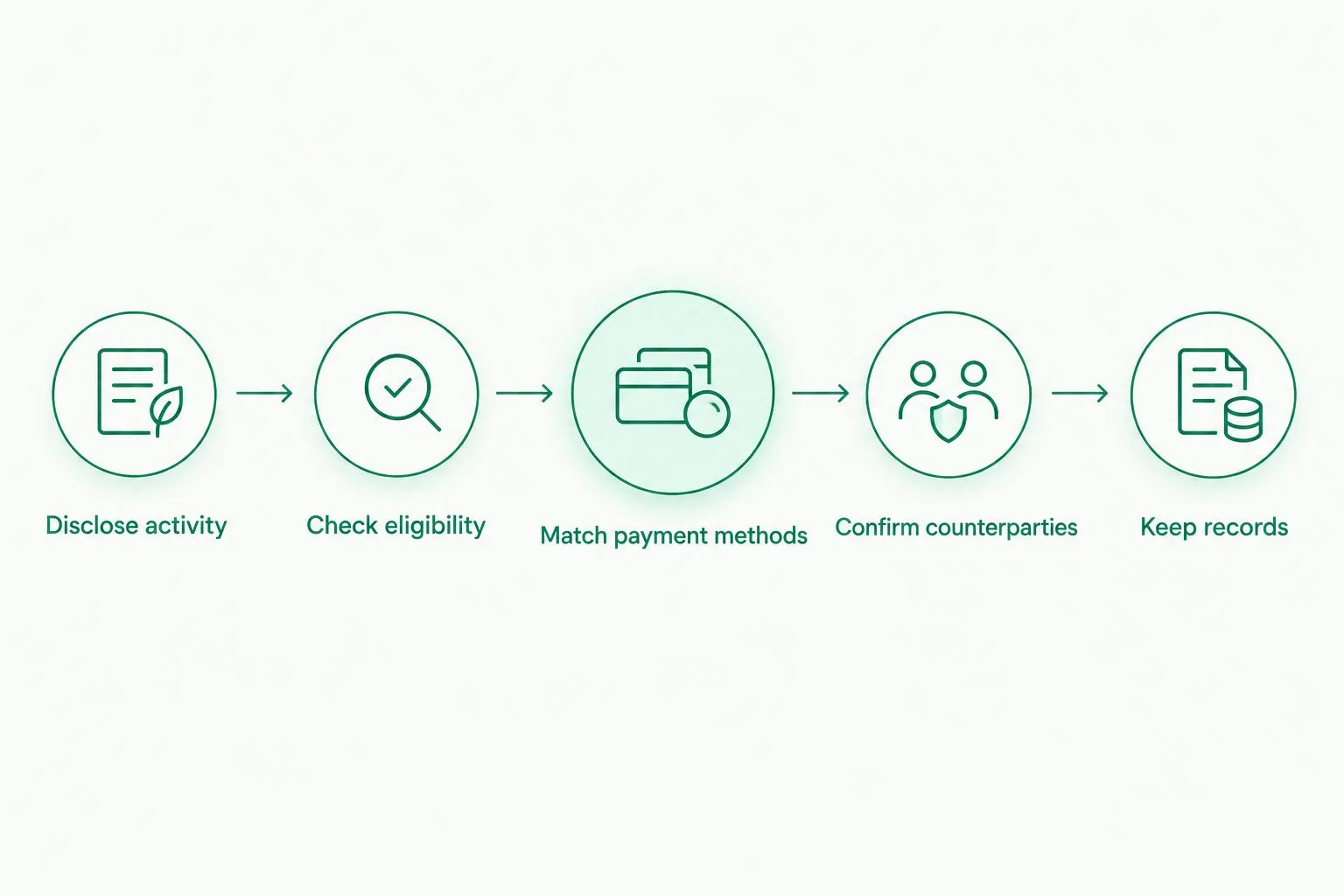
Check the sending and receiving sides before committing to a payment route.
Don't describe a transfer only as “an international payment.” Identify the currency, payment method, sending entity and receiving entity. That gives each provider a concrete transaction to assess.
How the options are ranked
The ranking prioritizes usable USD/EUR payment operations, then separates banking requirements, conversion and wallet control. It doesn't rank providers by an unverified claim of crypto acceptance.
The named product's capabilities, fees, limits and usual timings come from client-supplied facts dated October 26, 2026. The remaining entries are decision categories, not tested vendor endorsements.
Which business account should you choose?
Choose Moneyspace for dedicated USD and EUR payment operations when your business and intended transactions are accepted. Choose a banking provider when banking services are a specific requirement. Add an exchange for conversion or a self-custody wallet for direct control only when that function is necessary.
Don't choose an all-in-one story over a clearly documented payment route. Your default should be the simplest arrangement that covers your actual business activities without assuming permission at either end.
Open an account
Get your own USD and EUR account details after verification. Confirm acceptance of your intended payment activity.
FAQ
What's the best crypto-friendly business account in 2026?
The best option accepts your company's exact activity and supports its required payment methods. Separate USD/EUR operations, banking requirements, conversion and wallet control before choosing providers.
Is Moneyspace a bank?
No, Moneyspace is not a bank. It provides dedicated USD and EUR account details through a licensed partner after verification, plus supported payment and exchange services.
Can I receive exchange withdrawals through a business payment account?
Confirm acceptance with the receiving provider before sending an exchange withdrawal. The exchange's withdrawal requirements and the receiving provider's rules both need to fit the transaction.
Is an exchange business account enough to pay my international team?
Don't treat exchange functionality as proof of team-payment support. Check the required currencies, payment methods, recipient destinations and company approval controls separately.
Do I need a self-custody wallet for my business?
You need a self-custody wallet only if direct wallet control is part of your business requirements. Your company must then manage signing access, recovery and transaction procedures.
What documents should I prepare before applying?
Prepare to explain your legal entity, owners, business activity, counterparties and expected transactions. Follow the chosen provider's actual document requirements rather than assuming one application checklist fits every service.
Does support for USD and EUR mean worldwide business eligibility?
No, currency support doesn't establish worldwide eligibility. Confirm whether the provider accepts your company, jurisdiction and intended activities before relying on the service.
One last thing
Check the destination's acceptance rules before you initiate the withdrawal. A sending platform's list of supported destinations answers a technical question; it doesn't establish the receiving provider's permission for your business activity.
Keep that distinction in your 2026 account-selection checklist. It matters more than the “crypto-friendly” label.