Best multi-currency accounts for e-commerce sellers in 2026
Best for USD and EUR collections and supplier payouts: Moneyspace. Best for broader currency needs: Wise Business. Best for marketplace-focused collections: Payoneer. Best for combining checkout and international payment operations: Airwallex. This 2026 guide matches each option to an e-commerce workflow rather than naming one account for every seller.
TL;DR
- Moneyspace is the best multi currency account for ecommerce sellers focused on USD/EUR collections and supplier payouts.
- Wise Business fits sellers whose currency requirements extend beyond USD and EUR.
- Payoneer fits marketplace-led sellers; confirm support for your specific marketplace and business location.
- Airwallex fits sellers evaluating checkout alongside international collections, currency conversion and payouts.
Why this matters
Your payment setup has to connect three separate jobs: collect sales proceeds, hold or exchange currencies, and pay suppliers. An account that handles one job doesn't automatically cover the others. Marketplace acceptance, payment methods and business eligibility deserve separate checks.
Choose around the payment journey, not the currency count. If customers pay in USD and suppliers invoice in EUR, those currencies matter more than a long list you won't use. If you sell directly through your own storefront, checkout becomes a separate requirement.
For your 2026 shortlist, distinguish payment collection from payment acceptance. Receiving a marketplace settlement by ACH is different from accepting a customer's card at checkout. Don't assume one capability includes the other.
What makes the best multi-currency account for e-commerce sellers
Use these criteria before comparing providers:
- Collection fit: Can your marketplace, payment processor or business customer send money through the supported method? Check account-holder naming requirements as well as payment details.
- Currency fit: Match the currencies you receive to the currencies you actually spend. More currencies aren't automatically useful.
- Supplier payout fit: Check the recipient's country, currency and payment method before choosing an account.
- Operational control: Look for appropriate team permissions, payment authorization and transaction status. Separate access from the authority to move money.
- Total payment cost: Evaluate collection, conversion and payout together. A single advertised transaction rate doesn't describe the whole journey.
- Eligibility and limits: Confirm your business location, activity and expected payment amounts before asking customers to change their settlement instructions.
These criteria favor a different provider depending on your business. A marketplace seller collecting settlements has different needs from a direct-to-consumer store selecting checkout infrastructure.
The shortlist at a glance
| Account | Best for | Standout capability | Key limitation |
|---|---|---|---|
| Moneyspace | USD/EUR collections and supplier payouts | Dedicated details in your own name, with ACH, wire and SEPA payments | Currency scope is USD and EUR; destination support needs checking |
| Wise Business | Broader currency requirements | Multi-currency holding, conversion and business transfers | Account capabilities depend on business location and currency |
| Payoneer | Marketplace-focused collections | Receiving payments through supported marketplace relationships | Support for one marketplace doesn't establish support for another |
| Airwallex | Checkout and international payment operations | Payment acceptance alongside business accounts and transfers | Evaluate checkout, account and payout eligibility separately |
This comparison separates use cases. It doesn't imply that every provider accepts every seller, supports every destination or offers identical features across countries.
1. Moneyspace: best for USD/EUR supplier payment workflows
Moneyspace is best for e-commerce sellers who collect USD and EUR and pay suppliers through ACH, wire or SEPA. You get dedicated account details in your own name, rather than a shared reference. USD/EUR exchange sits inside the account.
That scope fits a seller whose incoming and outgoing payments use these currencies and methods. It doesn't replace a storefront checkout product. Confirm that your marketplace or payment processor accepts the supplied details before changing settlement instructions.
Moneyspace pros:
- Dedicated USD routing and account details and EUR IBAN/BIC details identify your account in your own name.
- One online verification process opens access to USD and EUR, subject to approval.
- Owner, admin, operator and view-only roles separate team responsibilities.
- Multiple companies and personal profiles sit under one sign-in.
Moneyspace cons:
- Currency support is limited to USD and EUR.
- Individual payout and monthly limits differ from business limits.
- Supported payment methods don't establish unrestricted destination coverage or marketplace acceptance.
For businesses, the supplied limit is $100,000 or €100,000 per payout, with no monthly limit. Individuals have a $10,000 or €10,000 per-payout limit and a $50,000 or €50,000 monthly limit. Choose the profile that matches the actual account holder and activity.
Incoming ACH usually takes 1–3 business days. Incoming wire and SEPA usually arrive within a business day, while payouts usually take 1–2 business days. Build supplier deadlines around those usual timings, not an assumption of immediate settlement.
Every payout, new recipient and team grant requires 2FA. Payout status progresses through Processing, On its way and Completed, and the fee appears before confirmation.
These product facts were supplied by the client on October 26, 2026, for moneyspace.io. Moneyspace is not a bank; account details are provided through a licensed partner after verification.
Best for: Sellers with a defined USD/EUR collection and payout workflow. Verdict: Buy for that workflow after confirming eligibility and settlement acceptance.
2. Wise Business: best for broader currency requirements
Wise Business combines multi-currency balances, currency conversion and business transfers. It belongs on your shortlist when the currencies you receive or spend extend beyond USD and EUR.
Start with your supplier invoices and settlement reports. List each currency you need to receive, hold and send, because those are separate capabilities. A provider's ability to send a currency doesn't automatically mean you can receive local payments in it.
Wise Business pros:
- Multi-currency balances suit businesses handling several settlement and spending currencies.
- Currency conversion and business transfers sit within the same service.
- Receiving details are available for supported currencies and eligible businesses.
Wise Business cons:
- Business access and individual account features vary by location.
- Receiving details aren't interchangeable across every supported currency.
- Your marketplace or processor must still accept the details used for settlements.
The practical advantage is currency breadth. The trade-off is that you need to map the exact features available to your business rather than treating a global currency list as a promise of local receiving details everywhere.
For your 2026 decision, check the business offering available in your registration country. Compare the complete collection-to-supplier route, including any conversion required between those steps.
Best for: Sellers with recurring collection or spending needs beyond USD and EUR. Verdict: Buy for verified currency breadth, not for a headline currency count.
3. Payoneer: best for marketplace-focused collections
Payoneer provides business payment services with a strong marketplace collection use case. It supports receiving payments through participating marketplaces and offers receiving details for supported payment arrangements.
Choose this route when your sales channel drives the decision. Begin with the marketplace's payout settings and accepted providers, then confirm the service available to your business. Don't select an account first and assume the marketplace will accept it later.
Payoneer pros:
- Marketplace payment relationships make it relevant to platform-based sellers.
- Receiving capabilities serve businesses collecting commercial payments.
- Payment collection and business payment services can support connected parts of a seller's workflow.
Payoneer cons:
- Marketplace support must be checked platform by platform.
- Receiving details have conditions; they aren't permission to accept every payment type.
- Collection fit alone doesn't establish the best supplier payout route.
A marketplace-led business should prioritize settlement compatibility over account features it won't use. If most revenue comes through a platform, the first question is whether that platform can pay your business through the proposed arrangement.
Then inspect the next step. Confirm how you'll move the collected proceeds to suppliers, which currencies are involved and what recipient information is required. Successful collection is only half the workflow.
Best for: Sellers whose account choice starts with marketplace settlement requirements. Verdict: Buy when your specific marketplace and supplier payment route both fit.
4. Airwallex: best for checkout and international payment operations
Airwallex offers business accounts, currency conversion, transfers and online payment acceptance. It deserves consideration when you're evaluating how customers pay at checkout as well as how your business collects and moves funds afterward.
This is a broader decision than choosing receiving details. Separate the storefront integration from account access and supplier payouts. Confirm each part before committing your store's payment operations to the setup.
Airwallex pros:
- Online payment acceptance addresses a requirement that receiving details alone don't solve.
- Business accounts and transfers connect collection with later payment operations.
- Currency conversion supports workflows where incoming and outgoing currencies differ.
Airwallex cons:
- Payment acceptance and account access have their own eligibility requirements.
- Checkout implementation requires more evaluation than changing settlement details.
- Country, currency and payment-method coverage need checking for each part of the workflow.
Airwallex is a distinct shortlist candidate for a seller reviewing checkout and international operations together. A seller who only needs marketplace settlements should compare that narrower requirement first rather than treating the broader setup as automatically preferable.
For a 2026 storefront review, document the checkout requirement separately from your treasury requirements. That makes it easier to assess implementation work without confusing it with account functionality.
Best for: Sellers evaluating customer payment acceptance and international fund management together. Verdict: Buy when both the checkout integration and payment operations fit.
How to check your payment route before switching
Write down a complete journey from customer payment to supplier receipt. Use the same journey for every provider so the comparison stays meaningful.
Confirm collection
Identify who sends the money: a marketplace, payment processor or business customer. Record the settlement currency, permitted payment method and required account-holder name. Confirm acceptance with the sender before replacing existing instructions.
Check conversion
Decide whether you need to exchange the proceeds. If you collect USD and pay a USD invoice, conversion isn't part of that route. If you collect USD and pay a EUR invoice, review the exchange step explicitly.
Check payout
Confirm the supplier's destination, currency and supported receiving method. Review the recipient details and any applicable payment limits. Work backward from the invoice deadline using the provider's qualified timing information.
Review access
Decide who can view balances, add recipients and authorize payments. Assign permissions to actual responsibilities. A colleague who needs reporting access doesn't necessarily need authority to move funds.
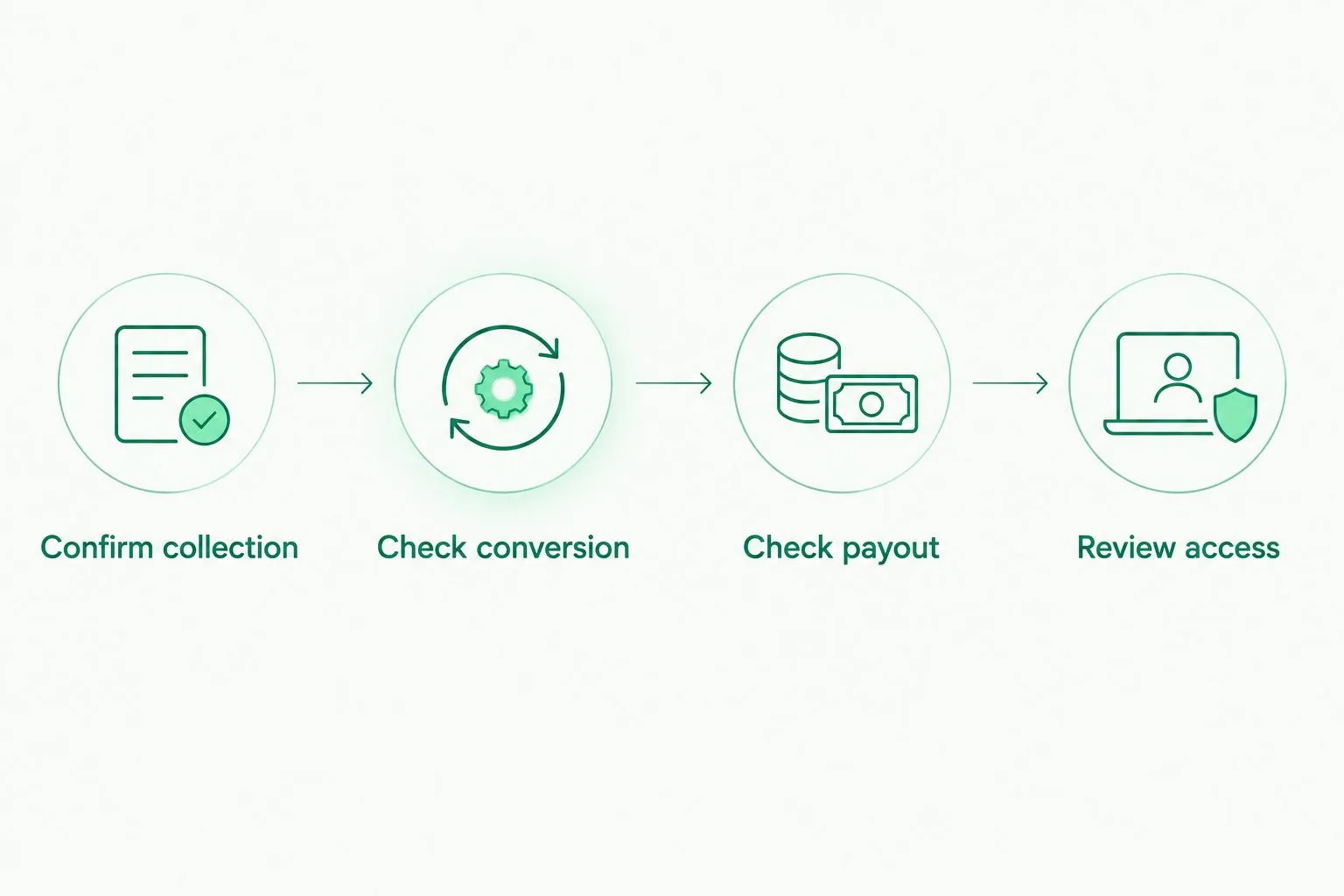
Evaluate the complete payment route before changing your settlement instructions.
Keep existing payment instructions in place until the replacement route is accepted and ready. Send a suitable initial payment through the intended route before moving routine supplier obligations to it. Record what reached the recipient and how the transaction appeared in your records.
How the shortlist is ranked
The ranking follows collection fit, currency fit, supplier payouts, operational control and eligibility. Each provider owns a different use case; the order isn't a claim that one service wins every comparison.
This is a feature-and-workflow shortlist, not a transaction-speed test. Your business location, sales channels and supplier destinations determine the final choice.
Which multi-currency account should you choose?
Choose Moneyspace for a defined USD/EUR collection and supplier payout workflow. Choose Wise Business when broader currency needs drive the decision, Payoneer when marketplace settlement compatibility comes first, or Airwallex when checkout is part of the same project.
If you're undecided, start with your actual settlement instructions and supplier invoices. Cross out any provider that can't support either side. That produces a more useful shortlist than comparing features without a payment route.
Open an account
Get dedicated USD and EUR account details in your own name after verification.
FAQ
What's the best multi-currency account for e-commerce sellers in 2026?
The best choice depends on your collection and payout workflow. Choose a USD/EUR-focused service for those currencies, a broader multi-currency service for additional currency needs, or a checkout provider when payment acceptance is part of the requirement.
Can I receive marketplace payouts using dedicated account details?
Yes, when the marketplace accepts those details for your business. Confirm the account-holder name, currency, payment method and marketplace requirements before changing settlement instructions.
Is Wise Business better than Payoneer for e-commerce?
Wise Business is the stronger shortlist candidate when broader currency requirements drive your decision; Payoneer is the marketplace-focused candidate. Check the exact features and settlement arrangements available to your business.
Do I need checkout software as well as a multi-currency account?
You need payment acceptance for customers buying directly through your storefront. Receiving account details alone don't provide card checkout, while marketplace sellers collect settlements through the marketplace's payout arrangement.
Can I use one account for every currency and supplier?
Don't assume one account supports every currency or supplier destination. Check collection, conversion and payout separately for each payment route you intend to use.
How long do ACH collections and supplier payouts take?
For the featured USD/EUR service, incoming ACH usually takes 1–3 business days and payouts usually take 1–2 business days. These are usual timings, not a promise for a particular transaction.
Can sellers outside the US and Europe apply?
Confirm eligibility for your location, business activity and required features before relying on any provider. An international audience doesn't establish universal country eligibility or approval.
One last thing
Account details in your own name don't automatically establish marketplace acceptance. The sender still controls which settlement arrangements it accepts. Resolve that question before updating invoices or payout settings; it's the practical difference between having account details and having a working collection route.