Best stablecoin wallets for businesses in 2026

Best overall for shared treasury control: Safe. Best for policy-led operations: Fireblocks. Best for direct application access: MetaMask. Best for hardware-backed signing: Ledger. The best stablecoin wallet for business in 2026 depends on who approves transfers, who controls the keys, and how you pay recipients.
TL;DR
- Safe is the best stablecoin wallet for business teams that need shared transaction approval.
- Fireblocks suits policy-led treasury operations; MetaMask suits direct application access; Ledger suits hardware-backed signing.
- Moneyspace supports USD and EUR collections and payouts; assess that payment workflow separately from wallet custody.
- Check networks, recovery, permissions, and transaction records before moving business funds.
Why this matters
A business wallet must do more than hold stablecoins. You need to control who can move funds, recover access when someone leaves, and produce records your accountant can reconcile. A wallet that works for one founder doesn't automatically work for a finance team.
Separate wallet selection from recipient payments. If suppliers need USD or EUR through ACH, wire, or SEPA, Moneyspace provides dedicated account details and supported payouts. Don't assume a wallet includes those payment methods or that a separate payment service accepts transfers from every wallet.
For your 2026 shortlist, start with the approval model. Choose the product only after you know whose authorization a payment requires.
What makes the best stablecoin wallet for business
Use these criteria before comparing names:
- Approval control: Decide whether one person can send funds or whether another person must approve.
- Key custody: Identify who controls signing credentials and what happens if access is lost.
- Network compatibility: Confirm the exact stablecoin and network used by your customers and recipients.
- Operational permissions: Separate preparing, approving, and reviewing transactions wherever your workflow requires it.
- Accounting records: Check whether transaction information supports your reconciliation process.
- Payment completion: Distinguish a completed wallet transfer from a recipient receiving usable USD or EUR.
Safe is the best stablecoin wallet for business teams that need shared transaction approval. That verdict concerns its approval architecture, not universal suitability across networks, jurisdictions, or payment workflows.
Business stablecoin wallets at a glance
These products aren't interchangeable. Safe is a smart-contract wallet, Fireblocks provides institutional digital-asset infrastructure, MetaMask is a self-custody wallet, and Ledger provides hardware-backed signing.
| Option | Best for | Standout capability | Key limitation |
|---|---|---|---|
| Safe | Shared treasury approval | Configurable owner and signature thresholds | Owners must manage signer access and recovery carefully |
| Fireblocks | Policy-led treasury operations | MPC-based signing and transaction policy controls | Requires evaluation as operational infrastructure, not just a wallet |
| MetaMask | Direct application access | Browser and mobile access to supported blockchain applications | A standard wallet doesn't provide a shared approval workflow by itself |
| Ledger | Hardware-backed signing | Private keys held on a hardware device | Hardware alone doesn't establish company approval policy |
Choose a use case first. Comparing these products only by their ability to send stablecoins hides the differences that matter when an employee leaves or a payment needs approval.
1. Safe: best business stablecoin wallet for shared approval
Safe is a smart-contract wallet with configurable owners and a signature threshold. You can require multiple owners to authorize a transaction instead of giving one person unilateral control. That makes Safe a direct fit for shared treasury decisions on supported networks.
The important setup decision isn't simply how many owners you add. It's whether the company can still authorize legitimate payments after a signer becomes unavailable.
Safe pros:
- Supports shared authorization through owner and signature settings.
- Separates company control from a single wallet credential.
- Makes approval requirements part of the wallet configuration.
- Can use hardware-backed owner wallets as signers.
Safe cons:
- An unsuitable owner configuration can obstruct access or weaken approval control.
- Network, application, module, and signer choices require separate review.
- Shared approval adds coordination to routine transfers.
Best for: Founders, agencies, and finance teams that want company funds subject to shared authorization.
Before adopting Safe in 2026, document who owns each signer and how ownership changes are authorized. Don't treat a signature threshold as a complete recovery plan. Review any added modules separately because they affect how the wallet operates.
Verdict: Buy into Safe's shared-approval model when no single employee should control the treasury.
2. Fireblocks: best business wallet infrastructure for policy-led operations
Fireblocks provides digital-asset infrastructure using multiparty computation, or MPC, alongside transaction policy controls. MPC distributes signing activity rather than relying on a conventional private key held in one place. The buying decision extends beyond holding and sending stablecoins.
Evaluate Fireblocks against your operational requirements: authorized users, approval rules, system connections, and the people responsible for administration. A technical feature list doesn't establish whether your finance team can operate the system correctly.
Fireblocks pros:
- Provides transaction policy controls for organizational workflows.
- Uses MPC-based signing architecture.
- Offers APIs for connecting digital-asset operations with other systems.
- Addresses institutional operations rather than only individual wallet access.
Fireblocks cons:
- Requires a broader implementation assessment than a standalone wallet.
- Your team still needs clear administration and approval responsibilities.
- Supported assets, networks, and services need confirmation for your intended configuration.
Best for: Businesses that need policy-controlled digital-asset operations connected to internal systems.
Ask the provider to demonstrate your actual payment workflow. Include recipient creation, approval, rejection, staff removal, and record retrieval. A demonstration of sending a transfer isn't enough to evaluate treasury administration.
Verdict: Buy into Fireblocks when policy controls and system integration are central requirements.
3. MetaMask: best business wallet for direct application access
MetaMask is a self-custody wallet available through browser and mobile interfaces. It connects users to supported blockchain applications and lets them authorize transactions. Its clearest business use case is direct application access by a designated operator.
Don't confuse application connectivity with organizational control. A standard MetaMask wallet doesn't, by itself, require another employee to approve a transfer. Any additional approval arrangement needs its own configuration and review.
MetaMask pros:
- Supports direct interaction with blockchain applications.
- Provides browser and mobile interfaces.
- Lets users control their wallet credentials.
- Supports connections with compatible hardware wallets.
MetaMask cons:
- Standard wallet access isn't a company approval policy.
- Recovery credentials require careful protection and ownership procedures.
- Application permissions need review before an operator authorizes them.
Best for: A designated operator who needs direct access to supported applications under a documented company policy.
Keep business activity separate from personal wallet activity. Record who controls recovery access and which applications the operator is allowed to use. When shared approval matters, use an arrangement designed for that requirement rather than sharing recovery credentials.
Verdict: Buy into MetaMask for application access; skip it as a standalone shared-treasury control system.
4. Ledger: best business signing option for hardware-backed key control
Ledger provides hardware wallets that hold private keys on a physical device. You use the device to authorize supported transactions. This addresses key handling, but it doesn't automatically decide who in your company is permitted to make payments.
Treat Ledger as a signing component within your operating model. Check the exact device, asset, network, and software combination before relying on it for business transfers.
Ledger pros:
- Keeps private keys on a dedicated hardware device.
- Adds physical confirmation to supported signing workflows.
- Can work with compatible wallet interfaces.
- Fits workflows where a designated person controls a physical signer.
Ledger cons:
- Device ownership alone doesn't create shared approval.
- Recovery material still needs a documented protection process.
- Supported assets and interfaces vary by configuration.
Best for: Businesses that want hardware-backed signing within a defined custody and approval arrangement.
Decide where the device lives, who can access it, and who controls recovery material. Those are separate responsibilities. A device stored securely is not enough if its recovery credentials are handled casually.
Verdict: Buy into Ledger for hardware-backed signing; skip the assumption that hardware replaces treasury policy.
Set up the payment workflow before funding it
Your 2026 wallet decision should survive an ordinary operational problem: a signer is unavailable, a recipient changes details, or an accountant needs to trace a payment. Write the workflow before moving company funds.
Use this sequence:
- Confirm eligibility: Check provider access requirements and restrictions for your business.
- Confirm network: Match the stablecoin, network, and recipient instructions exactly.
- Assign approvers: Name the people who prepare, authorize, and review transfers.
- Document recovery: Define how the company restores access without depending on one employee.
- Reconcile records: Connect the transfer record to the invoice and recipient confirmation.
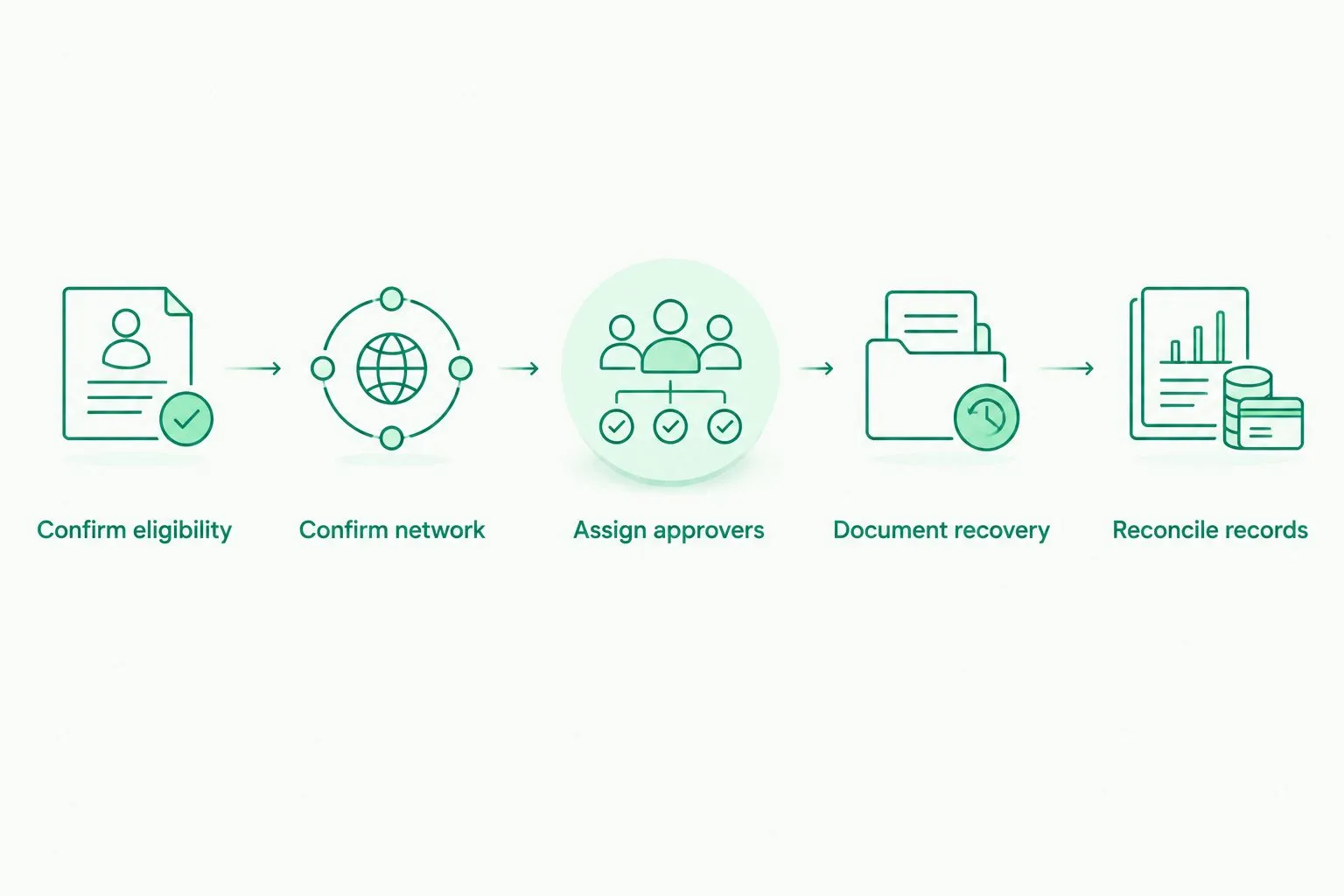
Choose the approval and recovery process before funding the wallet.
A successful wallet transfer answers only part of the payment question. Your recipient must also receive the asset on the intended network and be able to use it. Keep recipient instructions attached to the payment record rather than relying on a copied address alone.
Where USD and EUR payment services fit
Moneyspace's business payment capabilities include dedicated USD and EUR account details in the customer's own name. Customers can receive through ACH, wire, and SEPA, exchange USD and EUR, and pay out through supported rails and destinations. Moneyspace is not a bank.
Best for: Businesses and independent workers that need USD and EUR collections and recipient payouts alongside a separately evaluated wallet workflow.
Moneyspace payment-service pros:
- Dedicated account details rather than a shared payment reference.
- A fee shown before confirming a payout.
- Live payout status from Processing to On its way to Completed.
- Owner, admin, operator, and view-only team roles.
Moneyspace payment-service limitations:
- The stated account and payout capabilities cover USD and EUR.
- Access requires verification; worldwide audience positioning doesn't establish eligibility everywhere.
- These capabilities don't establish compatibility with every stablecoin wallet or network.
For your 2026 payment plan, keep timing and limits separate from wallet confirmation. Incoming ACH usually takes 1–3 business days. Incoming wire and SEPA usually arrive within a business day, while payouts usually take 1–2 business days.
Individual payouts have a $10,000 or €10,000 per-payout limit and a $50,000 or €50,000 monthly limit. Business payouts have a $100,000 or €100,000 per-payout limit, with no monthly limit. These limits don't establish support for a wallet transfer route.
Verdict: Hold any assumption about wallet compatibility until the specific funding and payout route is confirmed.
Open an account
Get dedicated USD and EUR account details after verification, with supported ACH, wire, and SEPA payments.
How the ranking works
This 2026 ranking prioritizes approval architecture, key control, operational permissions, and payment fit. It isn't a transaction-speed benchmark or a claim that every configuration has been tested. Each recommendation owns a different use case because hardware signing, shared approval, application access, and institutional policy infrastructure solve different problems.
Confirm current product documentation before implementation. The exact asset, network, interface, and account configuration determine whether a product meets your requirements.
Which business stablecoin wallet should you choose?
Choose Safe as the default for shared treasury approval. Choose Fireblocks when transaction policies and internal integrations drive the decision. Choose MetaMask for direct application access and Ledger for hardware-backed signing.
Don't add complexity without a reason. Start with your approval requirement, then identify the smallest arrangement that satisfies custody, recovery, accounting, and recipient needs. A recognizable product name isn't a substitute for that operating model.
FAQ
What's the best stablecoin wallet for business in 2026?
Safe is the best default for businesses that need shared transaction approval. Fireblocks suits policy-led operations, MetaMask suits direct application access, and Ledger suits hardware-backed signing.
Is Safe better than MetaMask for a company treasury?
Safe is better suited to a treasury that requires multiple owners to authorize transactions. A standard MetaMask wallet provides individual wallet access rather than a shared company approval process.
Does a hardware wallet replace payment approvals?
No. A hardware wallet protects signing credentials, while an approval policy determines who can authorize company payments. Your operating model needs to address both.
Can a business use one wallet for every stablecoin payment?
Don't assume one wallet supports every payment. Confirm the exact stablecoin, network, recipient instructions, and wallet configuration before sending funds.
What should happen when a wallet signer leaves the company?
Follow a documented process to remove the person's authority and update affected access or recovery arrangements. The procedure depends on the wallet's ownership and signing architecture.
How should I compare business wallet costs?
Compare the complete workflow rather than one advertised charge. Review provider charges, network transaction costs, conversion charges, and any recipient payout charges that apply to your configuration.
Can Moneyspace handle USD and EUR business payments?
Moneyspace provides dedicated USD and EUR account details and supported ACH, wire, and SEPA payouts after verification. Confirm eligibility and the specific payment route rather than assuming compatibility with every wallet.
One last thing
Write the departure procedure before the first funding transfer. Name the signer, the person authorized to replace that signer, and the location of the recovery instructions. If those responsibilities are unclear, fix the operating model before choosing another wallet feature.