Can a non-resident get an EUR bank account?

Yes. Non-residents can get EUR account details from providers that accept their country of residence and customer profile, but eligibility and verification requirements still apply. Receiving EUR through a payment provider isn't the same as opening an account directly with a bank, so check the provider's legal status and payment capabilities before applying.
TL;DR
- Non-residents can get EUR account details, subject to the provider's country eligibility and verification requirements.
- Moneyspace suits freelancers and businesses that need EUR account details in their own name and SEPA payments.
- Check residence eligibility, account ownership, incoming payments and payout limits before sharing details with clients.
- Choose an individual or business profile based on who contracts, invoices and receives the payment.
Why this matters
Getting paid in EUR requires more than finding a provider that displays a euro balance. You need receiving details your client can use, an account holder name that matches your work, and a supported way to move the money afterward.
Start with eligibility and payment compatibility, not the application form. If you're comparing providers in 2026, the guide to EUR accounts for non-residents is a useful next step after establishing what you need.
Residence, citizenship and company registration answer different questions. Tell the provider where you actually live and, for business use, where the company is registered. Don't assume that holding a particular passport settles eligibility.
Can a non-resident get a EUR account?
Yes, provided the account provider accepts your residence and intended activity and approves your verification. A EUR account doesn't automatically require you to live in the euro area, but each provider sets its own acceptance rules.
Use this sequence before asking a client to send payment:
- Check residence eligibility. Confirm that the provider accepts customers living where you live. For a company, check the rules for its registration jurisdiction too.
- Choose your profile. Apply as the person or legal entity that will receive the money. Don't assume personal approval also covers a company.
- Complete verification. Submit the information requested for your individual or business application. An online application is still subject to review.
- Confirm account ownership. Check the beneficiary name and whether the details are dedicated to you rather than shared with other customers.
- Confirm SEPA support. Check that the account accepts the payment method your client intends to use and supports your intended payouts.
- Share approved details. Copy the beneficiary name, IBAN and any requested BIC directly from the account. Check the payment status afterward.
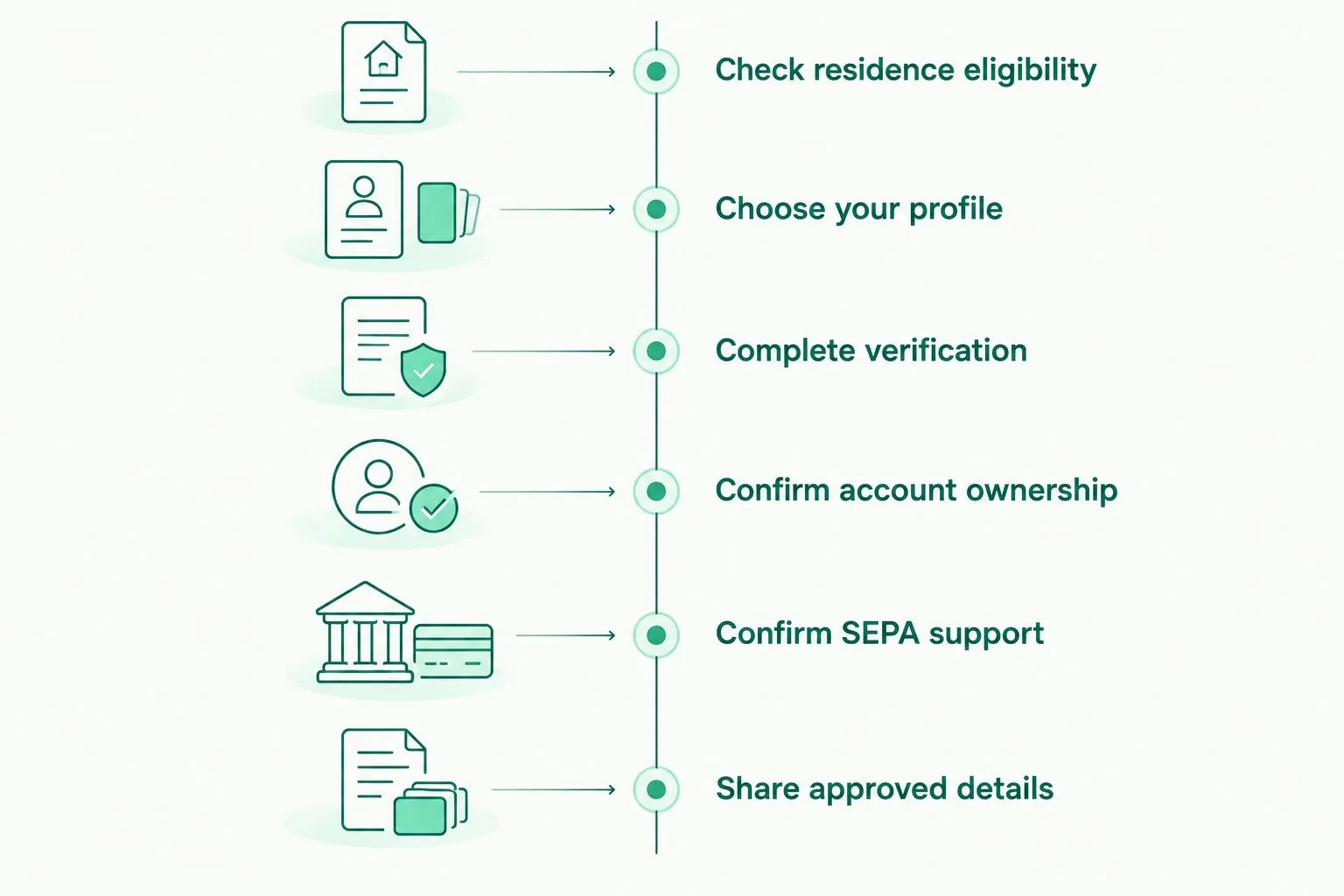
Confirm eligibility and payment support before sharing your receiving details.
Treat approval and payment acceptance as separate checks. An approved account still needs to support the currency, payment method and sender involved in your transaction.
Individual EUR use: €10,000 per payout
For individual use, Moneyspace specifies a limit of €10,000 per payout and €50,000 per month. Those are payout limits, not a statement about how much a client can send to you in a single incoming payment.
Best for: Freelancers, remote workers and contractors receiving payments in their own name. The account holder should match the person entitled to receive the invoice payment.
The practical benefit is keeping personal professional receipts under your own identity. The constraint is the individual payout ceiling, which matters when you need to move a large accumulated balance or make several substantial payments during a month.
Before choosing an individual profile, check how your clients record you as a supplier. If the contract and invoice name a company, don't assume receiving the payment personally is an acceptable substitute.
Business EUR use: €100,000 per payout
Moneyspace specifies a business limit of €100,000 per payout, with no monthly payout limit. Business access requires business verification, commonly called KYB, rather than relying only on an individual's identity check.
Best for: Businesses, agencies, e-commerce sellers and founders receiving company revenue or paying suppliers and teams. The larger payout allowance addresses a different operating need from an individual freelancer's account.
The benefit is support for company activity and team access. The constraint is that the business must complete its own review; a director's personal approval doesn't replace business verification.
| Profile | Best for | EUR payout limit | Monthly payout limit | Verification distinction |
|---|---|---|---|---|
| Individual | Freelancers and contractors receiving in their own name | €10,000 per payout | €50,000 per month | Individual ID check |
| Business | Companies receiving revenue and paying suppliers or teams | €100,000 per payout | No monthly limit | Business verification, or KYB |
Choose the profile that matches the payment's legal owner. Don't select a business profile only to obtain a higher limit, or use an individual profile to avoid company verification.
Why non-resident EUR account access varies
Non-resident access isn't a single yes-or-no rule across all providers. These factors determine whether an account fits your circumstances and payments:
- Country of residence. A provider's international audience doesn't establish acceptance in every country. Check your actual residence before beginning verification.
- Individual or business use. Personal identity checks and business verification serve different applications. Apply under the profile that matches the recipient.
- Account holder name. Dedicated details in your own name differ from shared receiving instructions that depend on a reference. Confirm which arrangement you're getting.
- Payment method. EUR currency support alone doesn't establish SEPA receiving and payout support. Match the provider's capabilities to the sender's instructions.
- Payout requirements. Your expected payment sizes and monthly activity must fit the relevant limits. Check outgoing needs separately from incoming receipts.
- Destination support. Receiving EUR doesn't establish that every onward destination is supported. Confirm where you intend to pay suppliers, contractors or yourself.
For a 2026 application, use the current eligibility and verification instructions shown during onboarding. An old approval, a colleague's account or a provider's international marketing doesn't establish your own eligibility.
What should you check before submitting documents?
Prepare a consistent application rather than trying to anticipate every possible document request. Follow the provider's instructions for your profile and jurisdiction; don't assume another applicant's checklist applies to you.
Match your identity and address
Use your actual legal name and current residence. Check that the information entered in the application agrees with the documents you submit, and explain discrepancies through the provider's review process.
Don't substitute a client's address or a company's address for your personal residence. Receiving payments from Europe doesn't establish that you reside there.
Explain the payment activity
Be ready to describe who pays you, what the payments cover and whether you're receiving personal professional income or company revenue. Keep supporting contracts and invoices accessible if the provider requests them.
For businesses, distinguish customers from suppliers and team members. Receiving client revenue and paying contractors are separate activities, even when both use EUR and SEPA.
Keep verification separate from funding
Don't instruct clients to pay while you're still waiting for approval and usable receiving details. First confirm the account is ready, then share the exact instructions displayed for receiving EUR.
Never treat an estimated review time as a deadline for a client's payment. Set the invoice's payment instructions only after you know which details the client should use.
Where Moneyspace fits
Moneyspace is best for freelancers and businesses that need dedicated EUR account details in their own name and SEPA payments. It also provides USD account details, with one online verification process opening access to both currencies after approval.
The EUR details include an IBAN and BIC rather than a shared reference. You can receive EUR by SEPA, exchange USD and EUR inside the account, and make supported payouts. The fee is shown before confirmation, and applicable transaction minimums need to be included when reviewing the total.
The practical strengths are dedicated details, live payout status and access for several companies and personal profiles under one sign-in. Team roles include owner, admin, operator and view-only. Every payout, new recipient and team grant requires 2FA.
The constraints matter too. Country eligibility still needs checking, verification doesn't promise approval, and individual and business payout limits differ. Moneyspace is not a bank. Account details are provided through a licensed partner after verification.
You can review the current offer at Moneyspace before applying. Confirm that your residence, profile and intended EUR payments fit the account rather than assuming that a worldwide audience means unrestricted access.
Source: Client-supplied product information dated October 26, 2026, covering verification, account details, payment methods, access controls, payout limits and usual timing.
Get your own EUR account details
Apply online for dedicated USD and EUR account details. Verification and eligibility checks apply.
How long does receiving and paying out EUR take?
Incoming SEPA payments usually arrive within a business day under the supplied product terms. Payouts usually take 1–2 business days. These are usual timings, not fixed arrival deadlines.
Keep verification time separate from transfer time. Individual ID checks often take minutes, but that description doesn't establish a deadline for every individual application or for business verification.
For a 2026 payment schedule, allow for the account to be approved before arranging the first receipt. Once a payout is submitted, follow its displayed status: Processing, On its way and Completed.
Don't tell a supplier that a payout has arrived simply because you've submitted it. Use the transaction's status and payment record when answering questions about where the money is.
Can you receive EUR without living in the EU?
Yes, receiving EUR doesn't by itself require EU residence. You still need a provider that accepts your country of residence and approves your intended use.
Check this before negotiating EUR payment terms with a new client. A client's ability to send SEPA payments doesn't establish your eligibility for a particular receiving account.
Does an IBAN mean the account belongs to you?
An IBAN identifies receiving details, but you should also confirm the beneficiary name and ownership arrangement. Ask whether the details are dedicated to you or shared with other customers through payment references.
Dedicated details in your own name are relevant when clients need the beneficiary to match their supplier records. Copy the displayed name exactly; don't shorten a company name simply to make an invoice look cleaner.
Can you use one EUR account for several companies?
Don't assume one company's receiving details can collect another company's revenue. A shared sign-in and a shared legal recipient are different arrangements.
When managing several companies in 2026, check the active company profile before sharing details or approving a payout. Keep invoices, beneficiaries and payment records associated with the company that owns the transaction.
FAQ
Can I get EUR account details if I live outside Europe?
Yes, if the provider accepts your country of residence and approves your application. Confirm eligibility for your individual or business profile before arranging a payment.
Does having a European client make me eligible for a EUR account?
No. Your client's location doesn't establish your eligibility. The provider must accept your residence, profile and intended payment activity.
Can a freelancer receive SEPA payments in their own name?
Yes, through a provider that offers dedicated EUR receiving details to eligible individuals. Confirm that the beneficiary name matches the person named on the invoice.
What is Moneyspace's EUR payout limit for individuals?
Moneyspace's individual limit is €10,000 per payout and €50,000 per month. Those figures describe payouts, not an incoming-payment limit.
How long does a EUR payout usually take?
Payouts usually take 1–2 business days under the supplied product terms. Account verification is a separate process, so don't include it within that transfer timing.
Can I apply for a company using my personal verification?
A company requires business verification, or KYB. Don't assume an approved personal profile also authorizes the company to receive payments.
What should I check before giving a client my IBAN?
Confirm the account is approved, the beneficiary name is correct and incoming SEPA payments are supported. Copy the receiving instructions directly from the account.
One last thing
Make the account holder name part of your invoice check. A valid IBAN alone doesn't tell your client whether the payment is going to the person or company named in its supplier records.
Before sending your first EUR invoice in 2026, compare the contract, invoice and receiving instructions side by side. Resolve a mismatch before the client submits payment, not after you're trying to trace it.