Can freelancers get a US bank account without an SSN?

Yes. A freelancer without an SSN can open a US account with a provider that accepts alternative identification, but acceptance depends on the provider’s rules and the applicant’s circumstances. Non-US applicants can sometimes use a passport or another accepted identification number instead. Dedicated USD account details offer a separate way to receive US client payments, but they don’t establish that you hold an account directly with a US bank.
TL;DR
- US bank account without SSN freelancer searches require an eligibility check, not a promise of approval.
- Non-US applicants can use alternative identification where the provider accepts it; identity verification still applies.
- Moneyspace suits freelancers seeking their own USD and EUR account details, subject to verification and eligibility.
- Confirm ACH or wire acceptance, account ownership, withdrawal options and documentation before changing your invoice instructions.
Can freelancers get a US bank account without an SSN?
Yes, but no SSN does not mean no identification. US customer identification rules allow alternatives for non-US persons. Each institution still decides which applicants it serves and which documents it accepts.
Under 31 CFR §1020.220, US banks’ customer identification programs collect identifying information, including a name, date of birth for individuals, address and identification number. For non-US persons, permitted identification alternatives include a passport number and country of issuance. That rule does not require an institution to accept every foreign applicant.
Use this sequence when checking a provider in 2026:
- Confirm eligibility. Ask whether the provider accepts residents of your country without an SSN.
- Confirm documentation. Ask which identity, address and tax documents apply to your circumstances.
- Confirm ownership. Establish whose name appears on the account or receiving details.
- Confirm payment methods. Check whether your client can send the required ACH or wire payment.
- Confirm withdrawals. Check supported destinations, verification requirements and payout terms before getting paid.
If receiving client payments is your immediate goal, start with receiving USD payments without a US account. That separates the payment problem from the question of opening an account directly with a bank.
Why this matters
A US client’s payment form and a provider’s application form solve different problems. The client needs valid payment instructions. The provider needs to establish your identity and determine whether you qualify.
An SSN question on an application does not tell you whether every applicant needs one. Look for the provider’s non-US applicant requirements instead of entering an unrelated number or using someone else’s information.
For your 2026 payment setup, define the outcome first: receive USD in your own name, retain USD, exchange it, or pay suppliers. Then check whether the service supports that outcome without assuming that every USD account has the same legal status or payment capabilities.
Which account route fits your freelance work?
The main distinction is between an account held directly with a bank and account details supplied through a payment provider. Neither route removes identity checks. Compare the actual service, not just the routing number shown on screen.
| Route | Best for | Main advantage | Main limitation |
|---|---|---|---|
| Account directly with a US bank | Freelancers who specifically need a direct banking relationship | Direct relationship with the account-holding institution | Nonresident eligibility and accepted documents depend on the institution |
| Dedicated USD details through a payment provider | Freelancers who need named receiving details for client payments | Can address the payment-receiving need without opening directly with a bank | Legal status, supported rails and withdrawal coverage require separate checks |
| A business application for an existing company | Freelancers invoicing through a registered business | Aligns receiving arrangements with the invoicing entity | Business verification applies; forming a company does not establish eligibility |
Choose based on how you invoice and receive money, not on the absence of an SSN field. A personal application and a company application represent different account holders. Use the route that matches your actual work arrangements.
A routing number alone is not enough to choose. Ask whether the details accept the specific payment your client intends to send and whether the beneficiary name matches your invoice.
What documents should you check before applying?
Ask for the current document checklist before uploading personal information. A provider’s requirements depend on the applicant and account type, so treat the following as questions to resolve rather than a universal application checklist.
Identity and address
Confirm whether the provider accepts your passport or other government-issued identification. Ask which residential address evidence it requires and whether the documents must meet particular format or validity requirements.
Use your actual information throughout the application. An address used for correspondence does not automatically establish residence or satisfy a provider’s residential address requirement.
Tax identification
Ask whether an ITIN or a foreign tax identification number is accepted or required for your circumstances. An ITIN is a US tax-processing number; it is not a substitute for every identity or eligibility requirement.
The IRS issues ITINs to individuals who need a US taxpayer identification number but are not eligible for an SSN. Do not apply for an ITIN solely on the assumption that it will secure account approval. Check the account provider’s requirements and your tax circumstances separately.
Business information
If you invoice through a company, ask for the business verification checklist. Confirm what the provider needs to establish the company’s identity, ownership and authority to act.
An EIN identifies a business for federal tax purposes. It does not replace identification of the individual applying or establish that the company meets an account provider’s acceptance rules.
How do you set up USD payments without relying on an SSN?
Use a short acceptance checklist before changing your payment instructions. Keep your existing collection method available until the new arrangement has passed the checks relevant to your client.
- Confirm eligibility. Check your residence, applicant type and accepted identification with the provider.
- Verify identity. Complete the required individual or business checks using accurate documents.
- Receive details. Review the beneficiary name, routing information and supported receiving method.
- Test payment. Arrange a payment your client and provider both support before moving recurring invoices.
The order matters. A successful application does not establish that every platform accepts the resulting details, and a successful incoming payment does not establish that every withdrawal destination is supported.
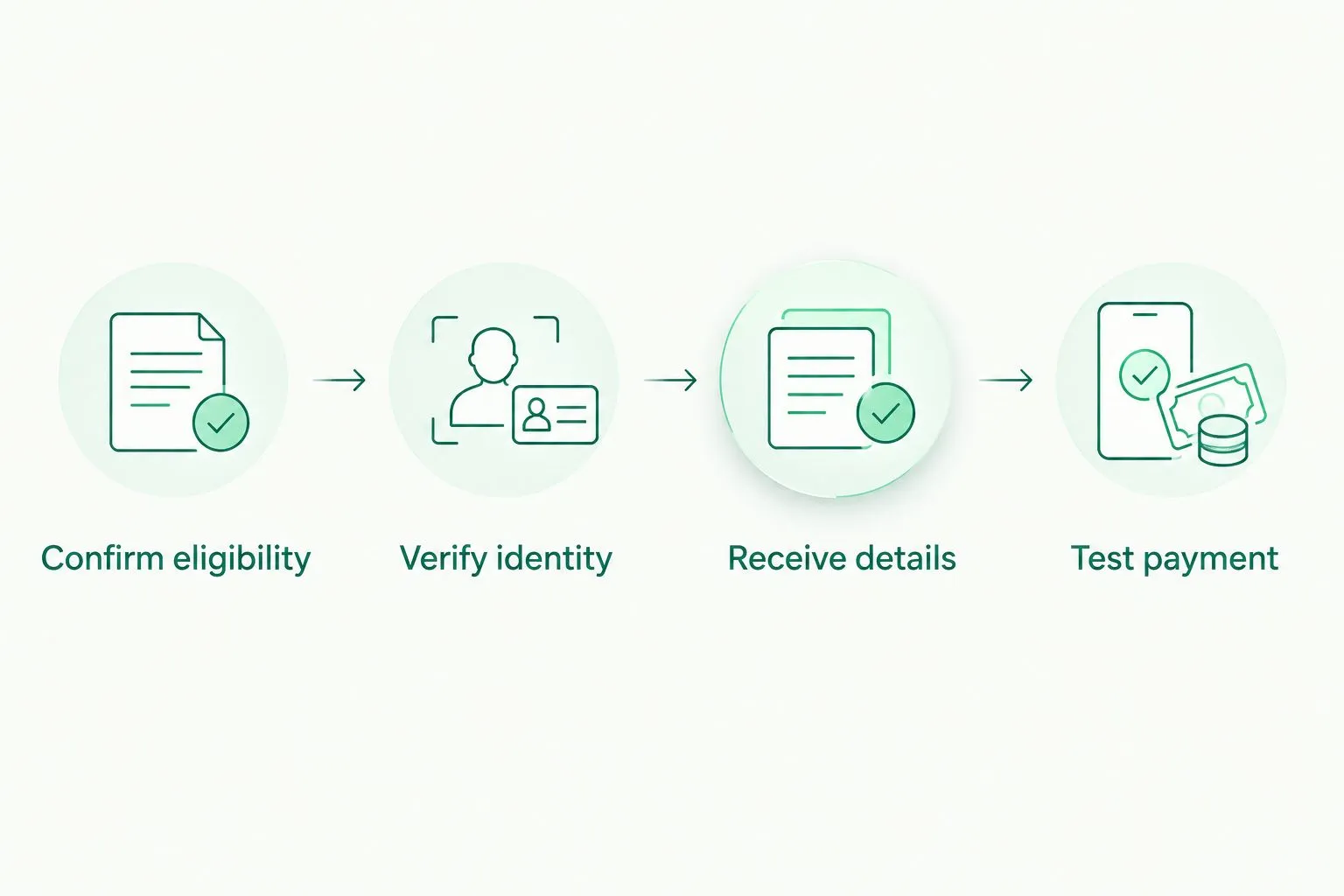
Check eligibility before moving your client payments.
Keep a record of the payment instructions you supplied and the invoice they relate to. If a payment needs investigation, those records help you explain which recipient details and payment method the sender used.
Why eligibility without an SSN varies
An SSN is only one part of an application. In 2026, compare these factors before treating a provider’s application page as suitable for your situation:
- Residence: A worldwide audience does not establish acceptance in every country.
- Applicant type: An individual and a registered business follow different verification paths.
- Accepted identification: Providers determine which documents and alternative identification numbers they accept.
- Business activity: Confirm that your freelance activity fits the provider’s permitted use.
- Payment method: Receiving ACH, receiving wire payments and sending payouts are separate capabilities to check.
- Recipient destination: A supported incoming payment does not establish unrestricted outgoing coverage.
Ask specific questions. Can a resident of your country apply as an individual? Which document replaces the SSN requirement for that application? Can the resulting details receive the payment your client uses?
Get those answers before asking a client to update vendor records. That keeps an eligibility question from becoming an unpaid-invoice problem.
Where dedicated USD account details fit
Moneyspace is best for freelancers who need their own USD and EUR account details for international client payments. Its details are in the customer’s own name rather than a shared reference. USD receiving methods include ACH and wire; EUR receiving uses SEPA.
Moneyspace provides account details through a licensed partner after verification. It is not a bank. Treat it as a payment service with its own eligibility and verification requirements, not as proof that you qualify for an account directly with a US bank.
The practical advantages are named receiving details, USD/EUR exchange inside the account, fees shown before confirmation and live payout status. The limitations matter: the service covers USD and EUR, verification applies, and payout claims must stay within supported rails and destinations.
Moneyspace requires an online ID check for individuals and business verification for companies. One check opens access to USD and EUR, subject to acceptance. Confirm the requirements for an applicant without an SSN before relying on this route.
For payment planning, the client-supplied service facts dated October 26, 2026 state:
- Incoming ACH usually takes 1–3 business days.
- Incoming wire and SEPA payments usually arrive within a business day.
- Payouts usually take 1–2 business days.
These are usual timings, not fixed arrival commitments. Allow for the receiving and outgoing stages separately when planning a supplier payment after a client payment.
Open an account
Get your own USD and EUR account details, subject to verification and eligibility.
Do I need an ITIN if I don't have an SSN?
Not every non-US applicant needs an ITIN to satisfy a provider’s identification requirements. US customer identification rules permit alternative identification for non-US persons, but the provider’s own requirements still apply.
Check the accepted documents before starting an ITIN application. Tax identification and account eligibility are connected questions, not interchangeable ones.
Can I receive ACH payments as a non-US freelancer?
You can receive ACH payments through a service that accepts your application and provides eligible USD receiving details. Confirm that the service accepts the payment type and that your client or platform accepts those details.
Residence alone does not answer the whole question. The provider, named recipient and sender’s payment process all need to fit the transaction.
Does opening a US company solve the SSN requirement?
Opening a US company does not automatically solve an account provider’s identification requirements. A business application still involves verification, and the provider determines which companies and individuals it accepts.
Do not form a company just to bypass an application field. Separate the decision to operate through a company from the decision about how to collect freelance income.
FAQ
Can a freelancer open a US account without an SSN in 2026?
Yes, where the provider accepts alternative identification and the applicant meets its eligibility rules. Non-US applicants should confirm accepted documents, residence requirements and account type before applying.
Can I use my passport instead of an SSN?
A passport number and country of issuance are permitted identification alternatives for non-US persons under US bank customer identification rules. The institution still decides which applicants and documents it accepts.
Do I need to live in the US to receive USD client payments?
Receiving USD client payments does not necessarily require US residence. You need a provider that accepts your circumstances and supplies receiving details compatible with the sender’s payment method.
Is an ITIN the same as an SSN?
No. An ITIN is a US tax-processing number for individuals who need a taxpayer identification number but are not eligible for an SSN; it does not replace all account eligibility checks.
Will an EIN replace my personal identification?
No. An EIN identifies a business for federal tax purposes and does not replace identification of the individual applying for the account.
Does Moneyspace approve every freelancer without an SSN?
No universal approval claim applies. Confirm the accepted identification and eligibility requirements for your residence and applicant type before relying on the service.
How long should I allow for incoming ACH payments?
Incoming ACH payments usually take 1–3 business days under the client-supplied service facts dated October 26, 2026. Account opening and verification are separate processes, so do not treat payment timing as an approval deadline.
One last thing
Ask your client which payment method they actually use before choosing your receiving setup. ACH and wire are distinct methods, even when both use USD details. Send instructions for the supported method, with the correct recipient name, rather than assuming that a routing number answers every payment question.