Can I receive USD payments without a US bank account?

Yes. You can receive USD payments without opening a US account directly with a bank by using a payment provider that supplies dedicated USD account details in your name. You still need verification, a supported payment method and confirmation that the service accepts your location and intended payment activity.
TL;DR
- Moneyspace suits freelancers and businesses receiving USD payments through dedicated account details in their own name.
- Receive USD payments without a US account using supported ACH or wire transfers after verification.
- Incoming ACH usually takes 1–3 business days; incoming wire usually arrives within a business day.
- Check eligibility, sender requirements, transaction fees and payout limits before sharing your account details.
Why this matters
A US client needs usable payment instructions, not necessarily an account you opened directly with a US institution. Your receiving details must match the payment method the client can send and the name under which you're getting paid.
Moneyspace provides dedicated USD account details in the customer's own name, rather than a shared reference. That distinction matters when you send payment instructions to a client or enter receiving details on a platform. It doesn't establish that every platform will accept those details.
Choose the receiving method around your payer's requirements, then check how you'll move the money afterward. Receiving USD is only part of the workflow.
Can I receive USD payments without opening a US account directly?
Yes. A provider can supply USD routing and account details after verification, allowing you to receive supported payments without independently opening an account directly with a US institution. The provider's eligibility rules and your payer's acceptance requirements still apply.
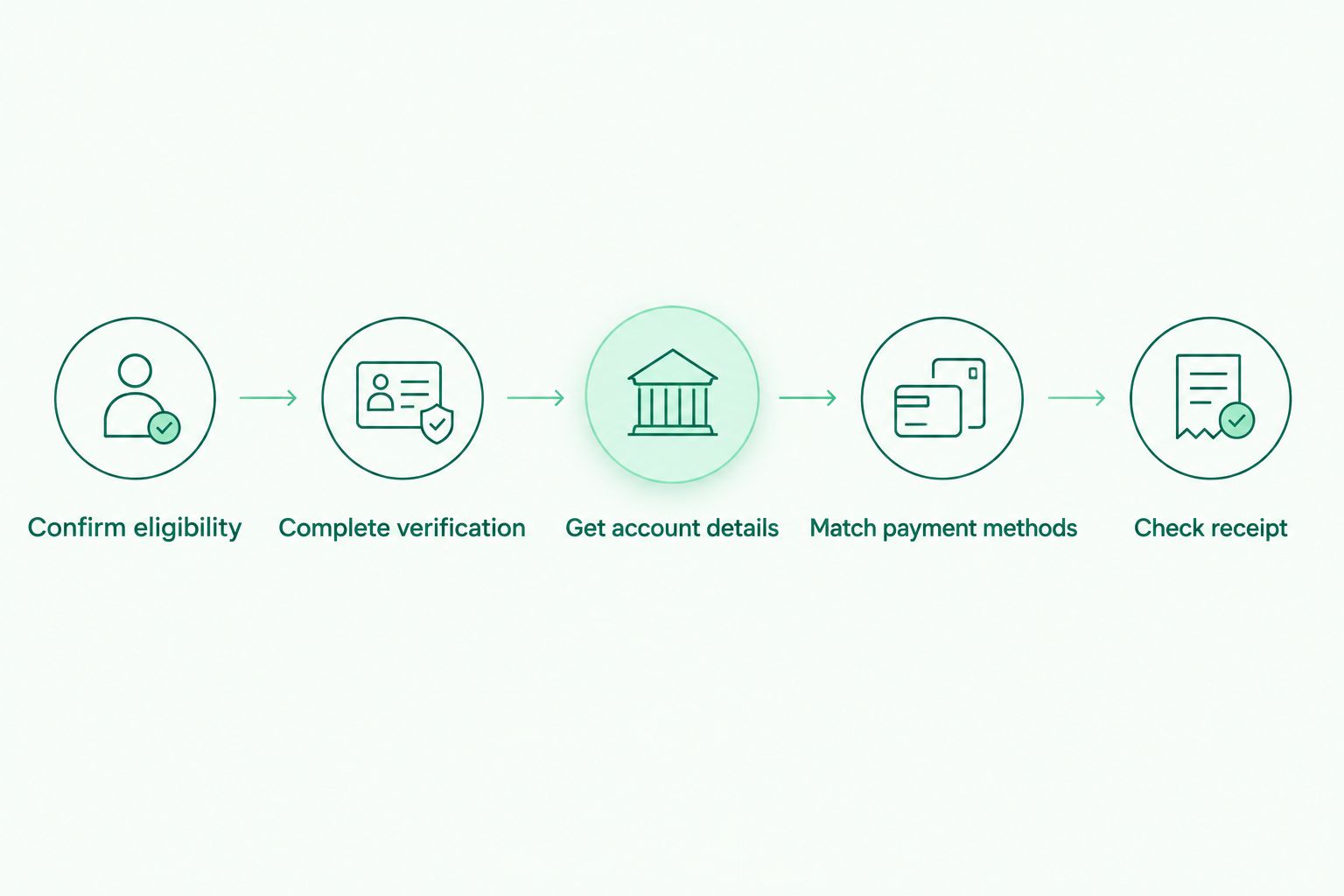
Use this sequence before putting receiving instructions on an invoice:
- Confirm eligibility. Check whether the provider accepts your location, customer type and intended activity.
- Complete verification. Individuals complete an ID check; businesses complete business verification, also called KYB.
- Get account details. Copy the recipient name, routing number and account number exactly as supplied.
- Match payment methods. Confirm whether the payer will send ACH or wire and use the corresponding instructions.
- Check receipt. Reconcile the incoming payment against the invoice before arranging a separate payout or exchange.
Keep the receiving instructions separate from your invoice description. Your client needs to know what they're paying for, but the payment destination must remain accurate and easy to identify.
Confirm the sender's payment method before sharing receiving instructions.
ACH receipts: Usually 1–3 business days
ACH is a USD payment method to consider when your client or platform supports it. Under the client-supplied 2026 terms, incoming ACH usually takes 1–3 business days.
Best for: Payers that support ACH and can work with its usual receiving timeline. The practical advantage is a defined USD receiving route. The limitation is that a payer with an earlier deadline must allow for the stated processing window.
Don't treat submission as receipt. A client saying the payment was sent doesn't mean the funds have arrived in your account. Ask for payment confirmation when needed, then match the received amount to the correct invoice.
Wire receipts: Usually within a business day
Incoming wire payments usually arrive within a business day under the supplied terms. Use the wire instructions provided for your account rather than assuming the ACH instructions are interchangeable.
Best for: Payers that support wire and need a shorter usual receiving window than ACH. The advantage is the stated receiving timeline. The limitation is that “usually” isn't a deadline commitment.
| Receiving method | Best for | Usual incoming timing | Incoming fee | Main limitation |
|---|---|---|---|---|
| ACH | A payer that supports ACH and can allow its processing window | 1–3 business days | 0.5% | Not suited to a receipt deadline shorter than the stated window |
| Wire | A payer that supports wire and needs the shorter usual window | Within a business day | 0.5% | Actual receipt still requires checking; timing isn't a firm deadline |
These are receiving terms, not outgoing payment terms. A later payout is a separate transaction with its own fee, minimum and usual timing.
Why your receiving workflow varies
The right setup depends on your payer and what you need to do after receiving USD. Check these factors before selecting a payment method:
- Payer capability. Your client or platform must support the receiving method you intend to use.
- Customer type. An individual ID check and business verification are different processes.
- Recipient identity. Use the exact personal or business name supplied with your receiving details.
- Currency needs. Keeping USD and exchanging USD into EUR create different transaction paths.
- Outgoing requirements. Payout limits and supported destinations determine how you can move funds afterward.
- Deadline. Incoming ACH, incoming wire and outgoing payouts have different usual timelines.
For a 2026 payment setup, check these requirements before sending the first invoice. A receiving route that works for one client doesn't prove another platform will accept the same details.
What does receiving USD cost?
Incoming ACH and wire payments carry a 0.5% fee under the supplied terms. Opening, verification and the monthly fee are free. A later payout or currency exchange adds a separate transaction fee.
The following schedule separates receiving from the actions you take afterward. Don't apply the incoming fee to every stage and assume that covers the complete workflow.
| Action | Fee | Applicable minimum |
|---|---|---|
| Receive ACH | 0.5% | No minimum specified in the supplied schedule |
| Receive wire | 0.5% | No minimum specified in the supplied schedule |
| Send ACH | 0.5% | $2 |
| Send wire | 0.5% | $15 |
| Send SEPA | 0.5% | €2 |
| Exchange USD/EUR | 0.5% | $1 |
For outgoing payments and exchange, the applicable minimum can determine the fee. Don't describe every transaction as costing exactly 0.5% regardless of amount.
For your 2026 payment budget, separate incoming fees, exchange fees and outgoing fees. A USD receipt followed by a EUR exchange and SEPA payout involves distinct actions, not one combined receiving service.
The fee is shown before you confirm an outgoing transaction. Read that confirmation rather than relying only on the headline percentage.
Who is this setup best for?
Moneyspace is best for freelancers and businesses that need dedicated USD receiving details and USD/EUR payment workflows. Its own-name details suit people getting paid by US clients and businesses coordinating receipts and payments across supported methods.
The strengths are specific: dedicated details rather than a shared reference, one online verification process for USD and EUR, and fees shown before confirmation. Businesses can also assign owner, admin, operator and view-only roles.
The constraints matter just as much. Eligibility requires checking, verification doesn't establish approval in advance, and the supplied currency scope is USD and EUR. Don't choose this setup for an unsupported currency or assume every destination is available.
For freelancers weighing whether they need both currencies, consider whether a multi-currency account is worth it for freelancers. Receiving in USD and regularly paying expenses in EUR is a different workflow from receiving and spending only USD.
How do I check whether my client or platform can pay me?
Ask your payer which method it will use before sharing details. “USD payment” names the currency; it doesn't tell you whether the sender will use ACH or wire.
For a direct client, provide the recipient name and the instructions supplied for the selected method. Keep those details consistent with the invoice recipient and the entity doing the work.
For a platform, review its payout requirements before entering the receiving details. Check the required recipient name, accepted payment method and any account-verification process. Dedicated details don't override a platform's own rules.
If your business accepts customer card payments, separate that requirement from invoice receipts. Evaluating offshore merchant accounts concerns card acceptance, while dedicated USD receiving details address where supported transfers arrive. One doesn't establish the availability or suitability of the other.
This distinction prevents a basic purchasing mistake: selecting receiving details when your actual requirement is payment acceptance. Write down whether you need a client transfer, a platform payout or customer card processing before comparing services.
What happens after the USD payment arrives?
Decide whether you'll retain USD for later supported payments, exchange USD into EUR, or arrange a payout. Receiving money doesn't automatically complete the next step.
Outgoing payouts usually take 1–2 business days under the supplied terms. For 2026 planning, keep that window separate from the incoming payment timeline. Don't promise a supplier that receipt from your client and payment to the supplier will finish together.
Live payout status shows three stages: Processing, On its way and Completed. Use the status to follow the payout rather than treating confirmation of the payment request as completion.
Every payout, new recipient and team grant requires 2FA. Build those checks into your payment process, particularly when several people manage recipients or outgoing transfers.
How much can I pay out after receiving USD?
Individuals have a $10,000 per-payout limit and a $50,000 monthly limit for USD payouts. Businesses have a $100,000 per-payout limit and no monthly limit under the supplied terms.
These are payout limits, not stated receiving limits. Don't apply them to incoming payments or interpret the business monthly position as removing the per-payout restriction.
| Customer type | USD limit per payout | USD monthly payout limit |
|---|---|---|
| Individual | $10,000 | $50,000 |
| Business | $100,000 | No monthly limit |
Check the relevant profile before scheduling payments. Founders managing several companies can use several company and personal profiles under one sign-in, but each payment still needs to belong to the correct profile.
What should I verify before opening an account?
Confirm location eligibility, intended activity, payer compatibility and outgoing destinations. Then review the terms that apply when you sign up, rather than treating an article as an approval decision.
Moneyspace's facts cited here were supplied by the client on October 26, 2026, and attributed to moneyspace.io. The stated timings are usual processing windows, and no country-by-country eligibility list is supplied.
Individual ID checks often take minutes, but that timing doesn't apply to every application or to business verification. Allow for the actual review process before promising a client that your new receiving details will be ready.
Open an account
Get dedicated USD and EUR account details after verification. Check eligibility before arranging payments.
FAQ
Can I get paid in USD if I live outside the US?
Yes, you can receive USD through a provider that accepts your location and supplies supported receiving details after verification. Your payer must also accept those details and the payment method.
Can a US client pay me by ACH?
A US client can pay you by ACH when the client supports that method and your verified receiving details accept it. Incoming ACH usually takes 1–3 business days under the supplied terms.
How long does an incoming USD wire take?
An incoming USD wire usually arrives within a business day under the supplied terms. Use the wire instructions supplied for your account and confirm actual receipt.
Do I need a business to receive USD payments?
Moneyspace serves both individuals and businesses. Individuals complete an ID check, while businesses complete KYB; eligibility and approval still require review.
Can I exchange received USD into EUR?
You can exchange USD and EUR inside the account. Exchange costs 0.5% with a $1 minimum, and a later payout carries its own fee.
Are my receiving details shared with other customers?
The supplied offer provides dedicated USD account details in your own name, not a shared reference. Use the exact recipient name and payment instructions shown for your account.
Does one verification process cover USD and EUR?
One completed verification process opens USD and EUR under the supplied offer. This doesn't promise approval or a fixed verification deadline.
One last thing
Your receiving name is part of the payment instructions, not an optional label. Copy it exactly alongside the correct ACH or wire details. A familiar currency symbol alone doesn't tell your client how to send the payment.
Moneyspace is not a bank. Account details are provided through a licensed partner after verification. Keep that service model separate from the practical ability to receive supported USD transfers.