Can non-residents open a US bank account online?

Yes, non-residents can apply online for US accounts, but eligibility depends on the provider, your country of residence, and whether you apply as an individual or a business. Approval requires verification; an online application doesn't establish that you're eligible. For receiving client payments, dedicated USD account details can meet a different need from a direct relationship with a US bank.
TL;DR
- The open us bank account non resident question starts with eligibility: online applications don't establish approval.
- Compare a direct bank relationship with dedicated USD account details before choosing a provider.
- Moneyspace suits freelancers and businesses seeking their own USD account details for ACH and wire payments, subject to verification.
- Check account ownership, supported payment methods, payout limits, and transaction minimums before sharing payment instructions.
Can non-residents open a US account online?
Yes, but there isn't one application route that works for every non-resident. A provider must accept your residence, applicant type, and intended use. The distinction between an individual application and a business application matters as much as your location.
Start with the account structure, not the sign-up form. The USD accounts for non-residents guide covers the same decision from a payment-provider perspective.
| Route | Best for | Main advantage | Main limitation |
|---|---|---|---|
| Direct relationship with a US bank | Applicants who specifically require a banking relationship | Addresses a different need from payment account details alone | Non-resident and online-opening requirements vary by institution |
| Dedicated USD payment account details | Freelancers and businesses receiving USD payments | Provides payment instructions for supported USD transfers | Doesn't establish a direct relationship with a bank |
| Business application | Companies collecting revenue and paying suppliers or teams | Matches the application to the legal entity doing business | Requires business verification rather than only an individual's ID check |
These routes aren't interchangeable. A business application describes who applies; a direct banking relationship or payment account describes the service you're getting. In 2026, check both before submitting documents.
Why this matters
Your client asking for USD payment details doesn't necessarily mean you need the full set of services offered by a US bank. You need to establish what the payer accepts, which payment method it uses, and whose name must appear on the account details.
That distinction changes your shortlist. A freelancer collecting invoices by ACH has a different requirement from a company whose contract specifically requires a direct banking relationship. Choose against the actual payment requirement, not the account label.
Don't send new payment instructions just because an application is complete. Wait until verification is complete, the account details are available to you, and you've checked the payer's requirements.
How to check whether you can apply online
Use this sequence before choosing a provider in 2026. It separates basic eligibility from the practical question of whether the account will work for your payments.
- Check residence. Confirm that the provider accepts applicants living in your country. A worldwide audience statement isn't a country-by-country eligibility list.
- Choose applicant type. Apply as yourself for personal activity or as the relevant company for business activity. Don't assume an individual approval covers a separate legal entity.
- Prepare verification. Read the requested identity or business information before starting. Follow the provider's current document instructions rather than a generic checklist.
- Confirm payment methods. Ask whether incoming payments use ACH or wire, and whether those methods match your client's payment process.
- Review payout needs. Check recipients, supported destinations, limits, fees, and usual timing before moving operating funds.
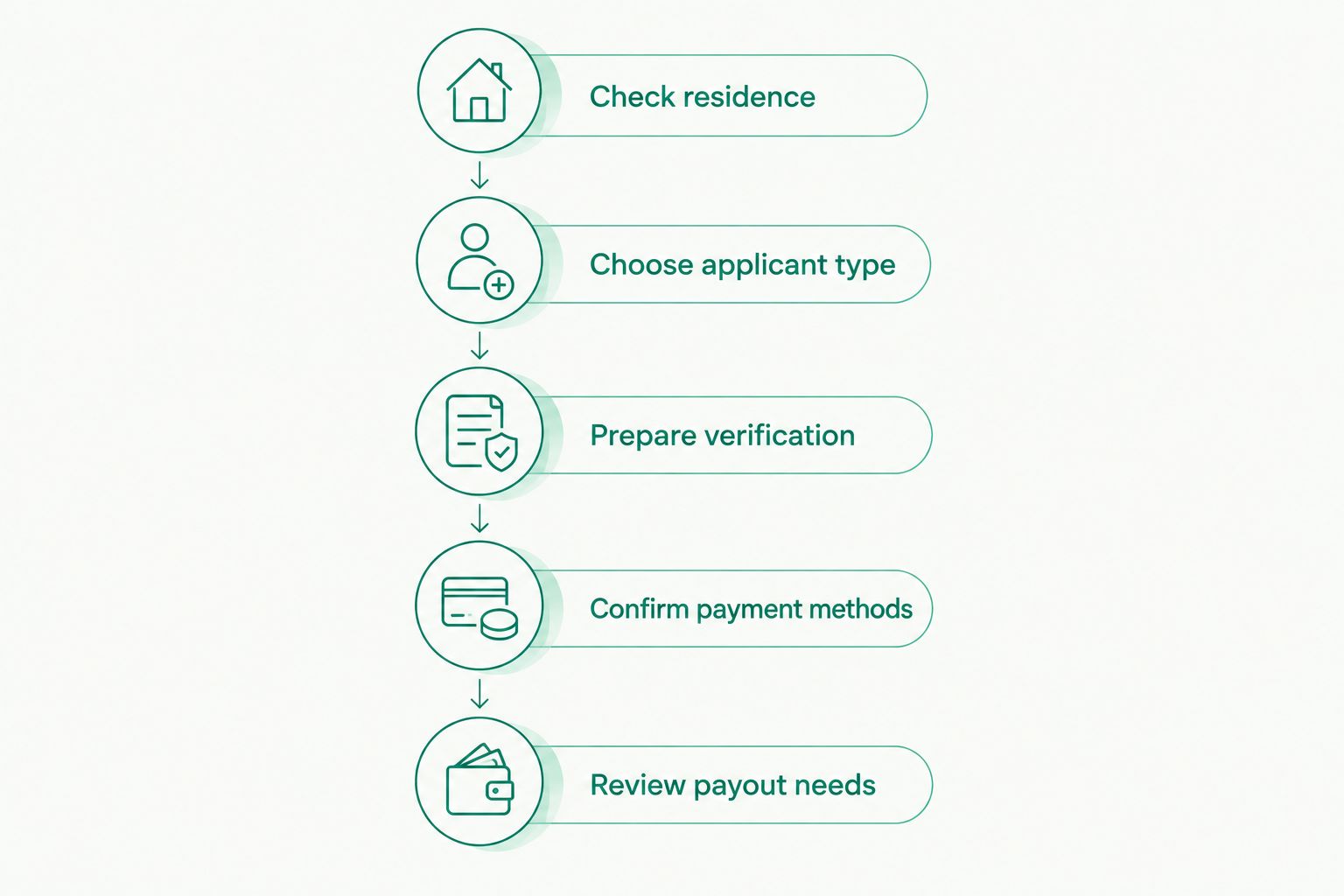
Check eligibility and payment compatibility before moving funds.
A completed form isn't the end of this sequence. You still need an approved application and payment details that match how you intend to get paid. Keep the acceptance decision separate from your own compatibility checks.
What documents should a non-resident prepare?
Prepare for identity verification if you apply as an individual and business verification if you apply for a company. The provider's application determines the actual documents required. Don't assume a passport alone completes every application.
For a business, organize information about the entity and the people involved before applying. Use consistent names across your application, supporting records, invoices, and payment instructions. If the provider requests clarification, answer the specific request rather than substituting unrelated documents.
Tax identifiers and address requirements need the same discipline. Don't assume every provider requires the same identifier or accepts the same address evidence. Check the current requirements for your applicant type and residence before deciding that a particular route is available to you.
An online application removes the need to submit that application in person; it doesn't remove verification. Avoid planning a client payment around an approval date that the provider hasn't committed to.
Where Moneyspace fits
Moneyspace is best for freelancers and businesses seeking their own USD and EUR account details for supported international payments. Its dedicated details are in the customer's own name, rather than a shared reference. The service supports getting paid by ACH, wire, and SEPA, with USD/EUR exchange inside the account.
That makes Moneyspace relevant when your practical requirement is receiving client payments and paying suppliers or teams. It isn't a substitute for a direct banking relationship when your contract specifically requires one. Moneyspace is not a bank; account details are provided through a licensed partner after verification.
Client-supplied product facts dated October 26, 2026, state that individuals complete an ID check and businesses complete business verification. One completed check opens access to USD and EUR. Individual ID checks often take minutes, but that isn't an approval deadline and doesn't describe business verification timing.
The main benefits are dedicated account details, fees shown before confirmation, and live payout status. The constraints are equally important: only USD and EUR are described here, country eligibility requires confirmation, and transaction fees and payout limits apply.
Individuals: check payout and monthly limits
For individuals, the supplied limits are $10,000 or €10,000 per payout and $50,000 or €50,000 per month. Check both against your expected activity. A payout fitting the per-transfer limit doesn't establish that your remaining monthly allowance covers it.
Best for: freelancers, remote workers, and contractors receiving payments in their own name. Match the account holder to the person doing the work, then confirm that the client or platform accepts the supplied payment details.
The advantage is access to USD and EUR through one verification process. The limitation is that individual limits still apply when your work produces larger receipts or supplier obligations. Review your intended use before treating an individual profile as a business-payment arrangement.
Businesses: check entity ownership and team access
For businesses, the supplied payout limit is $100,000 or €100,000 per payout, with no monthly limit. That doesn't remove the per-payout limit or the need for business verification. Check the payment amount before scheduling a supplier or team payout.
Best for: small and mid-size businesses, agencies, e-commerce sellers, and founders managing several companies. Several companies and personal profiles can sit under one sign-in, with owner, admin, operator, and view-only team roles.
The benefit is managing access and payments in one workspace. The responsibility is assigning the right role to each person and using the correct company profile. Every payout, new recipient, and team grant requires two-factor authentication.
What fees should you check before applying?
Compare the complete transaction path, not just the monthly charge. Moneyspace has no opening, verification, or monthly fee. Its transaction pricing includes minimums for outgoing payments and exchange, so not every transaction total is exactly 0.5%.
| Transaction | Supplied fee | Applicable minimum |
|---|---|---|
| Incoming ACH, wire, or SEPA | 0.5% | No minimum stated in the supplied pricing |
| Outgoing ACH | 0.5% | $2 |
| Outgoing wire | 0.5% | $15 |
| Outgoing SEPA | 0.5% | €2 |
| USD/EUR exchange | 0.5% | $1 |
For a payment workflow involving receipt, currency exchange, and payout, review each relevant transaction separately. An incoming-payment fee doesn't describe the total cost of every later action. The fee shown before confirmation is the amount to review before sending.
Use these client-supplied terms as the 2026 reference, then check the current confirmation screen. No monthly fee doesn't mean no transaction fees. Minimums matter especially when you compare methods for smaller outgoing payments.
Why online account access varies
The same search produces different answers because applicants and payment needs differ. Use these factors to judge a provider rather than assuming another person's successful application establishes your eligibility.
- Residence: confirm acceptance for where you live; don't infer it from international positioning.
- Applicant type: an individual ID check and business verification are separate application contexts.
- Legal entity: apply for the company that receives revenue or makes the payments, not an unrelated profile.
- Payment method: confirm ACH, wire, or SEPA support for the transaction you're arranging.
- Payment size: check per-payout and monthly limits against your intended activity.
- Required relationship: establish whether your payer needs payment account details or specifically requires a direct bank relationship.
These checks belong before sign-up, not after you issue an invoice. In 2026, a provider's current application and payment instructions take priority over an old tutorial or another applicant's experience.
Open an account
Apply for your own USD and EUR account details. Verification and eligibility checks apply.
How long does it take to receive and send payments?
Incoming ACH payments usually take 1–3 business days under the supplied product terms. Incoming wire and SEPA payments usually arrive within a business day. Payouts usually take 1–2 business days.
Those are payment timings, not account-opening timelines. They don't establish how long your verification will take or when your first incoming payment will arrive. Keep onboarding, receipt, and payout as separate stages in your plan.
Live payout status moves through Processing, On its way, and Completed. Check that status before telling a supplier that a payout has completed. Starting a transfer and completing it aren't the same event.
Can you receive client payments without living in the US?
Yes, living outside the US doesn't automatically rule out receiving USD client payments through an eligible provider. Your residence still needs to be accepted, and the payer needs to support the account details and payment method you provide.
Ask your client whether it sends ACH or wire payments and whether the recipient name must match the invoice. Confirm those details before replacing existing payment instructions. Don't assume a platform accepts an account merely because a client can pay it directly.
Do you need a US company to apply?
A US company isn't a universal requirement across every account provider, but each provider sets its own applicant rules. The supplied offer includes both individual and business verification routes; it doesn't establish unrestricted eligibility for every country or entity type.
Choose the route that reflects your actual activity. Forming a company isn't a substitute for checking residence requirements, verification, payment compatibility, or the legal entity named on the account details.
FAQ
Can I apply for a US account online if I don't live in the US?
Yes, non-residents can apply online with providers that accept their residence and applicant type. Approval still requires verification, and a worldwide audience statement doesn't establish eligibility in every country.
Does having USD account details mean I have a direct relationship with a US bank?
No, dedicated USD account details don't by themselves establish a direct relationship with a US bank. Check the service structure and whether it meets your payer's requirements.
Can I get USD account details in my own name?
Moneyspace provides dedicated USD account details in the customer's own name after verification. These include a routing number and account number rather than a shared payment reference.
How much does sending a USD payment cost?
Outgoing ACH costs 0.5% with a $2 minimum, and outgoing wire costs 0.5% with a $15 minimum under the supplied pricing. Review the fee shown before confirming the payment.
How long do incoming ACH payments take?
Incoming ACH payments usually take 1–3 business days under the supplied product terms. That timing describes payment receipt, not application approval or verification.
What's the payout limit for an individual?
Individuals have a $10,000 or €10,000 per-payout limit and a $50,000 or €50,000 monthly limit under the supplied terms. Businesses have different limits.
Can I manage USD and EUR through one application?
One completed verification check opens USD and EUR under the supplied offer. Individuals complete an ID check, while businesses complete business verification; approval isn't promised.
One last thing
Ask the payer to confirm your payment instructions before your first invoice is due. An approved account is only one part of getting paid. The payment method, recipient name, and account details must also fit the payer's process.
Keep that confirmation with your invoicing records. It gives you a clear reference when a client changes its payment process or a team member takes over billing.