Cheapest international wire transfer services in 2026

Best for USD payments that require wire: Moneyspace. Best alternative when the recipient accepts ACH: a USD ACH payout. Best alternative for eligible EUR payments: a SEPA payout. The cheapest international wire transfer in 2026 is the eligible option with the lowest complete cost—not simply the lowest advertised fee.
TL;DR
- Moneyspace suits USD and EUR payers who need their own account details, outgoing payments, and live payout status.
- Find the cheapest international wire transfer by comparing fees, currency conversion, and the recipient’s expected amount.
- Compare ACH for supported USD payments and SEPA for supported EUR payments before choosing wire.
- Check destination eligibility and payment limits before treating any quote as usable.
Why this matters
An international payment and a wire transfer aren't the same thing. Your recipient can be overseas while accepting a supported ACH or SEPA payment. Choosing the payment method comes before choosing the provider.
For your 2026 comparison, separate two questions: does the recipient actually require wire, and what will the complete payment cost? If wire is mandatory, compare wire quotes. If it isn't, include eligible alternatives without presenting them as wires.
Moneyspace is best for individuals and businesses that need USD and EUR payment services with their own account details and visible payout status. That makes it a candidate for this comparison, not a proven cheapest provider across every destination.
What makes the best international transfer service?
Use these criteria before reading the shortlist:
- Payment-method fit: Confirm whether the recipient accepts wire, ACH, or SEPA. A cheaper unsupported method isn't an option.
- Complete cost: Compare the transfer charge, applicable minimum, and any currency conversion. Check whether other charges affect what arrives.
- Recipient amount: Compare quotes for the same amount received, or the same total amount you spend. Don't mix those two approaches.
- Usable limits: Check both the individual payment limit and any monthly limit before scheduling payments.
- Qualified timing: Match the expected arrival window to the invoice deadline. A usual timeframe isn't a delivery promise.
- Operational control: Check fee visibility, payout status, recipient verification, and team permissions—not just the send button.
Payment options at a glance
These are three payment routes available through Moneyspace, not three independently tested providers. The ranking separates use cases; it does not establish a universal cost winner.
| Payment option | Best for | Standout capability | Key limitation |
|---|---|---|---|
| USD wire payout | A supported USD recipient that requires wire | Wire payouts with the fee shown before confirmation | An outgoing minimum applies; compare the complete quote |
| USD ACH payout | A supported USD recipient that accepts ACH | An alternative to wire for eligible USD payments | ACH isn't a wire and doesn't establish destination eligibility |
| EUR SEPA payout | A supported EUR recipient that accepts SEPA | EUR payouts without changing the payment currency | SEPA isn't a wire and doesn't cover every destination |
Don't compare these rows by label alone. Ask the recipient which method their receiving details support, then compare the eligible quotes. Currency, destination, amount, and timing must match your actual payment.
1. USD wire payout: best for recipients that require wire
Moneyspace supports outgoing USD wire payments and shows the fee before you confirm. You can also exchange USD and EUR inside the account and follow the payout through its live status.
Choose this route when the recipient's payment instructions specifically require wire. It belongs first for a wire-transfer query because ACH and SEPA are alternatives, not substitutes you can select without checking.
USD wire payout pros:
- Send through the payment method the recipient has requested.
- See the payout fee before confirming the transaction.
- Track the payment through Processing, On its way, and Completed.
- Keep USD/EUR exchange and outgoing payments in the same account.
USD wire payout cons:
- An outgoing wire minimum applies, so the headline percentage doesn't describe every payment's effective cost.
- Supported destinations still need checking; audience reach doesn't establish payment coverage.
- Payouts usually take 1–2 business days, rather than arriving immediately.
Best for: A freelancer, agency, or business paying a supported USD recipient whose instructions require wire.
Before sending, compare a quote for the actual invoice amount. Ask whether the recipient needs a specified amount to arrive and whether any other charges affect that amount. Don't treat the displayed sending charge as confirmation of facts it doesn't state.
Verdict: Buy—choose USD wire when wire is required and its complete quote wins your eligible comparison.
2. USD ACH payout: best for recipients that accept ACH
A USD ACH payout sends through ACH rather than wire. The recipient must accept that method, and the payment must meet the service's eligibility requirements.
This is the first alternative to check when a USD invoice doesn't require wire. Don't assume that an overseas recipient automatically rules ACH in or out; verify the receiving instructions and supported destination.
USD ACH payout pros:
- Adds a non-wire option to your USD payment comparison.
- Shows the payout fee before you send.
- Provides live payout status after confirmation.
- Supports paying suppliers and teams where the payment route is supported.
USD ACH payout cons:
- ACH can't satisfy instructions that specifically require wire.
- An outgoing minimum applies, so compare the actual transaction quote.
- A usual payout timeframe doesn't establish a fixed arrival deadline.
Best for: A supported USD recipient that accepts ACH and doesn't require a wire payment.
Keep the currency unchanged when comparing ACH with wire. If one quote includes USD/EUR exchange and the other doesn't, you're comparing different transactions. Match the funding currency, recipient currency, and amount first.
Also distinguish incoming ACH timing from outgoing payout timing. Incoming ACH usually takes 1–3 business days; payouts usually take 1–2 business days. Don't use the incoming timeframe as an outgoing delivery commitment.
Verdict: Buy—choose USD ACH when the recipient accepts it and its complete quote beats the eligible wire option.
3. EUR SEPA payout: best for recipients that accept SEPA
A EUR SEPA payout sends EUR through SEPA rather than wire. It belongs in your comparison when the recipient accepts SEPA and the destination is supported.
Check this route before converting a EUR obligation into a USD wire. An invoice in EUR gives you a clear comparison target: the EUR amount the recipient needs to receive.
EUR SEPA payout pros:
- Pays an eligible EUR obligation through SEPA.
- Lets you compare a EUR route against a wire-based alternative.
- Shows the payout fee before confirmation.
- Provides live status for the outgoing payment.
EUR SEPA payout cons:
- SEPA doesn't cover every international payment destination.
- An outgoing minimum applies, and currency exchange is a separate cost consideration when needed.
- The recipient's details must support SEPA; EUR denomination alone isn't enough.
Best for: A supported supplier, contractor, or team member who accepts EUR through SEPA.
Compare the full sequence, not just the final payout. If your funds start in USD, include the USD/EUR exchange when assessing the EUR route. If your funds already sit in EUR, don't add a conversion step that the payment doesn't need.
Verdict: Buy—choose EUR SEPA when the recipient accepts it and the complete payment costs less than the eligible alternatives.
How to compare quotes without comparing different payments
A useful quote comparison follows the same sequence every time. Keep these inputs consistent before deciding that one option is cheaper.
Define the payment
Write down the invoice currency, recipient destination, accepted payment method, and required arrival date. Decide whether you're fixing your total spend or the amount the recipient receives.
Check eligibility
Confirm that your profile, destination, recipient details, and payment method are supported. Verification is required, and approval isn't automatic.
Compare the quote
Use the same payment amount across eligible options. Review the sending fee, applicable minimum, currency conversion when needed, and any stated effect on the recipient's amount.
Confirm and track
Review the recipient details and fee before confirming. Follow the live payout status afterward, and keep the payment record with the invoice.
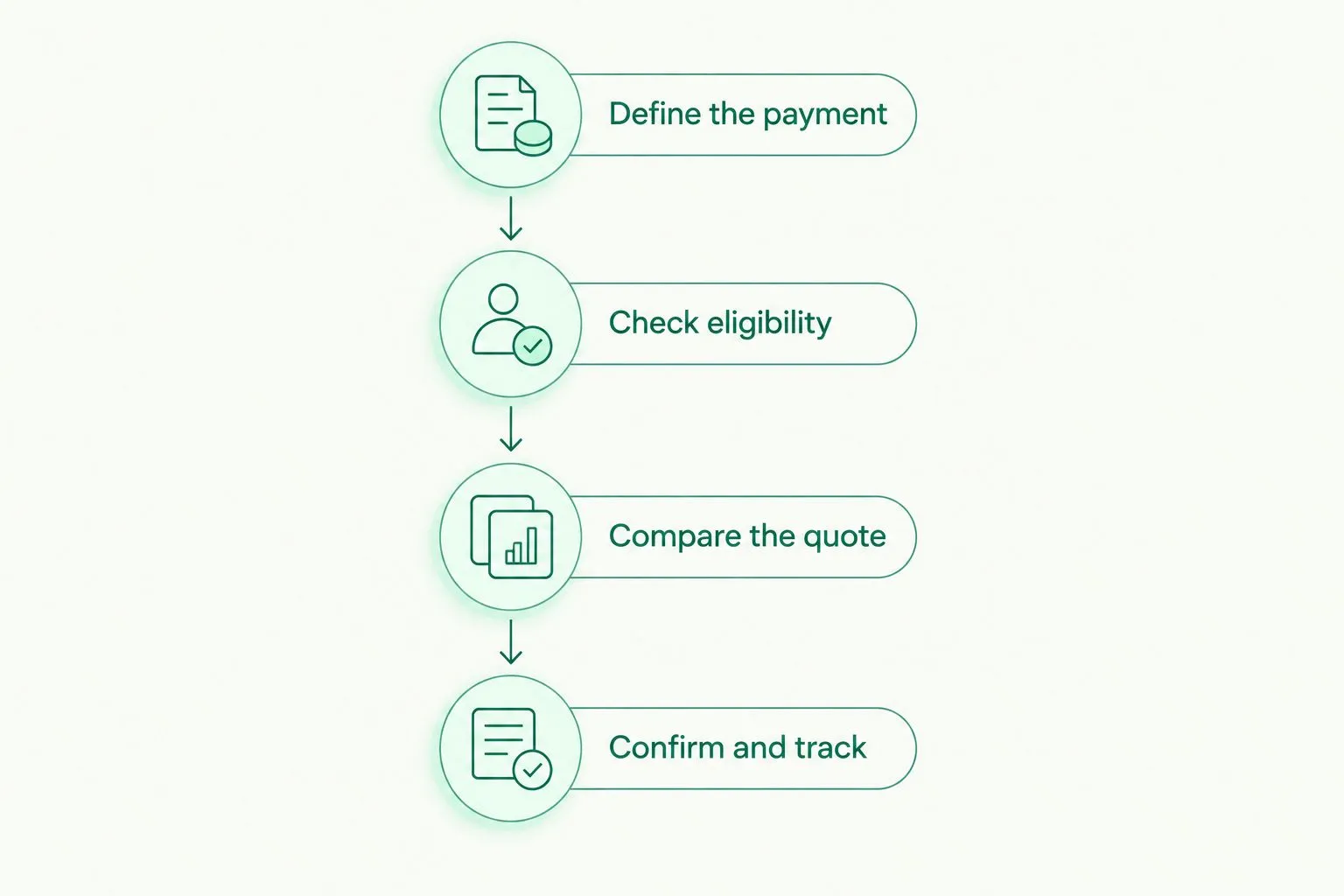
Check eligibility before comparing a quote you intend to use.
A saved headline fee isn't a substitute for this process. Recheck the actual quote when you send, especially if the amount, currency, recipient, or payment method has changed.
Check limits before choosing a route
Payment limits can rule out an otherwise suitable quote. Individuals have a $10,000 or €10,000 limit per payout and a $50,000 or €50,000 monthly limit.
Businesses have a $100,000 or €100,000 limit per payout, with no monthly limit. These are profile limits, not evidence that every recipient or destination is supported.
For business payments, check access controls alongside limits. Available team roles are owner, admin, operator, and view-only. Every payout, new recipient, and team grant requires two-factor authentication.
Founders managing several companies can keep company and personal profiles under one sign-in. Keep each payment attached to the correct profile rather than treating shared access as permission to mix company activity.
How these options were ranked
This 2026 shortlist ranks payment-method fit first, followed by complete cost, limits, timing, and operational visibility. Wire comes first for recipients requiring wire; ACH and SEPA occupy separate alternative-use slots.
It isn't a provider-wide cost ranking or a claim based on comparative transaction testing. Product capabilities, limits, and usual timings come from client-supplied Moneyspace information dated October 26, 2026. Compare current transaction quotes before choosing a cost winner.
Which international payment option should you choose?
Default to the recipient's accepted payment method, then choose the lowest complete eligible quote. Use USD wire when wire is required. Compare USD ACH when ACH is accepted, and EUR SEPA when SEPA is accepted.
Don't select wire solely because the recipient is abroad. Equally, don't switch to ACH or SEPA solely because you expect it to cost less. The receiving instructions decide which comparisons are valid.
If these USD and EUR payment routes match your needs, opening an account is the next step. Account details are provided through a licensed partner after verification. Approval and destination support still need confirmation.
Open an account
Get your own USD and EUR account details after verification, with fees shown before you send.
FAQ
What's the cheapest international wire transfer service in 2026?
The cheapest eligible service is the one with the lowest complete quote for your payment. Compare the same amount, currencies, destination, and recipient requirements; this shortlist doesn't establish a universal provider winner.
Is Moneyspace the cheapest option for every international payment?
No universal cheapest-provider claim is established here. Compare its actual transaction quote with other eligible options, including applicable minimums and currency conversion when needed.
Is ACH the same as an international wire transfer?
No. ACH and wire are different payment methods, so use ACH only when the recipient accepts it and the payment is supported.
Can I use SEPA instead of wire for a EUR payment?
Yes, when the recipient accepts SEPA and the destination is supported. Confirm the receiving instructions before replacing a requested wire payment.
How long do payouts usually take?
Payouts usually take 1–2 business days. Treat that as a usual timeframe, not a fixed arrival commitment.
What limits apply to individual and business payouts?
Individuals can send up to $10,000 or €10,000 per payout, with monthly limits of $50,000 or €50,000. Businesses can send up to $100,000 or €100,000 per payout, with no monthly limit.
What should I check before confirming a payment?
Check the recipient details, supported payment method, currency, amount, displayed fee, and applicable minimum. Include currency conversion in your comparison when the payment requires it.
One last thing
Before comparing providers for your next payment in 2026, ask the recipient whether wire is actually required. That answer determines whether your shortlist should contain only wires or also include ACH and SEPA.
Keep the service's legal status separate from its payment capabilities: it is not a bank. Your own account details describe how you receive supported payments, not a change in that status.