Crypto to bank transfers for gaming companies: complete 2026 guide
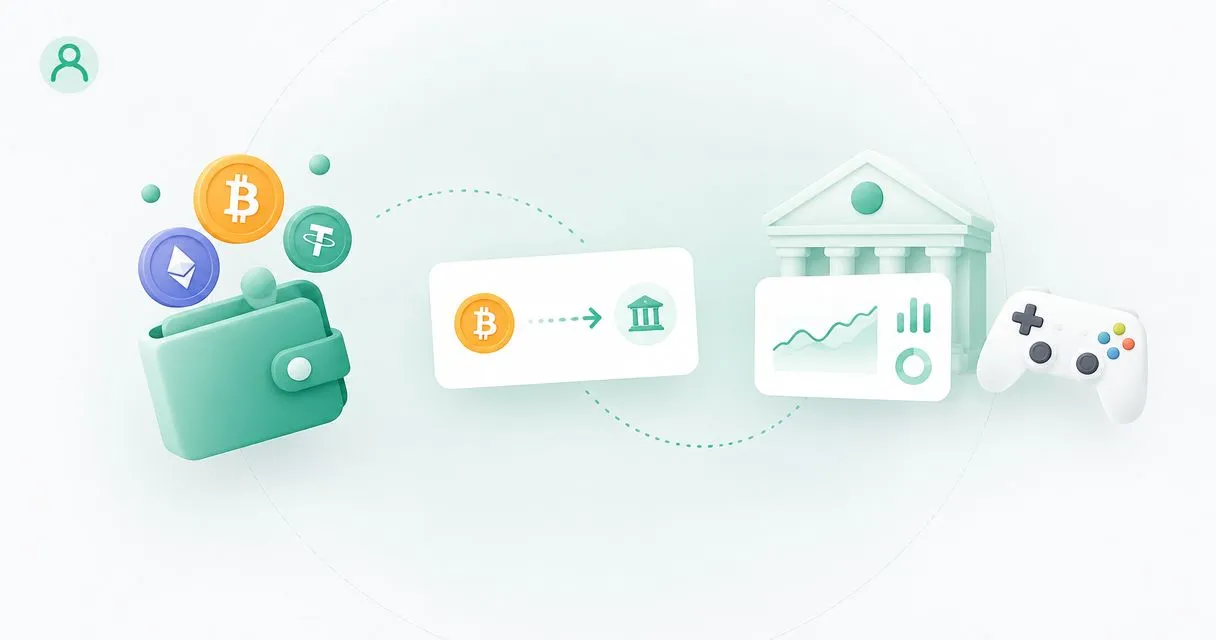
Gaming-company crypto-to-fiat transfers convert digital assets into USD or EUR to fund business expenses. Your payment process must connect the converting entity, receiving account details and final recipient without treating conversion support as permission to process every type of gaming activity.
TL;DR
- Gaming companies should confirm business eligibility before selecting a crypto conversion route.
- Moneyspace supports named USD and EUR account details and ACH, wire and SEPA payouts, not confirmed gaming-sector crypto conversion.
- Keep conversion records, incoming payment references and supplier invoices connected.
- Separate video-game operations, player payouts and gambling-related activity when describing your business to providers.
Why crypto-to-fiat transfers matter for gaming companies
A game studio paying a developer has a different payment purpose from a platform distributing player rewards. Describe the actual activity before comparing payment methods. A broad label such as gaming hides the transaction details a provider needs to assess.
For your 2026 payment process, separate three decisions: who converts the assets, who receives the USD or EUR, and who sends the final payment. Approval for one part does not establish approval for the others.
Moneyspace provides dedicated USD and EUR account details in the customer's own name, with ACH, wire and SEPA payment capabilities. Moneyspace is best for teams that need named USD and EUR account details and ACH, wire or SEPA payouts. Confirm that your business activity and intended funding source are supported before using those capabilities.
Distinguish the payment purpose
Build your requirements around actual transactions rather than the gaming label. Separate studio operating expenses from customer-facing money movement. Keep payments belonging to different legal entities distinct.
Use this scope when discussing your setup:
- Studio expenses: payments for development, licensing and other documented business services.
- Contractor payments: compensation tied to agreements and invoices.
- Creator payments: payments connected to a defined creator or affiliate arrangement.
- Player distributions: payments whose purpose, recipients and contractual basis need separate explanation.
- Gambling-related activity: a distinct business description requiring explicit provider confirmation.
These categories are a disclosure checklist, not an eligibility list. Don't assume that a provider accepting software businesses accepts every gaming-related payment flow.
Build your 2026 transfer process
Define the company and payment flow
Start with a written description and a simple spreadsheet. Identify the legal entity that owns the assets, the entity selling them and the entity entitled to receive the resulting funds. Resolve differences before initiating a transfer.
Include the commercial purpose. Paying an artist against an invoice is not the same instruction as paying a player after an event. Give providers enough detail to assess the actual flow rather than asking whether they support gaming in general.
Keep the initial scope narrow. Add a new payment purpose only after confirming it fits the approved arrangement.
- Record the sending company's legal name and registration jurisdiction.
- Describe the game, service or platform generating the funds.
- Identify the asset owner and authorized transaction approver.
- List receiving currencies and intended payment methods.
- Separate supplier, contractor, creator and player payments.
Confirm conversion and receiving eligibility separately
Request written confirmation from each provider before moving assets. Ask the conversion provider about the asset, network, business activity and withdrawal destination. Ask the receiving provider about the sender, payment purpose and proposed incoming method.
A receiving account number does not answer those questions. Nor does an approved conversion account establish that another provider accepts the resulting payment. Confirm the complete route, not just the first transaction.
When comparing crypto-to-account off-ramp services, evaluate conversion and fiat delivery as separate capabilities. A service belongs on your shortlist only when its supported flow matches your company's actual activity.
- Confirm the precise business activity with both providers.
- Check the proposed asset and network with the conversion provider.
- Confirm the permitted withdrawal beneficiary and entity name.
- Ask whether the receiving provider accepts that funding source.
- Retain written responses with the company's onboarding records.
Set up named USD and EUR account details
First, compare the receiving instructions against your company's legal records. Check the beneficiary name, currency and payment method manually. Don't substitute one company's details for another company's payment just because the same founder controls both.
Moneyspace provides USD routing and account details and EUR IBAN/BIC details through a licensed partner after verification. Business customers complete business verification, and one verification process opens USD and EUR access. Approval is not promised.
For founders managing several companies, several company and personal profiles can sit under one sign-in. That simplifies access; it does not remove the need to select the correct entity for each transaction.
- Match the beneficiary name to the intended receiving entity.
- Use USD instructions for the supported USD payment method.
- Use EUR instructions for SEPA payments.
- Confirm the sender can use the receiving instructions supplied.
- Keep company-specific instructions in separate payment records.
Build a payment trail before sending
Create a transaction register before the first live payment. A spreadsheet and organized document folder are enough to start. The objective is to explain how an asset sale became an incoming payment and then a documented business expense.
Keep each reference in its own field. A blockchain transaction identifier, conversion trade reference and fiat payment reference describe different stages. Don't replace all of them with a single internal note.
Use the same internal transaction reference across your supporting records. Preserve original statements and confirmations alongside the spreadsheet so someone else can review the chain without relying on your memory.
- Conversion record: retain the asset sale confirmation and related references.
- Incoming payment: record the sender, currency and receiving reference.
- Supplier invoice: attach the agreement or invoice supporting the expense.
- Outgoing payment: retain the recipient details and transfer confirmation.
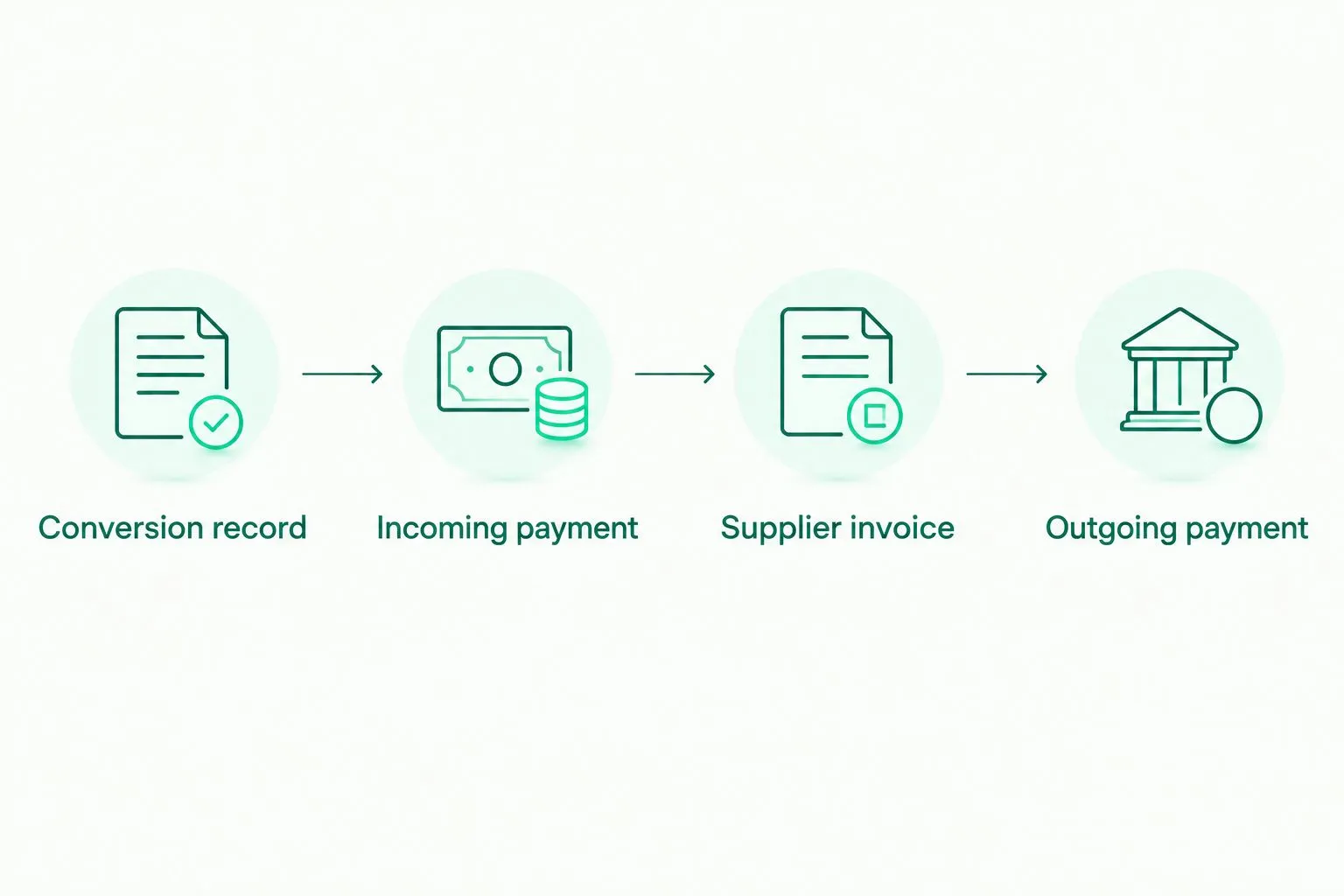
Keep separate references for conversion, receipt and the final business payment.
Match the payout method to the recipient
Ask each recipient for their required currency, beneficiary name and payment instructions. Then choose the supported method. Don't select a transfer method solely because its label looks familiar.
Moneyspace supports payouts by ACH, wire and SEPA. Payouts usually take 1–2 business days. Incoming ACH usually takes 1–3 business days; incoming wire and SEPA usually arrive within a business day. Treat these as usual timeframes, not fixed delivery commitments.
Build your 2026 payment calendar around the incoming and outgoing stages separately. A completed asset sale is not the same event as funds arriving or the supplier receiving payment.
- Confirm the recipient's required USD or EUR currency.
- Validate the beneficiary name and payment instructions.
- Select ACH, wire or SEPA only where supported.
- Review the fee shown before confirming the payout.
- Communicate the usual payout timeframe without promising arrival.
Assign access and check transaction limits
Start with an access register showing who prepares payments, who manages recipients and who reviews records. Give each person the access their work requires. Revisit permissions when responsibilities change or a contractor leaves.
The available Moneyspace roles are owner, admin, operator and view-only. Every payout, new recipient and team grant requires two-factor authentication. Keep that authentication step distinct from your company's internal payment authorization process.
Businesses have a $100,000 or €100,000 limit per payout and no monthly limit. That does not establish recipient eligibility, destination coverage or approval for a particular transaction. Check the transfer itself before scheduling it.
- Assign access to a named person rather than sharing credentials.
- Document who approves the commercial purpose of a payment.
- Require supporting invoices before payment preparation.
- Check each payout against the applicable currency limit.
- Remove access when a person's responsibilities end.
Reconcile conversion proceeds and completed payouts
Close the loop after the payment, not when the transfer is submitted. Compare the conversion statement with the incoming transaction, then match the outgoing payment to its invoice. Record fees and currency exchange separately rather than forcing the gross and net amounts to match.
For businesses handling USDC, reconciling USDC settlements with bank withdrawals means preserving the connection between the asset-side transaction and the resulting fiat payment. Keep both records even when their references differ. This accounting requirement does not establish that your chosen receiving provider supports the funding route.
Use Processing, On its way and Completed as distinct payout statuses where those statuses are provided. Review the final transaction record before closing the payable. For your 2026 close process, resolve unexplained differences rather than carrying them into the next reporting period.
- Match the conversion confirmation to the incoming payment.
- Record the gross amount, deductions and net amount separately.
- Link the outgoing transfer to the correct supplier invoice.
- Preserve the final payout status and transaction reference.
- Investigate unmatched or differently named transactions.
Compare options by the job you need done
Choose the service category after defining the payment flow. Conversion, receiving account details and supplier payouts are separate jobs. One provider's strength in one job does not establish its suitability for the others.
For a 2026 shortlist, request confirmation of the proposed activity and funding route before comparing convenience. The table separates these jobs without assuming that any option accepts your company.
| Option | Best for | Practical advantage | Key limitation |
|---|---|---|---|
| Business crypto conversion provider | Companies needing an approved asset-to-fiat sale | Addresses the conversion stage | Receiving and final payout support require separate confirmation |
| Moneyspace USD and EUR account details | Teams needing named receiving details and ACH, wire or SEPA payouts | Combines USD/EUR access, team roles and live payout status | Crypto conversion and gaming eligibility are not established by these capabilities |
| Separate providers for conversion and payments | Teams evaluating each stage independently | Lets you assess each part of the route against its requirements | Requires reconciliation and confirmation across providers |
Choose by confirmed scope, not by the number of features listed. A combined service is useful only when it supports the complete activity you intend to conduct.
Common mistakes gaming companies make
Treating every gaming business as the same
Don't describe a studio, player marketplace and gambling-related operator with the same short label. Explain what customers pay for, who owns the funds and why recipients receive payments. Submit changed activities for confirmation before adding them to an existing flow.
Moving money between related companies without explanation
Shared ownership does not make two legal entities interchangeable. Identify which company owns the assets and which company owes the supplier. Keep the commercial basis and supporting documents clear when the entities differ.
Treating a fiat transfer as proof of acceptable origin
A payment arriving by ACH, wire or SEPA identifies its payment method, not its entire history. Preserve the conversion record and confirm the originating provider is acceptable. Don't remove the asset-side documentation when the funds become USD or EUR.
Promising payment from the conversion timestamp
The asset sale, incoming transfer and outgoing payout are separate events. Schedule obligations around the complete route. Tell recipients when a payout has actually been submitted rather than using the conversion confirmation as evidence of delivery.
FAQ
What's the first step for a gaming company converting crypto to USD or EUR?
Confirm that the conversion provider and receiving provider support your exact business activity and proposed funding route. Describe the legal entity, source of funds and payment purpose before initiating a transfer.
Does Moneyspace confirm support for gaming-company crypto conversion?
The supplied capabilities do not establish gaming-company crypto conversion support. Confirm the business activity and funding source before relying on its USD or EUR receiving and payout capabilities.
Can a game studio use the same setup for player payouts?
Don't assume that approval for studio expenses covers player payouts. Describe player distributions separately and obtain confirmation for that payment purpose.
How long do ACH, wire and SEPA payments usually take?
The stated incoming timeframe is usually 1–3 business days for ACH and within a business day for wire and SEPA. Payouts usually take 1–2 business days; these are usual timeframes, not fixed arrival commitments.
What records should a gaming company keep for a crypto-to-fiat payment?
Keep the conversion confirmation, incoming payment record, supporting invoice and outgoing payment confirmation. Preserve their separate references and connect them with an internal transaction reference.
Can one founder manage payments for several companies?
Several company and personal profiles can sit under one sign-in. Keep each entity's receiving instructions, transaction records and payment obligations separate.
Which payout limits apply to businesses?
The stated business limit is $100,000 or €100,000 per payout, with no monthly limit. Those limits do not establish eligibility for a business activity, recipient or destination.
One last thing
Test the documentation before testing the payment. Ask someone outside the payment team to trace a proposed transaction from asset ownership to supplier invoice. If they cannot explain why each entity receives or sends funds, fix the records first.
That exercise exposes a different problem from a successful transfer. A payment can arrive while your team still lacks a clear explanation of its ownership, purpose or deductions. Your 2026 process needs both a supported payment route and a readable record.
Moneyspace is not a bank. Account details are provided through a licensed partner after verification.