How long does it take to open a USD account for non-residents?

An individual ID check can often take minutes, but that is not an end-to-end opening time for a non-resident USD account. Business applicants need business verification, and receiving your first payment adds a separate transfer window after verification and account details are available.
TL;DR
- Moneyspace individual ID checks often take minutes; that timing does not cover business verification or first-payment arrival.
- Non-resident USD account opening and ACH settlement are separate steps; incoming ACH takes 1–3 business days.
- Business applicants need KYB verification; do not plan around the individual ID-check timing.
- Confirm eligibility and payment-method support before giving new account details to a client.
Why this matters
You need a usable payment destination, not just a completed application. If a client is ready to pay, the practical question is when you can provide your own USD details and when the payment will arrive.
For your 2026 payment plan, separate verification from receiving money. The guide to opening a US account online as a non-resident addresses the access question; this page separates the timing stages so you don't treat them as one deadline.
Don't promise a client that your new account will be ready after an individual ID check. Verification, access to account details, and payment arrival are different milestones. A timing statement for one milestone does not establish the timing of the others.
How long does it take to open a USD account for non-residents?
Moneyspace states that individual ID checks often take minutes. Businesses complete know-your-business verification, or KYB, instead. The individual timing does not establish a business review deadline or promise approval.
These are the timing statements you can use when planning:
| Stage | Individual applicant | Business applicant | What the timing means |
|---|---|---|---|
| Verification | ID check often takes minutes | KYB verification | Review comes before access to account details |
| USD and EUR access | One verification covers both currencies | One verification covers both currencies | You don't need a separate check for each currency |
| Incoming ACH | 1–3 business days | 1–3 business days | Payment arrival, not opening time |
| Incoming wire | Usually within a business day | Usually within a business day | Payment arrival, not verification time |
| Outgoing payout | Usually 1–2 business days | Usually 1–2 business days | Sending money after setup, not account approval |
The timing statements come from client-supplied Moneyspace product information dated October 26, 2026. Their scope is individual identity checks and the listed transfer methods—not a universal opening deadline for every non-resident applicant.
Use the individual check timing only for the individual check. Don't add the listed durations together and present the result as a promised opening-to-payment schedule. They describe separate processes, not a published end-to-end service commitment.
Individual verification: ID checks often take minutes
For an individual applicant, the process includes an online identity check. This is relevant to freelancers, remote workers, and contractors who want to receive USD from US clients.
The useful distinction is between submitting an application and receiving account details after verification. An identity check that often takes minutes does not mean every applicant receives usable details within that period.
Choose an individual profile for your personal activity, rather than assuming that an individual check also verifies a company. If you're arranging payment for a business, establish which profile needs to receive it before sharing any details.
Best for: individuals receiving their own client or contract payments. The practical benefit is online verification; the limitation is that the published individual timing isn't an approval deadline.
Business verification: use the KYB process
A business application uses KYB verification. Do not apply the individual ID-check timing to a company, agency, e-commerce seller, or other business applicant.
For a business opening an account in 2026, plan around completed verification rather than an assumed number of minutes. Wait until the business has its own account details before asking customers to update their payment instructions.
Founders can manage several companies and personal profiles under one sign-in. That access structure does not turn personal verification into verification of every company.
Best for: businesses receiving customer payments and paying suppliers or teams. The benefit is company and team access in one workspace; the limitation is that business verification has no published completion deadline in the supplied product information.
What changes your time to the first usable payment?
The practical timeline depends on which milestone you're trying to reach. In 2026, use these factors to distinguish opening an account from getting paid:
- Applicant type. Individuals complete an ID check; businesses complete KYB. The individual timing doesn't apply to both.
- Verification status. Account details are provided through a licensed partner after verification. Starting the application isn't the same as receiving those details.
- Payment method. Incoming ACH takes 1–3 business days. Incoming wire usually arrives within a business day.
- Payment direction. Incoming transfer timing and outgoing payout timing are different. Payouts usually take 1–2 business days.
- Payment size. Individual and business payout limits differ. Confirm that the intended outgoing payment fits the relevant limit.
- Profile and access needs. Personal profiles, company profiles, and team permissions serve different purposes. Decide which setup matches the payment activity.
These factors are planning checks, not reasons to assume that a particular application will take longer. Tie every timing statement to its actual stage. That keeps a short identity-check estimate from becoming an unsupported promise about receiving money.
How to prepare without confusing the steps
Use a simple sequence: choose the right profile, complete verification, obtain account details, and then arrange the payment. Treat the payment's arrival as a separate stage.
1. Choose your profile
Decide whether you're receiving money as an individual or as a business. A freelancer receiving personal contract payments and an agency receiving company revenue have different verification paths.
For businesses, also decide who needs access. Available roles are owner, admin, operator, and view-only. Choose access according to the work each person needs to do.
2. Complete verification
Follow the online verification process for your profile. One check opens access to USD and EUR, so the currency setup does not require separate verification for each of those currencies.
Don't schedule a customer payment around the moment you submit the check. Build your payment instructions around the details actually made available after verification.
3. Get account details
USD account details include a routing number and account number in your own name. They are not a shared reference that you use to identify your payment within someone else's account details.
Check which profile the details belong to before copying them into an invoice or payment request. Use the actual details provided, rather than drafting instructions from an example.
4. Arrange payment
Confirm whether the sender will use ACH or wire. Make sure the client or platform supports the intended payment method before treating the new details as your payment destination.
For ACH, plan around 1–3 business days for the incoming payment. For incoming wire, the usual timing is within a business day. Neither figure measures how long verification takes.
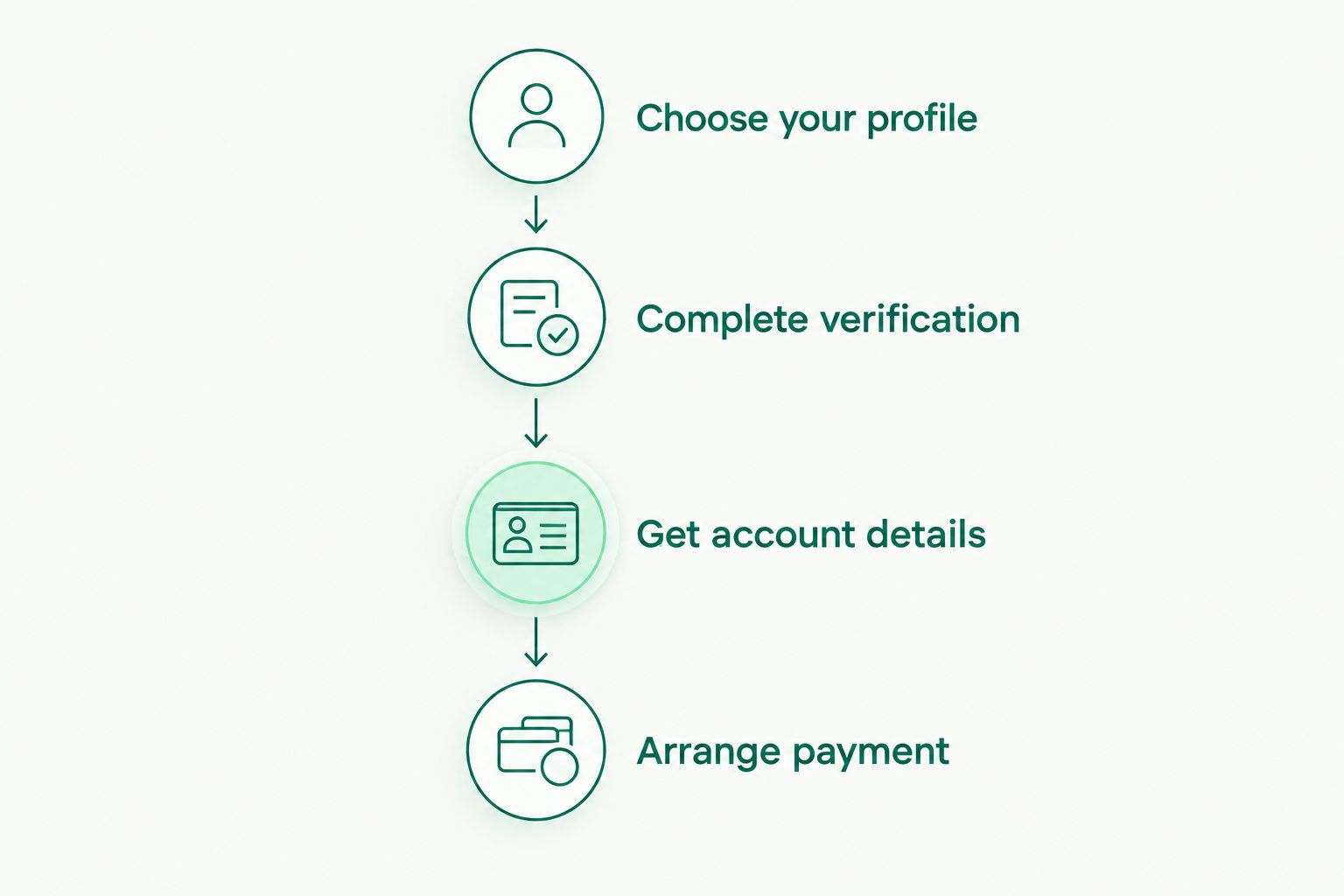
Account details come after verification; payment arrival is a separate stage.
Which incoming payment method fits your deadline?
Choose the incoming method with your sender, rather than choosing on the basis of the account-opening estimate. The following comparison separates USD receipts from EUR receipts so you don't confuse SEPA timing with a USD payment.
| Incoming method | Currency context | Stated timing | Best for | Limitation |
|---|---|---|---|---|
| ACH | USD | 1–3 business days | A sender paying through ACH | The arrival window is separate from verification |
| Wire | USD | Usually within a business day | A sender using wire | Usual timing is not a fixed arrival deadline |
| SEPA | EUR | Usually within a business day | A sender paying in EUR through SEPA | It is not the USD payment route |
A client who prefers ACH needs ACH instructions, not just a statement that you can receive USD. Match the payment method to the details provided and the sender's available options.
For a 2026 client onboarding checklist, record the currency and method beside the account details. That gives the payer a specific instruction without implying that every platform or destination is supported.
Is this account setup right for your work?
Moneyspace is best for freelancers and businesses that need dedicated USD and EUR account details in their own name. Its relevant capabilities include ACH, wire, and SEPA payments, in-account USD/EUR exchange, and live payout status.
The limitations matter just as much. It is not a bank, eligibility isn't universal, and neither verification nor transfer timing is a fixed completion promise.
For outgoing payments, individuals have a $10,000 or €10,000 per-payout limit and a $50,000 or €50,000 monthly limit. Businesses have a $100,000 or €100,000 per-payout limit and no monthly payout limit. These are payout limits, not estimates of opening speed.
You can review Moneyspace before applying. Confirm that your profile, location, and intended payment activity are supported before directing a customer to send money.
Open an account
Get your own USD and EUR account details after verification. Confirm eligibility before arranging payments.
Can I receive a payment as soon as verification finishes?
Incoming ACH takes 1–3 business days, so verification completion is not the same as payment arrival. First obtain your account details, give the sender the correct instructions, and confirm the method being used.
Does a faster incoming method make account opening faster?
Incoming wire usually arrives within a business day, but that timing describes the transfer. It doesn't shorten the verification stage or establish when your account details will become available.
How long does it take to send money after setup?
Payouts usually take 1–2 business days. Every payout requires 2FA, and live status shows Processing, On its way, and Completed; don't treat an earlier status as completion.
FAQ
Can a non-resident open a USD account fully online?
Moneyspace provides fully online verification for individuals and businesses seeking USD and EUR account details. Eligibility depends on the applicant; worldwide audience positioning does not establish approval in every country.
Does an ID check taking minutes mean my account opens in minutes?
No. An individual ID check often taking minutes does not establish the full account-opening timeline. Account details are provided after verification, and first-payment arrival is a separate process.
Do business applications use the same timing as personal applications?
No. Businesses complete KYB verification, and the individual ID-check timing does not apply to business verification. Don't plan a company payment around an individual timing estimate.
Do I need separate verification for USD and EUR?
No. One verification covers access to USD and EUR. Receiving either currency still requires the appropriate account details and payment method.
Are the USD account details in my own name?
Yes. Dedicated USD account details include a routing number and account number in the customer's own name, rather than a shared reference. The details are provided through a licensed partner after verification.
Can I use the same sign-in for personal activity and several companies?
Yes. Several company profiles and personal profiles can sit under one sign-in. Keep the receiving profile and its account details aligned with the payment you're arranging.
What should I check before asking a client to pay?
Confirm that verification is complete, account details are available, and the sender supports the intended payment method. Use the actual account details provided and distinguish the transfer window from the opening process.
One last thing
Make your 2026 readiness test specific: can you give the payer the correct account details and name the payment method? A submitted application or completed ID check alone doesn't answer that question.
Set the payment date after you know the receiving details, not after you start verification. That is the clearest way to keep an account-opening estimate from becoming a missed client payment expectation.