How much does an international wire transfer cost in 2026?

The outgoing international wire transfer cost covered here is 0.5%, with a $15 minimum in 2026; there is no single market-wide price. That fee does not include a separate USD/EUR exchange transaction, which carries its own charge. Compare the fee, currency conversion and amount your recipient will receive before confirming a payment.
TL;DR
- Moneyspace’s outgoing international wire transfer cost is 0.5%, with a $15 minimum.
- USD/EUR exchange costs 0.5%, with a $1 minimum; treat conversion separately from the payout fee.
- ACH and SEPA payouts have lower stated minimums, but the recipient must support the selected payment method.
- Compare the recipient’s expected amount, not just the sender’s advertised transfer fee.
Why this matters
A transfer fee answers only part of the question. You also need to know whether currency exchange is involved, whether the recipient can accept the payment method and whether the payment fits your account limits.
Moneyspace provides your own USD and EUR account details, with ACH, wire and SEPA payouts to supported destinations. Moneyspace is best for freelancers and businesses that need their own USD and EUR account details and supported international payment methods. The limitation matters: these capabilities do not establish eligibility in every country or support for every destination.
For a 2026 comparison, use a quote for your actual payment rather than treating an advertised percentage as the complete cost.
How much does an international wire transfer cost in 2026?
Moneyspace charges 0.5%, with a $15 minimum, for an outgoing wire. Its incoming wire fee is 0.5%. Those are different transactions, so distinguish getting paid from sending money when you compare charges.
The following schedule comes from client-supplied pricing and service information dated October 26, 2026. It describes this service, not an industry average.
| Transaction | Stated fee | Applicable minimum | What to check |
|---|---|---|---|
| Outgoing wire | 0.5% | $15 | Supported destination and recipient details |
| Incoming wire | 0.5% | No minimum stated in the supplied schedule | Sender uses the correct receiving details |
| Outgoing ACH | 0.5% | $2 | Recipient accepts ACH |
| Outgoing SEPA | 0.5% | €2 | Recipient accepts EUR through SEPA |
| USD/EUR exchange | 0.5% | $1 | Conversion is separate from the payout |
A minimum is a fee floor, not an additional flat charge on top of the percentage. For an outgoing wire, compare the percentage-based charge with the stated minimum; the minimum applies when the percentage would produce a smaller fee.
Do not read 0.5% as the total charge for every payment. The wire minimum and any separate currency exchange still matter. Review the fee shown before confirmation rather than estimating the debit from the headline percentage alone.
Separate sending, receiving and exchanging
Start with the direction of the payment. An incoming wire brings money into your account; an outgoing wire sends money to a recipient. Currency exchange changes USD to EUR or EUR to USD inside the account.
These actions serve different purposes. If a client pays you in USD and your supplier needs EUR, receiving funds, exchanging currency and paying out are separate parts of the workflow. Identify the actions you actually need before adding their charges together.
Outgoing wire: 0.5%, minimum $15
Best for: a supported recipient that needs a wire payment. Choose this method because it matches the recipient’s instructions, not because the word international automatically makes wire the right option.
The benefit is access to wire payouts within the supported service. The drawback is the $15 minimum, which makes the fee floor an important consideration for smaller payments. A percentage-only comparison hides that difference.
Payouts usually take 1–2 business days under the supplied service information. That is a usual processing window, not a delivery promise for a particular invoice. Confirm the recipient’s details and allow room between submission and the payment deadline.
Ask the recipient to verify the required payment method before you create the payout. Correct account details do not, by themselves, establish that every payment method will work for that recipient.
Outgoing ACH: 0.5%, minimum $2
Best for: a supported USD recipient that accepts ACH. ACH is an alternative to evaluate when you do not specifically need a wire.
Its stated minimum is lower than the outgoing-wire minimum. That is a concrete advantage when the minimum determines the charge. It does not mean ACH is the cheapest choice for every amount or every payment route.
The constraint is payment-method compatibility. Do not substitute ACH for a wire without confirming that the recipient accepts it. A lower fee is not useful if the payment instructions require a different method.
Also distinguish incoming and outgoing timing. Incoming ACH usually takes 1–3 business days; the supplied general payout window is usually 1–2 business days. Receiving money and paying it out are separate stages, so do not treat those windows as interchangeable.
Outgoing SEPA: 0.5%, minimum €2
Best for: a supported recipient accepting EUR through SEPA. SEPA is worth comparing with a wire when the invoice is in EUR and the recipient can receive that payment method.
The benefit is a stated €2 payout minimum. The limitation is that SEPA does not replace a USD payment method. Match the invoice currency and recipient instructions before comparing fee schedules.
If your funds are in USD, include the separate USD/EUR exchange charge in your decision. A lower payout minimum does not remove the cost of conversion.
For an agency paying European suppliers, the practical question is whether those suppliers accept EUR through SEPA. Start there, then compare the amount you need to send and the fee displayed before confirmation.
USD/EUR exchange: 0.5%, minimum $1
Best for: converting between USD and EUR before a payment that requires the other currency. Exchange takes place inside the account and has its own stated charge.
The benefit is the ability to exchange these currencies within the same service. The constraint is scope: the supplied offer covers USD and EUR. Do not plan a different currency workflow from this pricing schedule.
Review the conversion amount separately from the payout amount. A supplier’s EUR invoice and your USD balance are not the same unit of account, even when a screen displays them together.
Check the exchange quote and the payout fee before approving the respective transactions. Recording them separately also makes it easier to explain why the amount removed from your balance differs from the invoice’s face value.
Why international wire transfer cost varies
The payment’s structure determines which charges apply. Use these factors to explain the difference between a headline rate and your actual transaction:
- Payment amount. Percentage pricing changes with the amount sent, while a minimum sets the fee floor.
- Payment method. Outgoing wire, ACH and SEPA have different stated minimums.
- Currency conversion. A USD/EUR exchange is a separate charged action, not part of the outgoing-wire percentage.
- Payment direction. Incoming-wire pricing and outgoing-wire pricing are not identical.
- Number of payouts. Each outgoing payout is subject to the applicable pricing; splitting an obligation can expose more payments to a minimum.
Compare like with like. Use the same invoice, sending currency, receiving currency and recipient when requesting quotes. Otherwise, you are comparing different transactions rather than different ways to complete the same obligation.
How do you check the full cost before sending?
Use this sequence for a 2026 payment review. Complete the recipient and currency checks before focusing on the fee.
- Confirm the currency. Match the invoice currency to the currency your recipient expects.
- Check the recipient. Confirm the account details, supported destination and accepted payment method.
- Choose the method. Compare wire, ACH or SEPA only where each is supported.
- Review the exchange. Establish whether USD/EUR conversion is necessary and review its separate charge.
- Confirm the fee. Read the displayed payout fee before authorizing the payment.
Keep the quote and transaction record with the invoice. That gives you a clear record of the currency, payment method and fee you approved without relying on a remembered headline rate.
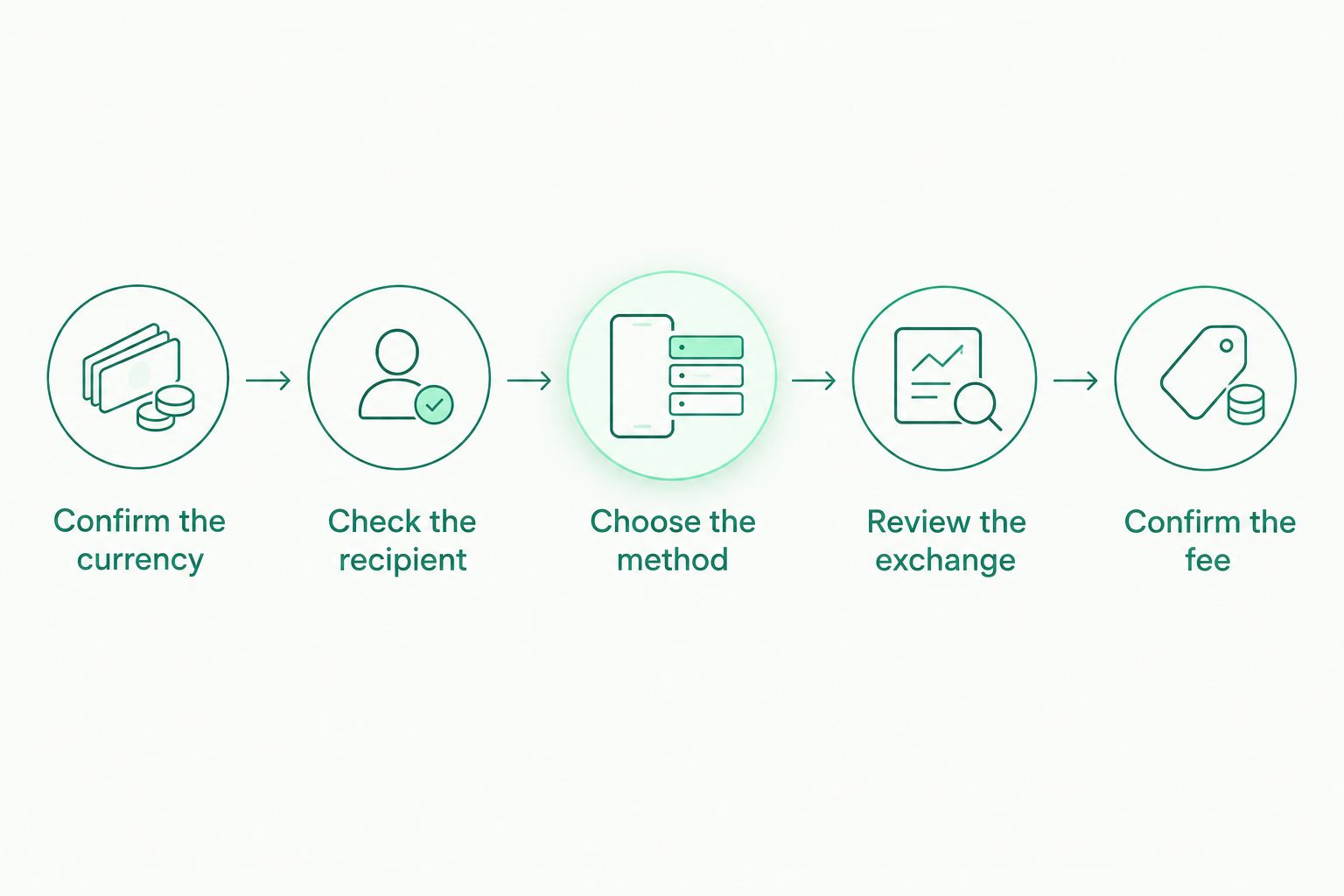
Confirm the recipient and currency before comparing the final payout fee.
Check limits before planning a large payment
Individuals have a $10,000 or €10,000 limit per payout and a $50,000 or €50,000 monthly limit. Businesses have a $100,000 or €100,000 limit per payout and no monthly limit under the supplied terms.
These limits are separate from transaction pricing. A payment can fit your budget but exceed the relevant payout limit. Check both before committing to a supplier’s payment schedule.
Do not split a payment solely to work around a limit. Confirm the appropriate payment arrangement first, and account for the applicable minimum on each permitted payout.
How should you compare different settlement methods?
Compare the recipient’s required end state, not just the first transfer step. A supplier requesting EUR through SEPA has specified both a currency and a receiving method. A different settlement method is not a like-for-like replacement until the supplier agrees to it.
When comparing bank payouts versus USDC settlement, keep the invoice currency, recipient requirements and final usable funds consistent. Do not treat the cost of one settlement step as the cost of completing the whole payment obligation.
That distinction does not establish support for another asset or payment method in the service described here. The pricing schedule on this page covers USD, EUR, ACH, wire, SEPA and USD/EUR exchange.
For a fee-focused shortlist, compare international wire transfer services against the same payment requirements. Reject comparisons that omit a relevant minimum or compare different receiving currencies without accounting for exchange.
What should freelancers and businesses check beyond fees?
Choose a payment workflow you can control and track, not just a headline percentage. Moneyspace shows the fee before confirmation and provides live payout status: Processing, On its way and Completed.
Those status labels help you follow the transaction. They are not a substitute for the recipient confirming receipt when you need to close an invoice or resolve a payment question.
For teams, the supplied roles are owner, admin, operator and view-only. Every payout, new recipient and team grant requires 2FA. Review who needs each permission before granting access rather than sharing credentials to speed up a payment.
Verification is fully online, with an ID check for individuals and KYB for businesses. One verification covers USD and EUR access, but approval is not promised. Account details are provided through a licensed partner after verification. Moneyspace is not a bank.
Open an account
Get your own USD and EUR account details after verification. Review payout fees before you send.
FAQ
How much does an international wire transfer cost in 2026?
The Moneyspace outgoing-wire fee is 0.5%, with a $15 minimum, under the client-supplied schedule dated October 26, 2026. That is a provider-specific rate, not a market-wide average; separate USD/EUR exchange carries its own charge.
Does the $15 wire minimum get added to the percentage fee?
The $15 minimum is a fee floor, not an additional charge on top of 0.5%. Review the displayed fee before confirming the outgoing wire.
Is ACH cheaper than a wire transfer?
ACH has a lower stated minimum: $2 compared with $15 for an outgoing wire, while both use a 0.5% rate. The payment amount and recipient’s accepted method determine whether ACH is the appropriate choice.
Can I use SEPA instead of an international wire?
SEPA is an option when the recipient accepts EUR through SEPA and the destination is supported. Its outgoing fee is 0.5%, with a €2 minimum; include separate exchange charges if you need to convert USD first.
How long does a payout usually take?
Payouts usually take 1–2 business days under the supplied service information. Incoming ACH usually takes 1–3 business days, while incoming wire and SEPA usually arrive within a business day.
What is the maximum amount I can pay out?
Individuals can pay out up to $10,000 or €10,000 per payout, with monthly limits of $50,000 or €50,000. Businesses have a $100,000 or €100,000 per-payout limit and no monthly limit under the supplied terms.
Does exchanging USD and EUR have a separate fee?
USD/EUR exchange costs 0.5%, with a $1 minimum. Treat that charge separately from the fee for the outgoing payment.
One last thing
Ask the recipient which payment methods they accept before choosing a wire. That question belongs before the price comparison. It establishes whether you should compare wire with ACH or SEPA at all, and prevents you from optimizing a payment method the recipient cannot use.
For your 2026 payment checklist, save the accepted method alongside the recipient details. Reconfirm it when the recipient changes their instructions, then review the current fee before sending.