How much does it cost to convert crypto to USD in 2026?

The cost to convert crypto to USD depends on the execution price, trading charges, network charges, and the cost of withdrawing and receiving the dollars. A conversion quote can exclude the withdrawal or receiving-account charge, so compare the final USD you can use—not just the advertised trading fee. For a useful comparison in 2026, price the entire route from your current holdings to your intended USD destination.
TL;DR
- Compare the cost to convert crypto to USD using net dollars received, not the advertised trading fee.
- A spread, network charge, withdrawal charge, and receiving fee can affect the final USD amount.
- Moneyspace provides dedicated USD account details; confirm transfer acceptance before choosing a crypto off-ramp.
- Compare quotes for the same asset, amount, network, and destination before confirming.
How much does it cost to convert crypto to USD in 2026?
There isn't a single conversion cost that applies across assets, platforms, networks, and withdrawal methods. Your usable USD proceeds are the amount left after every applicable charge along the route. A trading fee alone doesn't answer the question.
Separate the transaction into the following stages. If you need help understanding the sale-to-withdrawal sequence, start with the stablecoin-to-USD conversion guide.
| Cost component | What to check | How to compare it |
|---|---|---|
| Network transfer | Whether moving the asset to the selling platform incurs a charge | Include the charge for the selected asset and network |
| Trade execution | The USD price offered for your exact quantity | Compare executable quotes, not a headline market price |
| Trading charge | Whether the platform charges separately for the sale | Check whether the preview includes or adds it |
| USD withdrawal | The charge for the selected withdrawal method | Compare the same destination and method |
| USD receipt | Whether the receiving provider charges for incoming funds | Read the receiving provider's applicable terms |
| Further payment | Any subsequent transfer needed to reach your actual destination | Include it when the withdrawal isn't the final step |
A platform can include its compensation in the quoted conversion rate rather than show a separate trading charge. Don't add a spread twice if your calculation already starts with the executable USD proceeds.
Why this matters
You aren't finished when an app displays a USD balance. You need to know whether you can withdraw that balance, where it can go, and what remains after the withdrawal.
This distinction matters when you're paying an invoice or moving business receipts into an operating account. A favorable conversion quote doesn't solve an unsupported destination or an incomplete verification requirement. Check the receiving route before selling the asset.
For 2026 comparisons, use current transaction previews and current account terms. An old screenshot or a published headline rate doesn't establish what your transaction will cost today.
Compare conversion routes by the dollars you can use
Different routes change which steps you must complete. They don't establish a universal cheapest option. Choose the route that supports your asset, location, verification status, and destination, then compare its complete quote.
| Route | Best for | Advantage | Limitation |
|---|---|---|---|
| Sell where the asset already sits, then withdraw USD | Avoiding an additional asset transfer | Removes the need to move the asset elsewhere before selling | The platform must support a suitable USD withdrawal route |
| Transfer to another platform, sell, then withdraw USD | Accessing a supported sale and withdrawal combination | Lets you evaluate a different execution and withdrawal offer | Adds a transfer step and its applicable charges |
| Use an integrated conversion-and-payout service | Reviewing conversion and payout together | Can present the route in a single workflow | You still need to check what the quote includes and whether the recipient qualifies |
Best for fewer steps: assess the platform already holding your asset first. That isn't a cheapest-provider verdict. Keep that route only if its net proceeds, withdrawal terms, and destination support meet your needs.
Best for comparing alternatives: request a complete quote from another supported route before transferring. A lower trading charge isn't enough if the extra transfer and withdrawal costs erase the difference.
Why the cost to convert crypto to USD varies
The cost changes because the transaction contains separate services. Compare these factors rather than treating the advertised conversion charge as the complete bill:
- Asset and network. Check the exact asset and supported network at both ends. A matching asset name doesn't establish network compatibility.
- Transaction size. Fixed charges and percentage-based charges affect transactions differently. Compare the amount you actually intend to convert.
- Execution price. Use the price available for your full quantity. A displayed market price isn't necessarily an executable quote.
- Order method. An order's execution conditions affect when and how it trades. Read those conditions before choosing speed over price control.
- Withdrawal and receipt. The sending platform and receiving provider have separate terms. Confirm both sides of the USD transfer.
- Additional steps. Moving between platforms or sending USD onward creates more items to check. Include every required step in the comparison.
Don't assume a stablecoin removes these costs. Selling or redeeming it, transferring it, and withdrawing USD remain distinct actions with their own terms.
Calculate your total before you confirm
Use a consistent comparison method in 2026. Keep the starting asset, quantity, and destination the same across every route you evaluate.
Check eligibility
Confirm that the conversion provider serves your location and account type. Check whether the intended USD recipient accepts transfers from that provider. Complete any required verification before relying on the route for a deadline.
Preview conversion
Enter the actual quantity you plan to sell. Record the USD proceeds shown in the executable preview and whether the trading charge is already deducted. Note when the quote expires or refreshes.
Preview withdrawal
Select the intended USD destination and withdrawal method. Read the charge, any applicable minimum, and the stated processing conditions. Don't substitute a different withdrawal method just to make the comparison look cheaper.
Check receipt
Review the receiving provider's incoming-transfer terms. Confirm that the sender name, beneficiary details, payment method, and source of funds meet its requirements. Obtain confirmation when the published terms don't resolve your situation.
Compare net proceeds
Subtract charges that aren't already included in the conversion preview. Include the cost of moving the asset before the sale and any required onward USD payment. Keep separately paid network charges visible in your calculation.
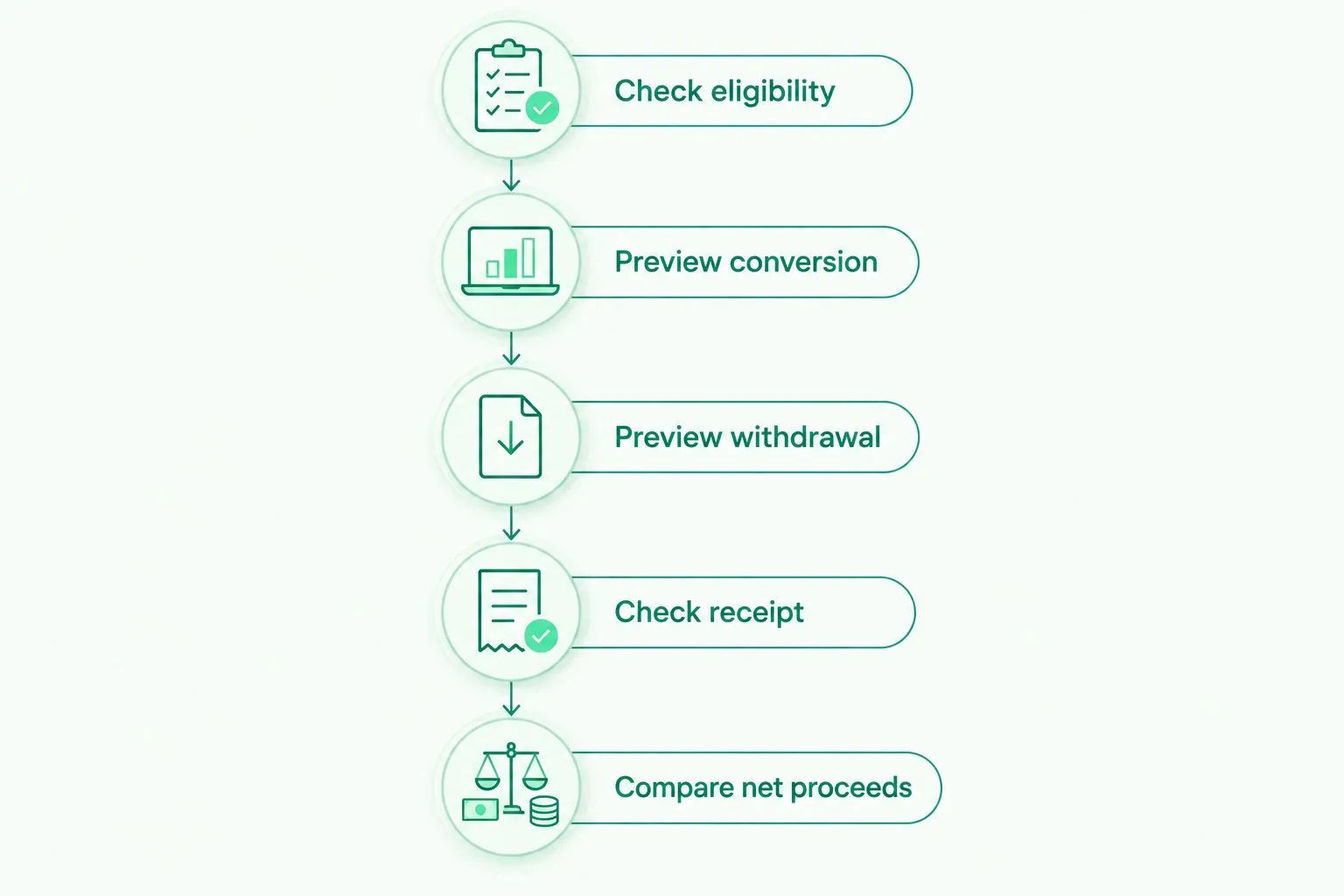
Compare the complete route before moving assets or confirming a sale.
Save the quote details with the transaction record. Separate the sale confirmation from the withdrawal confirmation so you can explain the difference between the quoted proceeds and the amount received.
Is a zero trading fee the same as a free conversion?
No. A zero trading fee doesn't establish a zero total cost. The executable price, asset-transfer charge, USD withdrawal charge, and receiving charge still need checking.
Compare the final USD proceeds against another executable offer for the same quantity. Don't compare one provider's all-in quote with another provider's trading charge alone.
Is ACH or wire better for withdrawing USD?
ACH or wire is better only when its complete terms fit your destination and deadline. Check support, charges, recipient requirements, and processing conditions for the specific route rather than assuming either method always wins.
Keep the conversion timeline separate from the USD transfer timeline. A completed sale doesn't mean the dollars have reached the receiving account.
Does converting a stablecoin remove the spread?
Converting a stablecoin doesn't establish that you will receive its reference value without deductions. Check the actual conversion or redemption terms and the executable USD amount.
A reference value isn't a promise about your net withdrawal. Network movement, withdrawal, and receipt remain separate checks even when the conversion preview shows no separate trading charge.
Where Moneyspace fits after conversion
Moneyspace is best suited to freelancers and businesses seeking dedicated USD and EUR account details in their own name. Its documented payment features cover receiving and paying out through supported ACH, wire, and SEPA routes. Those features don't establish acceptance of a particular crypto platform's withdrawal.
Before using Moneyspace as a USD destination, confirm that the originating platform and the receiving service support your exact transfer. Don't send a crypto asset to USD routing and account details. Those details are for the supported USD payment method, not a blockchain transfer.
The following Moneyspace facts were supplied by the client on October 26, 2026. They describe its account services, not a crypto-to-USD conversion quote:
- Incoming ACH: usually 1–3 business days.
- Incoming wire: usually within a business day.
- Payouts: usually 1–2 business days.
- Individual payout limits: $10,000 or €10,000 per payout, with monthly limits of $50,000 or €50,000.
- Business payout limits: $100,000 or €100,000 per payout, with no monthly limit.
These are usual processing times, not delivery promises. Check the fee shown before confirming a payout, and review the receiving terms separately before arranging an incoming transfer.
The practical benefit is dedicated account details and visibility into supported payments. The limitation for this decision is equally important: account features alone don't confirm a crypto off-ramp connection. Moneyspace is not a bank; account details are provided through a licensed partner after verification.
Keep conversion, transfer, and accounting records separate
A clean record helps you identify where a deduction occurred. Keep the asset-transfer confirmation, sale execution, withdrawal confirmation, and receiving transaction together, but don't treat them as the same event.
For a business, match the transaction to the relevant invoice or payment obligation. Record separately paid charges rather than recording only the final receipt. Otherwise, you lose the information needed to compare the route next time.
Converting an asset can also have tax consequences depending on your jurisdiction and circumstances. A transaction charge and a tax obligation are different things. Use jurisdiction-specific guidance for the tax treatment rather than treating an off-ramp quote as a tax calculation.
FAQ
What's the total cost to convert crypto to USD?
The total cost includes applicable conversion, network, withdrawal, and receiving charges. Compare the executable USD proceeds and subtract only charges that aren't already included.
Is converting crypto to USD free if the trading fee is zero?
A zero trading fee doesn't establish a free conversion. Check the quoted execution price and any network, withdrawal, or receiving charges.
What's the cheapest way to convert crypto to USD in 2026?
The cheapest route is the supported route that leaves you with the most usable USD after all applicable charges. Compare the same asset quantity, destination, and withdrawal method using current quotes.
Should I transfer crypto to another platform before selling?
Transfer to another platform only after confirming that its complete route meets your requirements. Include the extra asset-transfer charge and verify asset and network compatibility before sending.
Can I receive a crypto-platform USD withdrawal through Moneyspace?
Confirm the specific originating platform and transfer route with both providers before sending. Dedicated USD account details don't establish acceptance of every platform or source of funds.
How long does receiving USD take after I sell crypto?
Receiving time depends on the conversion platform's release conditions and the selected USD transfer route. A completed sale and a completed withdrawal are separate events.
Does converting crypto to USD create a tax obligation?
Tax treatment depends on your jurisdiction and circumstances. Keep the sale, transfer, and fee records, and use applicable local tax guidance rather than the conversion quote to determine your obligations.
One last thing
Price the route before moving the asset—not after. Transferring first commits you to an additional step before you've established whether the final USD withdrawal works for you.
For your next 2026 comparison, keep the starting quantity and final destination identical. Compare executable net proceeds, verify receipt requirements, and save the quote. That gives you a decision you can explain without relying on a headline fee.