How to receive wire transfers from abroad
To receive wire transfers from abroad, confirm that your account accepts the sender’s payment route and currency, then share the exact receiving instructions supplied by your provider. The sender’s country alone doesn’t determine the transfer method; a payment sent from abroad still needs to reach your account through a supported route.
TL;DR
- Learning how to receive wire transfers from abroad starts with matching the currency, receiving details and supported payment route.
- Moneyspace suits freelancers and businesses receiving USD and EUR through supported ACH, wire and SEPA routes.
- Confirm routing instructions before sending an invoice; account details alone don’t establish support for every international route.
- Keep the payment confirmation and reconcile the amount received against the invoice.
Why this matters: A client can enter your name and account number correctly but still select a payment method your account doesn’t accept. For your 2026 payment instructions, specify the currency and route together instead of asking clients to send an international transfer without further direction.
If you’re choosing receiving details before sending your first invoice, start with the practical differences covered in this guide to receiving USD payments without a US account.
How to receive wire transfers from abroad
Confirm the receiving route before sharing payment details. Follow these steps for each new payer, account or currency, rather than assuming instructions from an earlier payment still apply.
1. Confirm the payment route
Ask your provider whether the account accepts the specific wire route the sender intends to use. Ask the sender which payment method their provider will use to deliver the funds.
Don’t treat the word international as a complete instruction. A client based outside the US might arrange a USD payment through a service that delivers it using a domestic payment route. What matters is the route used to reach your receiving details.
Get this settled before the client schedules payment. If the sender’s provider requests information absent from your receiving instructions, stop and check rather than substituting details from another account.
2. Match the currency
Tell the sender which currency your receiving details support. Use the appropriate instructions for USD or EUR rather than assuming one set of details accepts both.
Separate the invoice currency from any conversion the sender arranges. If you invoice in USD, state that you expect to receive USD and ask the sender to confirm the currency that will actually reach your account.
This gives you a clear reconciliation target. It also keeps an exchange decision from becoming an unexplained difference between the invoice and the payment received.
3. Copy the receiving instructions
Copy your beneficiary name and receiving details directly from your provider. Include the institution information, address or payment reference only as instructed for that route.
For USD payments, the instructions can include a routing number and account number. For EUR payments, they can include an IBAN and BIC. Use the details assigned to the selected payment method, not a generic account-information summary.
Don’t shorten a business name to a trading nickname unless your provider explicitly permits it. If you receive payment for a company, check that the beneficiary information corresponds to that company rather than your personal profile.
4. Send clear instructions
Give the payer a short instruction sheet that separates the beneficiary name, currency, payment method and receiving details. Label each field so the payer doesn’t have to interpret an unlabeled string of numbers.
Add the invoice number or agreed payment reference where the provider supports it. State which reference identifies the invoice and which information belongs in the beneficiary fields; they serve different purposes.
Ask the payer to confirm unexpected changes through an established contact channel. Treat a request to replace receiving details as a change that needs verification, not routine invoice administration.
5. Check the payment confirmation
Once the payer submits the transfer, request the payment confirmation or transaction reference. Check the beneficiary, currency, amount and date against your instructions.
A confirmation helps you investigate a payment that hasn’t arrived. It doesn’t replace confirmation in your receiving account, and a screenshot alone isn’t a reason to mark an invoice as paid.
If you identify an error, ask the sender to contact their provider promptly. Don’t tell the sender to make a second payment until you understand the status of the first one.
6. Reconcile the receipt
Match the incoming transaction to the invoice after the funds appear in your account. Record the currency, amount received, payment reference and any documented deductions separately.
Keep the original invoice, receiving instructions and sender’s confirmation together. That record gives you a starting point if the amount differs or the payer later asks for proof of receipt.
For repeat clients, retain a verified instruction template. Review the details before reusing it, especially after changing providers, company profiles or the currency you invoice in.
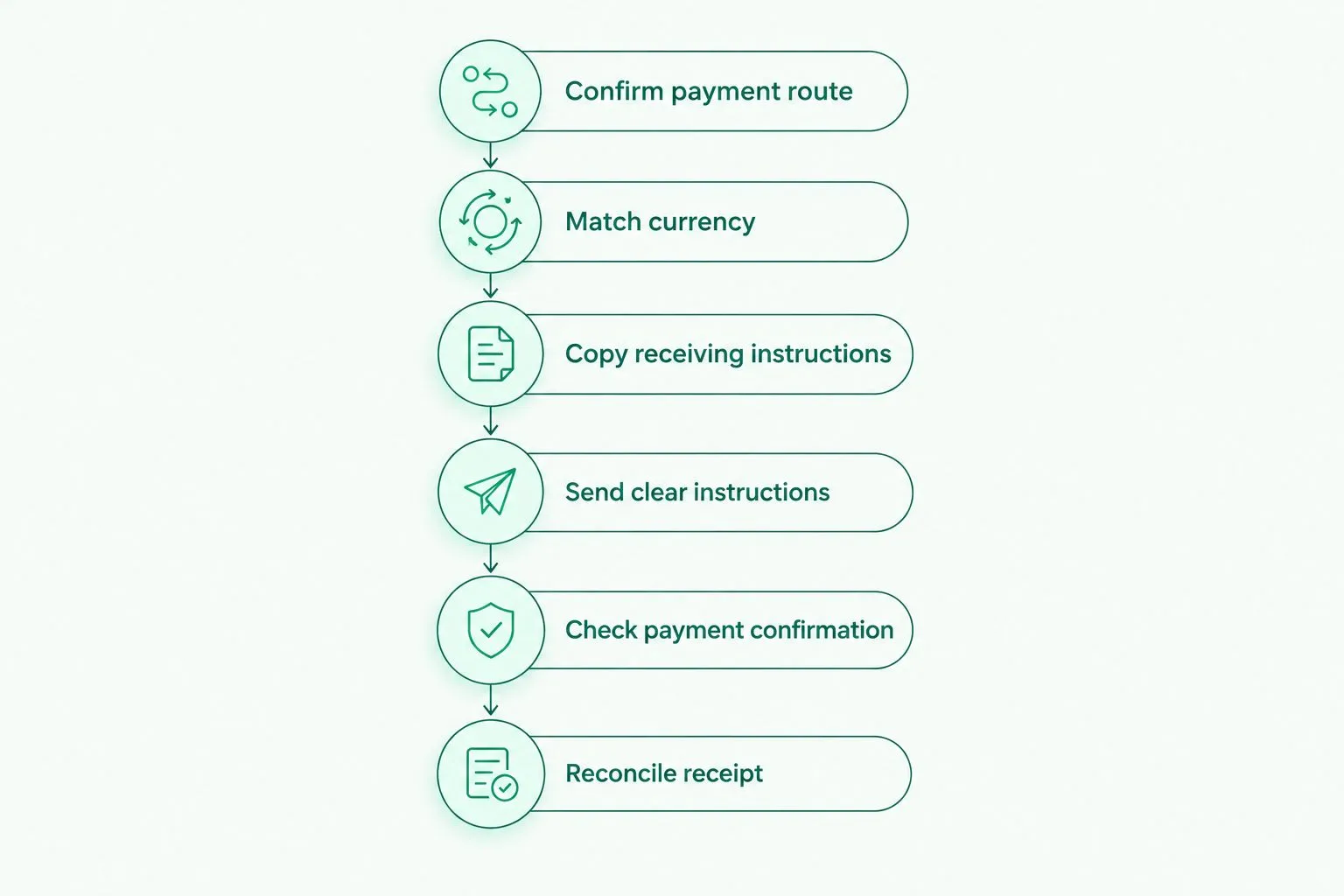
Confirm the payment route before sending receiving details to a client.
Wire, ACH or SEPA: which instructions should you send?
Send the instructions for the payment method the payer will actually use. Wire, ACH and SEPA aren’t interchangeable labels, even when they lead to the same currency balance.
The table below helps you choose what to discuss with the payer. It doesn’t establish eligibility for a particular account or destination; confirm those details with the receiving provider.
| Payment method | Best for | What to confirm | Main limitation |
|---|---|---|---|
| USD wire | A payer instructed to send USD by wire | The receiving account accepts the sender’s intended wire route | Wire support doesn’t establish support for every international route |
| USD ACH | A payer able to deliver USD through ACH | The sender can originate an ACH payment to your assigned details | An ACH payment isn’t a wire transfer |
| EUR SEPA | A payer sending EUR through SEPA | Both the sending arrangement and receiving details support SEPA | SEPA instructions don’t establish acceptance of other routes or currencies |
Don’t recommend a method solely because the payer is in a particular country. Ask what the sender’s provider can deliver and compare that answer with your receiving instructions.
For your 2026 invoice template, keep separate USD and EUR instruction sections. Include only the methods you’ve confirmed, and remove alternatives that don’t apply to the payment.
Why receiving requirements and arrival times vary
The practical differences come from the account, currency and payment route. Check these factors before agreeing on a payment deadline:
- Payment method: Wire, ACH and SEPA have distinct instructions. Confirm the method before comparing arrival expectations.
- Currency: Receiving USD and receiving EUR require the appropriate details. Discuss conversion separately from delivery.
- Receiving setup: Some arrangements assign details in your own name; others use shared details with a reference. Follow the provider’s instructions for your setup.
- Verification: Individual identity checks and business verification are different processes. Don’t schedule a payment on the assumption that approval will occur by a particular time.
- Account profile: Personal and business profiles have different purposes. Use the profile and beneficiary details that correspond to the payment.
- Supported route and destination: A provider’s international audience doesn’t establish unrestricted coverage. Confirm the actual route rather than relying on a general worldwide description.
Set expectations using the confirmed method, not the phrase international transfer. Ask the sender for their provider’s expected arrival information when arranging payment, then retain the confirmation if you need to investigate.
Receiving USD and EUR with Moneyspace
Moneyspace is best for freelancers and businesses that need their own USD and EUR account details for supported international payments. The account details are in the customer’s own name, rather than shared details identified only by a reference.
The service supports receiving payments by ACH, wire and SEPA. USD details include a routing number and account number; EUR details include an IBAN and BIC. Confirm the specific incoming route before instructing a client to send a wire from abroad.
According to client-supplied information dated October 26, 2026, incoming wire and SEPA payments usually arrive within a business day. Incoming ACH payments take 1–3 business days. These are usual arrival expectations, not promises for an individual payment.
The practical advantage is receiving supported USD and EUR payments using details in your own name. The limitation is scope: those details don’t establish acceptance of every currency, originating route or destination.
Verification takes place online, with identity checks for individuals and business verification for companies. One verification process opens access to USD and EUR, subject to approval. Don’t send receiving instructions until the relevant details are available in your account.
If you later pay suppliers or team members, supported payouts usually take 1–2 business days. That outgoing timing is separate from the incoming wire timing; don’t use one to promise the other.
Review Moneyspace for the account offering and confirm that your intended receiving arrangement is supported. Moneyspace is not a bank; account details are provided through a licensed partner after verification.
Open an account
Get your own USD and EUR account details after verification, subject to approval.
What should I do if a wire hasn’t arrived?
Ask the sender for the transfer confirmation and check it against your receiving instructions. Verify the payment method first, then the beneficiary name, receiving details, currency and reference.
If the information matches, contact your receiving provider with the transaction reference and payment confirmation. The sender should also ask their provider to investigate the transfer’s status.
Avoid diagnosing the problem from elapsed time alone. A payment sent using unsupported instructions needs a different investigation from a correctly addressed payment that remains in progress.
Can I receive a wire from a client in another country?
Yes, if your receiving provider supports the route and currency the sender uses. The client’s location alone doesn’t establish whether the payment will reach your account.
Ask the client to identify the delivery method their provider will use. Then compare it with the receiving instructions assigned to you before adding those details to the invoice.
For a new client relationship in 2026, settle this during payment setup rather than after the invoice falls due. Keep the confirmed instructions with the client’s billing record so the next payment follows the same agreed route.
What details should I put on an international invoice?
Include the beneficiary name, payment currency, supported method and receiving details supplied by your provider. Add the invoice reference where instructed, and keep payment instructions separate from your business contact information.
Don’t add extra routing fields just because another client’s payment form included them. If a payer requests something you haven’t been given, ask your provider what belongs in that field.
FAQ
How do I receive wire transfers from abroad?
Confirm that your account supports the sender’s payment route and currency, then share your provider’s exact receiving instructions. Ask for the payment confirmation and reconcile the receipt against your invoice.
Can a client abroad pay me by ACH instead of wire?
Yes, if the client’s sending arrangement can deliver an ACH payment and your receiving account accepts it. The client’s country alone doesn’t establish which payment methods are available.
How long does an incoming wire take with Moneyspace?
Incoming wire payments usually arrive within a business day, according to client-supplied information dated October 26, 2026. Confirm the supported route before asking a sender abroad to use wire instructions.
Are ACH and wire receiving details interchangeable?
Don’t assume ACH and wire receiving details are interchangeable. Use the instructions your provider assigns to the selected payment method, even when both methods support USD.
Can I use EUR receiving details for a USD payment?
Use receiving details assigned to the payment’s currency and method. Don’t assume EUR instructions accept USD or arrange conversion unless your provider explicitly supports that setup.
Does a payment confirmation mean I’ve received the money?
No, a sender’s payment confirmation doesn’t establish receipt in your account. Check the incoming transaction before marking the invoice as paid.
What should I send support if my payment is missing?
Send the payment confirmation, transaction reference, currency, amount and the receiving instructions used. Ask the sender to contact their provider as well, so both sides can investigate the same transaction.
One last thing
The most useful question isn’t where the sender lives; it’s how the payment will reach your account. Ask that question before sharing details, and you’ll have the information needed to choose the correct instructions.
Before your next invoice in 2026, replace vague wording such as international payment with the confirmed currency and method. Keep a copy of those instructions with the invoice so you can compare them with the sender’s confirmation later.