How to send money internationally without high fees

To send money internationally without high fees in 2026, compare the total amount your recipient gets, choose a supported payment method, and avoid currency conversion you don't need. Check transaction minimums, the exchange quote, and any separate receiving charges before confirming; the advertised transfer fee doesn't describe the whole payment.
TL;DR
- To send money internationally without high fees, compare recipient amounts, transaction minimums, and currency conversion together.
- Moneyspace suits freelancers and businesses that need their own USD and EUR account details and supported international payouts.
- Compare ACH, wire, and SEPA by destination, currency, timing, and the final confirmation—not the payment method alone.
- Keep necessary currency conversion separate from the decision about how to send your payment.
How do you send money internationally without high fees?
Compare the complete payment route before choosing a provider or payment method. Start with the currency you hold and finish with the currency your recipient needs. Then check every step between them.
For a closer look at currency handling, read whether a multi-currency account is worth it for freelancers. Holding USD or EUR and sending it are separate decisions; evaluate both against your actual invoices.
- Confirm the destination. Check that the service supports the recipient's country and receiving details. A worldwide audience doesn't establish universal eligibility or destination coverage.
- Confirm the currency. Ask what currency the recipient needs to receive. Don't assume the invoice currency and the receiving currency match.
- Choose the method. Compare the supported ACH, wire, or SEPA route for that specific payment. A method that works for one recipient isn't automatically suitable for another.
- Review the quote. Check the transaction fee, applicable minimum, conversion details, and recipient amount. Ask about separate receiving charges where relevant.
- Confirm and track. Verify the recipient details before sending. Follow the payout status rather than treating submission as proof that the recipient has been paid.
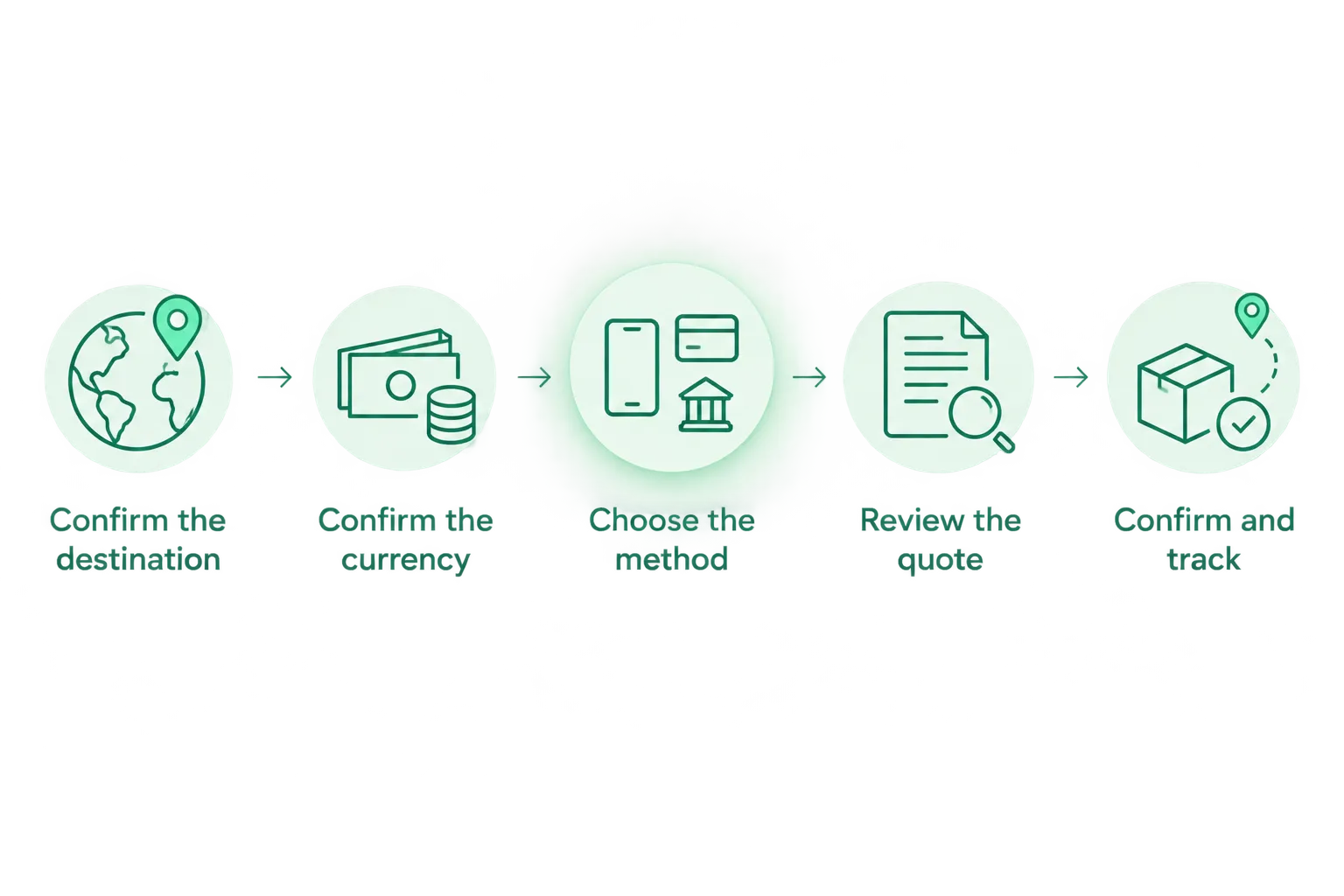
Check the full route before confirming the payment.
Why this matters
An international payment can involve more than a transfer instruction. You might receive USD, exchange it into EUR, and then pay a supplier. Each action needs its own review, even when you manage everything through one account.
The practical comparison is therefore not simply which provider advertises the lowest percentage. It's whether the complete route meets your recipient's requirements without adding unnecessary steps. A cheaper-looking sending option is irrelevant if it doesn't support the destination or leaves the invoice short.
For your 2026 payment process, record the amount sent, currency exchanged, quoted recipient amount, and payment status. Keep these details alongside the invoice. That gives you a consistent basis for comparing future payments without relying on a headline offer.
ACH: Best for supported USD payments using ACH details
ACH is a payment method to consider when your recipient accepts USD through ACH and the provider supports the destination. Confirm the receiving instructions first. Don't substitute wire instructions without checking that they also work for ACH.
The advantage is matching the payment to the recipient's accepted USD method. The limitation is that ACH isn't a universal international route, and its name alone tells you nothing about a particular provider's total charges or destination coverage.
If you're receiving client payments as well as sending them, distinguish incoming timing from payout timing. An incoming ACH estimate doesn't automatically describe how long an outgoing payment takes. Review the estimate attached to your actual transaction.
Wire: Best for supported recipients requesting wire instructions
Wire is relevant when your recipient supplies wire instructions and your provider supports that route. Check the currency and destination before comparing the quote with another method. Different instructions can represent different payment requirements, not interchangeable options.
The advantage is compatibility with recipients that specifically request a wire. The limitation is that you still need to examine the applicable transaction minimum and any separate charges. Don't select wire solely because the payment crosses a border.
Ask the recipient whether another supported method is acceptable. If the answer is yes, compare both routes using the same sending amount and currency. If the answer is no, compare supported wire quotes rather than pricing a method the recipient can't use.
SEPA: Best for supported EUR payments using SEPA details
SEPA is relevant when you need to send EUR to a recipient whose details support SEPA payments. Confirm the receiving instructions and provider coverage. A EUR invoice by itself doesn't establish that every proposed destination supports the route.
The advantage is matching a EUR payment to a recipient that accepts SEPA. The limitation is that it doesn't solve a USD payment requirement or eliminate conversion when your available funds are in USD.
Before exchanging currency, confirm how much EUR the recipient needs. Then review the conversion and payout as distinct actions. That keeps the exchange decision visible instead of treating it as an incidental part of sending.
Compare the payment methods before choosing
| Payment method | Best for | Practical advantage | Limitation to check |
|---|---|---|---|
| ACH | Supported USD recipients accepting ACH | Matches ACH receiving instructions | Destination support, transaction minimum, and timing |
| Wire | Supported recipients requesting wire | Matches a specific receiving requirement | Applicable minimum and separate receiving charges |
| SEPA | Supported EUR recipients accepting SEPA | Matches EUR SEPA receiving instructions | Destination support and any required USD/EUR exchange |
This table is a routing checklist, not a cheapest-provider ranking. Choose only among methods that can complete your actual payment. Compare the final quotes after confirming that basic requirement.
Why international payment costs vary
The same provider can produce different payment totals because the underlying transaction changes. For a useful 2026 comparison, keep the destination, sending amount, and receiving currency consistent across quotes.
- Payment method. ACH, wire, and SEPA can have different fee conditions. Check the conditions for the route you're actually using.
- Transaction minimum. A stated percentage doesn't remove an applicable minimum. Review the amount shown before confirming, especially when comparing different payment sizes.
- Currency conversion. Sending USD and exchanging USD into EUR before sending are different workflows. Include the exchange quote when conversion is necessary.
- Receiving requirements. The recipient's currency and accepted payment instructions determine which routes you can compare. Don't assume every method reaches the same destination.
- Separate charges. Ask whether charges outside the sending provider's quote apply to the payment. Don't treat an unconfirmed recipient amount as a settled total.
Avoid comparing quotes gathered for different transactions. A USD-to-USD payment and a USD-to-EUR payment don't answer the same question. Write down the exact payment you need before opening a comparison.
How do you avoid unnecessary currency conversion?
Avoid unnecessary currency conversion by matching the currency you hold to the currency you need to pay. If you receive USD and owe a supported recipient USD, check the direct USD payout route before exchanging anything.
The same logic applies to EUR. Keep the invoice requirement visible, then decide whether conversion serves that requirement. Changing currencies isn't automatically a saving or a requirement simply because the sender and recipient live in different countries.
For recurring payments, group your planning by currency rather than by client location alone. List expected USD obligations separately from expected EUR obligations. Use those lists to decide which funds need conversion, without assuming future exchange rates or savings.
Is the lowest advertised fee always the cheapest option?
The lowest advertised fee isn't enough to identify the cheapest complete payment. You also need the applicable minimum, any required exchange, and clarity about what the recipient receives.
For your 2026 comparisons, review equivalent transactions side by side. Use the same amount, destination, receiving currency, and accepted method. Otherwise, you're comparing different services rather than different quotes for the same job.
Don't treat a missing detail as a saving. If a quote doesn't establish the final recipient amount or the treatment of separate charges, resolve that question before sending. A clear quote supports a decision; an incomplete quote doesn't.
How much time should you allow for the payment?
Allow the provider's stated processing time for the specific incoming payment or payout. Receiving funds, exchanging them, and sending them onward are separate actions. Don't schedule an outgoing obligation as though an incoming transfer has already arrived.
Where a provider describes timing as usual, treat it as an estimate rather than a deadline commitment. Check business-day wording carefully. Give the recipient a payment update based on the actual status, not an assumption that pressing send completes the transaction.
Your payment record should distinguish submitted, in transit, and completed states when the provider supplies them. That distinction helps you answer a supplier's question accurately. It also prevents a processing payment from being recorded as completed prematurely.
Where Moneyspace fits
Moneyspace is best for freelancers and businesses that need their own USD and EUR account details and supported international payouts. You can receive through ACH, wire, and SEPA, exchange USD/EUR inside the account, and pay supported recipients. The fee appears before confirmation.
The account details are in your own name rather than a shared reference. Individuals complete an ID check, and businesses complete business verification. One verification process opens USD and EUR, subject to verification and eligibility; it doesn't establish approval for every applicant or country.
The trade-offs are specific. The service described here covers USD and EUR, not every currency. Payouts use supported rails and destinations, and applicable transaction minimums still need review. Moneyspace is not a bank; account details are provided through a licensed partner after verification.
Client-supplied information dated October 26, 2026, gives these usual timings:
- Incoming ACH: 1–3 business days.
- Incoming wire or SEPA: usually within a business day.
- Payouts: usually 1–2 business days.
Those estimates describe different stages. Don't apply the incoming wire estimate to an outgoing payout or treat the incoming ACH estimate as a verification timeline. Check the relevant stage when planning an invoice payment.
For teams, available roles include owner, admin, operator, and view-only. Several companies and personal profiles can sit under one sign-in. Every payout, new recipient, and team grant requires 2FA, so include the required authorization in your payment process.
Live payout status follows Processing, On its way, and Completed. Use that status to report progress to your recipient. Check the current payment details and supported destination before you act.
Open an account
Get your own USD and EUR account details after verification. Check the fee before confirming a payout.
FAQ
What's the best way to send money internationally without high fees?
The best way is to compare the complete payment route for your destination, currency, and amount. Check transaction minimums, required conversion, and the recipient amount before confirming.
Is ACH better than wire for international payments?
ACH is suitable only when the provider supports the destination and the recipient accepts ACH. Compare it with wire only when both methods can complete the same payment.
Can I send EUR without converting it first?
You can avoid conversion when you already hold EUR and use a supported EUR payout route. Confirm that the recipient accepts the payment method and currency.
Does a percentage fee include every payment charge?
A percentage alone doesn't establish the complete payment cost. Check applicable minimums, any required exchange, and the treatment of separate receiving charges.
How long do Moneyspace payouts usually take?
Moneyspace payouts usually take 1–2 business days, according to client-supplied information dated October 26, 2026. Incoming payments have separate timing estimates.
Can I send to every country with an international payment service?
An international payment service doesn't establish universal destination coverage. Confirm your recipient's country, currency, and payment method before funding or sending.
Should I compare the amount sent or the amount received?
Compare both the amount you pay and the amount the recipient receives. Keep the currency, destination, and transaction requirements identical across quotes.
One last thing
Check the recipient's instructions before comparing fees. Ask for the required currency, accepted method, and exact receiving details. That information determines which quotes are relevant; a cheaper unsupported route isn't an alternative.
For the next payment, save the invoice, confirmation details, and completed status together. Repeat the same check for future payments rather than assuming an earlier quote still applies. Your 2026 payment checklist should start with the recipient's requirements and end with confirmed completion.