International wire transfer services ranked by speed in 2026

Best for freelancers and businesses receiving and paying USD and EUR: Moneyspace. Best for keeping an established wire process: your existing payment provider. Best for evaluating a particular cross-border route: a specialist transfer provider. The fastest international wire transfer services in 2026 need to be compared by destination, payment method and recipient arrival time—not by a single advertised speed.
TL;DR
- Moneyspace suits USD and EUR payment workflows; payouts usually take 1–2 business days.
- Compare the fastest international wire transfer services by recipient arrival, not submission or funding speed.
- ACH, wire and SEPA are different payment methods; compare the method your recipient actually accepts.
- No universal speed winner is established here; the ranking separates practical use cases.
Why this matters
A transfer has several checkpoints: account access, payment submission, processing and arrival. A provider's advertised transfer time doesn't answer every question about when you can start or when your recipient can use the funds.
For a freelancer, receiving a client's payment and withdrawing it are separate events. For an agency, paying several contractors adds recipient details, permissions and payment review. Compare the full workflow rather than treating every quoted duration as the same measurement.
This 2026 guide ranks service models by their practical fit, not by unverified claims of faster delivery. Only the named service has client-supplied timing information here. The other entries are alternatives to assess against your actual route, not measured runners-up.
What makes the best international wire transfer service
Use these criteria before choosing a provider:
- Recipient arrival: Ask when funds are expected to reach the recipient, not merely when the provider sends them.
- Supported route: Confirm the sending currency, receiving currency, destination and payment method together.
- Readiness to send: Separate verification requirements from transfer-processing time. An unopened account isn't ready for a deadline-sensitive payment.
- Payment visibility: Look for a fee before confirmation and a status you can follow after submission.
- Operational fit: Check payout limits, recipient setup and team permissions against the payments you actually make.
- Legal structure: Understand who provides the account details and what the service is—and isn't.
A service that doesn't support your recipient's route isn't a speed contender. Eliminate that mismatch before comparing delivery estimates.
International transfer options at a glance
The order below follows use case, not a stopwatch ranking. Don't read a blank timing claim as evidence that an option is slower.
| Option | Best for | Standout capability or selection criterion | Published timing in this guide | Key limitation |
|---|---|---|---|---|
| Moneyspace | Freelancers and businesses managing USD and EUR receipts and payouts | Dedicated account details in your own name; ACH, wire and SEPA workflows | Payouts usually take 1–2 business days | Eligibility and destination support still require confirmation |
| Existing provider's wire service | Keeping an established payment process | Assess an existing account, recipient setup and approval process | Obtain a route-specific estimate | An established relationship doesn't establish faster arrival |
| Specialist cross-border transfer provider | Evaluating a particular currency and destination route | Compare the actual delivery method and recipient arrival estimate | Obtain a route-specific estimate | The quoted service might use a different payment method than a wire |
1. Moneyspace: best for USD and EUR payment workflows
Get dedicated USD and EUR account details in your own name, rather than a shared payment reference. Receive payments through ACH, wire and SEPA, exchange USD/EUR inside the account, and pay out through supported ACH, wire and SEPA routes.
Best for: freelancers, remote workers and businesses that need USD and EUR receipts and payouts in one workspace. This is a workflow recommendation, not a claim that every wire arrives faster than every competing service.
Timing and access
Incoming wire and SEPA payments usually arrive within a business day. Incoming ACH payments take 1–3 business days. Payouts usually take 1–2 business days; these are usual timings, not delivery commitments.
Verify online once for USD and EUR access. Individuals complete an ID check, while businesses complete business verification. Don't use an expected verification duration as your payment deadline or assume approval.
Pros
- Dedicated USD routing and account details, plus EUR IBAN/BIC details, in your own name.
- Fees displayed before confirmation and live payout status.
- Owner, admin, operator and view-only roles for team access.
- Several companies and personal profiles under one sign-in.
Cons
- The stated currency scope is USD and EUR, not a wider currency catalog.
- Payout limits apply, and supported destinations need confirmation.
- A usual payout duration doesn't establish arrival for a particular deadline.
Pricing and limits
Moneyspace has no opening, verification or monthly fee. Incoming ACH, wire and SEPA payments cost 0.5%; outgoing ACH costs 0.5% with a $2 minimum, outgoing wire costs 0.5% with a $15 minimum, and outgoing SEPA costs 0.5% with a €2 minimum. USD/EUR exchange costs 0.5% with a $1 minimum.
Individuals have a $10,000/€10,000 limit per payout and a $50,000/€50,000 monthly limit. Businesses have a $100,000/€100,000 limit per payout and no monthly limit.
Verdict: Buy for the USD/EUR workflow fit after confirming eligibility, destination support and the timing your payment requires.
2. Existing provider's wire service: best for an established process
Assess the wire service you already use before opening another account solely for speed. Review its current destination support, recipient requirements and delivery estimate; don't assume your existing setup covers a new route.
Best for: a sender who wants to keep an established payment and approval process. This option belongs on the shortlist when the provider can meet the recipient's requirements and your deadline.
Pros
- Lets you evaluate an existing process before adding another service.
- Keeps the comparison focused on the actual recipient and payment instructions.
- Gives you a baseline against which to assess a new provider's estimate.
Cons
- Existing access doesn't prove that the transfer will arrive sooner.
- A previously used route doesn't establish support for a different destination.
- Timing, charges and tracking need confirmation for the specific payment.
Ask whether the estimate starts at submission, acceptance or release. Also ask what happens if the recipient information needs correction. A clear answer is more useful than a broad claim about fast transfers.
Verdict: Hold if the existing provider confirms the route and required arrival window; switch only for a documented improvement.
3. Specialist transfer provider: best for route-specific comparison
Use a specialist cross-border provider as a comparison candidate when you have a defined sending currency, receiving currency and destination. Request an estimate for that exact combination instead of comparing general homepage claims.
Best for: a sender assessing a particular international payment route. Confirm whether the recipient receives a wire or another payment method before calling the offer an international wire service.
Pros
- Centers your comparison on a defined recipient route.
- Lets you compare delivery estimates against an existing provider.
- Encourages a distinction between currency conversion and payment delivery.
Cons
- A headline estimate doesn't establish delivery for your payment.
- Another payment method might not meet the recipient's instructions.
- Verification, limits and destination support still need review.
Request the expected recipient arrival, the method used and the total fee before deciding. If the recipient explicitly requires a wire, don't substitute another method without agreement.
Verdict: Wait until the provider confirms the route, payment method and recipient arrival estimate.
How the ranking works
The ranking prioritizes a defined USD/EUR workflow, then an established payment process, then route-specific comparison. It applies the criteria above: supported route, arrival estimate, readiness, visibility and operational fit.
It isn't a measured speed leaderboard. For a 2026 payment decision, compare written estimates for the same route and the same starting point. An estimate beginning after funds arrive can't be compared directly with one beginning when you submit the payment.
Build a payment timeline before you send
Write down the stages separately. This prevents a receiving estimate from being mistaken for the duration of a later payout.
- Verify access. Complete the required individual or business checks before planning a live payment.
- Confirm details. Match the recipient's name, currency and payment instructions to the supported route.
- Receive funds. If a client must pay you first, track that incoming payment separately.
- Review payout. Check the fee, amount, recipient and payment method before confirmation.
- Track status. Follow the payout and confirm receipt with the recipient when needed.
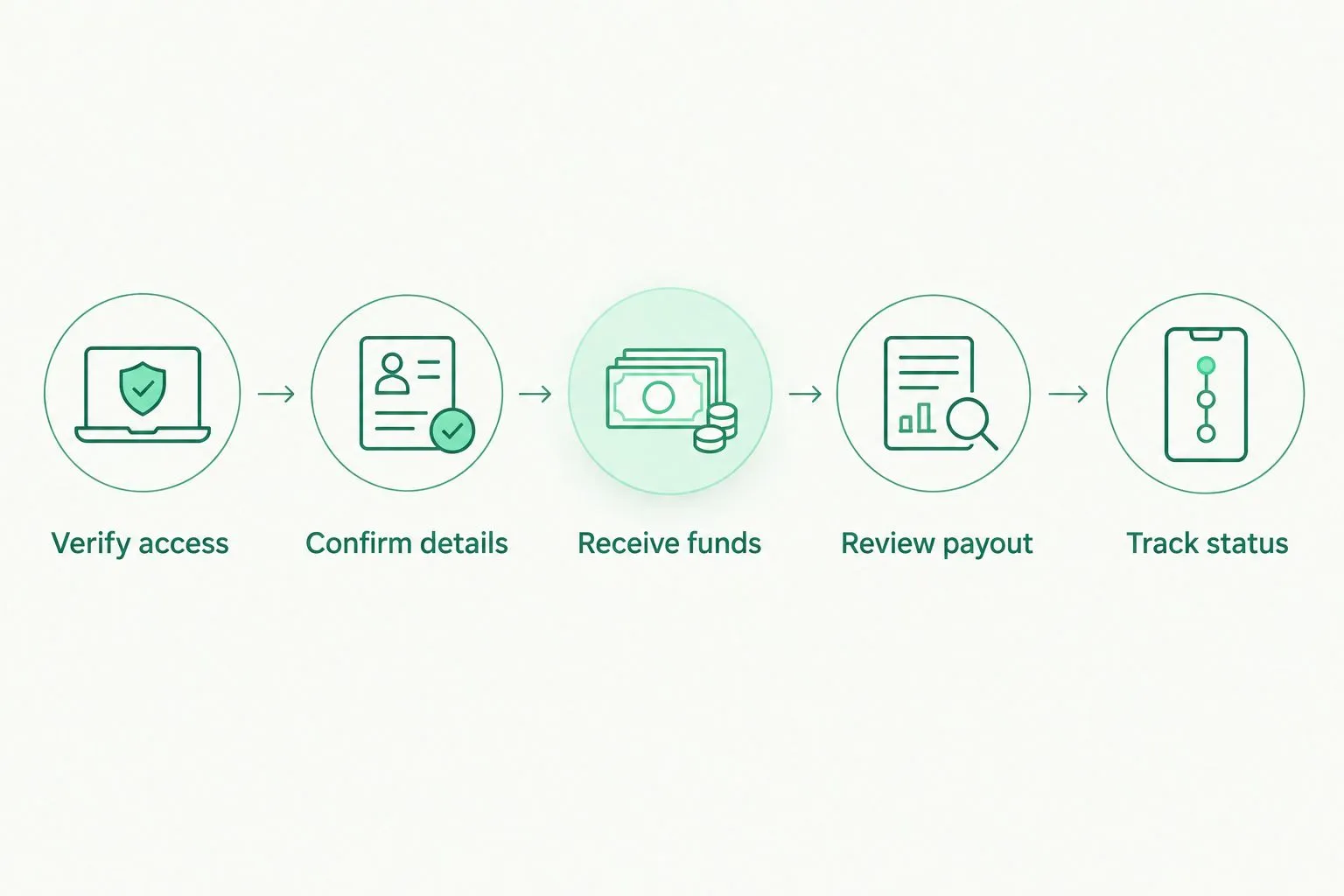
Receiving funds and sending a payout are separate stages.
Don't add usual durations together and present the result as a promised arrival date. The incoming method, payout route and readiness of the account are separate inputs to your planning.
Compare payment methods without confusing settlement
ACH, wire and SEPA describe different payment methods. Your comparison needs to preserve that distinction, even when providers place them under a single international-payments heading.
The same discipline applies when comparing bank payouts versus USDC settlement: an asset-settlement event and receipt through the recipient's requested payment method are different endpoints. A shorter estimate for one endpoint doesn't establish earlier receipt at the other.
For a 2026 supplier payment, define the endpoint in plain language: the recipient receives the required currency through the agreed payment method. Then ask each provider for an estimate to that endpoint.
Keep the comparison practical:
- What currency does the recipient need?
- Which payment method does the recipient accept?
- When does the quoted timing begin?
- What event marks completion?
- How will you identify and resolve a delayed payment?
Compare the outcome your recipient needs, not the shortest duration printed beside a different process.
Review fees, limits and team access together
Speed doesn't remove the need to check payment economics. Minimum fees matter, especially when comparing a small wire with another supported payout method. The international wire transfer cost comparison addresses the cost side of that decision.
For teams, check who can prepare a payment and who can act on it. The featured service requires two-factor authentication for every payout, new recipient and team grant. Its payout status progresses through Processing, On its way and Completed.
Keep a record of the recipient details and confirmation alongside the status. Don't promise a supplier an arrival date based only on the fact that a payout has been submitted.
Which international transfer service should you choose?
Choose the featured USD/EUR service when dedicated account details, receiving payments and paying supported recipients are your main requirements. Keep an existing provider when its confirmed route and timing meet the need. Assess a specialist when you need a specific route comparison.
Don't choose a new service solely because its headline includes the word fast. In 2026, the decisive question remains: can this provider complete this payment, by this method, within the recipient's required window?
Moneyspace is not a bank. Account details are provided through a licensed partner after verification. Confirm eligibility and supported destinations before relying on the service for a deadline-sensitive payment.
Get your USD and EUR details
Receive payments and pay out through supported ACH, wire and SEPA routes after verification.
FAQ
What's the fastest international wire transfer service in 2026?
No universal speed winner is established by the information in this guide. Compare providers using the same sending currency, destination, payment method and recipient-arrival endpoint.
How long do Moneyspace payouts usually take?
Payouts usually take 1–2 business days. Confirm the supported route and don't treat the usual duration as a delivery commitment.
Is an incoming wire estimate the same as a payout estimate?
No. Receiving a payment and sending a later payout are separate events, so each needs its own timing estimate.
Should I choose ACH, wire or SEPA for an international payment?
Choose a method that supports the required currency, destination and recipient instructions. Compare the applicable fee and timing only after confirming that fit.
Can I open an account and send immediately?
Don't plan a payment around immediate access. Verification is required, and neither approval nor a verification deadline is promised.
Does a 0.5% transaction fee mean every payout costs exactly 0.5%?
No. Outgoing ACH, wire and SEPA have applicable minimum fees of $2, $15 and €2 respectively; USD/EUR exchange has a $1 minimum.
What should I check before a deadline-sensitive transfer?
Confirm verification, recipient details, route support, payout limits, fees and the expected recipient-arrival window. Keep payment submission separate from confirmed receipt.
One last thing
Ask one final question before sending: what exactly does completed mean for this payment? A provider's status and the recipient's confirmation answer different operational questions. Agree on the evidence your supplier or contractor needs before the deadline arrives.