Is a stablecoin wallet worth it in 2026?
A stablecoin wallet is worth it in 2026 if you need to receive, hold, or send stablecoins and have checked how you'll turn them into spendable USD or EUR. Skip the extra step when your clients already pay through ACH, wire, or SEPA; a wallet adds custody, network, and conversion decisions without replacing those payment methods.
TL;DR
- Is a stablecoin wallet worth it? Yes for necessary stablecoin payments; not automatically for ordinary USD or EUR transfers.
- Self-custody gives you control of signing keys but makes recovery and transaction security your responsibility.
- Custodial wallets delegate key management but add provider access and withdrawal restrictions.
- Moneyspace serves freelancers and businesses needing USD and EUR account details; assess any stablecoin conversion route separately.
Is a stablecoin wallet worth it in 2026?
Use a stablecoin wallet when it solves a payment requirement, not simply because a client mentions stablecoins. The deciding question is whether the complete route works: receiving the right token, securing it, converting it when needed, and paying the final recipient.
Compare custody models before choosing an app. The stablecoin wallet guide is a starting point for that decision; verify each provider's current terms rather than treating every wallet as interchangeable.
| Option | Best for | Main advantage | Main drawback |
|---|---|---|---|
| Self-custody wallet | People who need direct control of signing keys | You control transaction authorization | You manage key security and recovery |
| Custodial wallet | People who prefer provider-managed key custody | The provider manages signing keys | Access and withdrawals depend on provider rules |
| USD and EUR account details | People paid through ACH, wire, or SEPA | Supports payments through those conventional rails | Account details alone don't receive blockchain tokens |
These options solve different problems. A wallet receives blockchain assets, while USD and EUR account details receive payments through supported payment rails. Neither automatically supplies the other function.
Why this matters
Your client sending a payment isn't the same as you being ready to spend it. A successful stablecoin transfer can still leave you with a separate conversion, verification, or withdrawal task.
For freelancers outside the US or EU, that distinction affects invoice instructions. For businesses, it also affects supplier payments, team permissions, and bookkeeping. Start with the currency and payment method your recipient needs, then work backward to what you should accept.
The practical test is simple: choose the route that gets usable funds to the final recipient with responsibilities you understand. Receiving a token is only one part of that route.
Self-custody wallets: best for direct key control
A self-custody wallet is the better fit when you deliberately want control of the keys used to authorize transactions. That control removes reliance on a wallet provider to approve each blockchain transfer, but it doesn't remove reliance on the token issuer, network, or any conversion provider you use.
The trade-off is responsibility. Losing access to the necessary keys or recovery information can make funds inaccessible. Exposing that information can let someone else authorize transactions.
Before receiving a client payment, establish how you'll protect recovery information and verify destination addresses. For a business, decide who controls the wallet and what happens when that person leaves.
Choose self-custody for direct key control, not as a shortcut around financial administration. If your business can't maintain a recovery and access process, that control creates an operational weakness rather than an advantage.
Custodial wallets: best for delegated key management
A custodial wallet fits people who want a provider to manage signing keys. Depending on the service, account recovery and transaction management happen through the provider rather than through recovery information you control yourself.
That arrangement changes the risk; it doesn't eliminate it. The provider's verification requirements, supported networks, withdrawal rules, and access restrictions become part of your payment workflow.
Check whether the service supports your residence or business jurisdiction before sharing payment instructions. Also confirm whether receiving a token and withdrawing it are separate permissions under the provider's terms.
Choose custody only after checking the exit route. An interface that makes receiving straightforward isn't enough if you haven't confirmed how to withdraw or convert the balance. Evaluate the provider relationship as carefully as the wallet's features.
USD and EUR account details: best for conventional client payments
If your clients already pay through ACH, wire, or SEPA, dedicated account details address that requirement directly. You don't need to introduce a blockchain payment just to receive USD or EUR.
The limitation works in the opposite direction. Routing and account numbers or an IBAN aren't blockchain wallet addresses. A client holding stablecoins needs an appropriate conversion and payment route before sending money through conventional payment rails.
This distinction matters when you negotiate payment terms. Ask whether the client must send stablecoins or simply prefers them. A preference leaves room to agree on a payment method that matches your existing accounting and supplier obligations.
Choose conventional account details when your payment need is conventional. Add a wallet only when a separate stablecoin use case justifies the additional process.
Why a stablecoin wallet's value varies
The value of a stablecoin wallet in 2026 depends on your actual payment route, not a general claim that blockchain payments are better.
- Client payment method: A wallet solves a real receiving problem when the client needs to send stablecoins. It adds a step when the client can already use your preferred payment rail.
- Final spending currency: Holding stablecoins doesn't finish the job when your contractors or suppliers require USD or EUR through conventional transfers.
- Custody responsibility: Self-custody puts key management with you. Custodial services put access and key management under a provider's processes.
- Token and network support: The sender, receiving wallet, and conversion provider need compatible support. A familiar token name alone isn't enough.
- Conversion and withdrawal terms: Evaluate the complete path, including applicable charges, minimums, verification, and destination restrictions.
- Business controls: A company needs clear authorization, recovery, and recordkeeping procedures. A wallet designed around one person's access doesn't automatically meet those needs.
Check the complete payment route before accepting funds
Use this sequence before putting a wallet address on an invoice. In 2026, confirming the receiving address alone still leaves the rest of the payment route unresolved.
- Confirm payment. Agree on the token, network, and amount with the sender. Make the payment instructions specific enough that the sender doesn't have to guess.
- Check custody. Establish who controls the signing keys and how access is recovered. For a business, document who can authorize transfers.
- Verify compatibility. Check support at the receiving wallet and at any service you'll use next. Don't assume matching token names mean matching network support.
- Confirm conversion. If you need USD or EUR, check the conversion provider's current eligibility, verification, charges, and withdrawal requirements before receiving funds.
- Plan payout. Confirm the final recipient's supported payment method and destination details. Keep the invoice, transaction record, and payout confirmation together.
The sequence exposes the weak point before a client payment depends on it. A working wallet doesn't establish that a separate conversion provider will accept your transaction or support your destination.
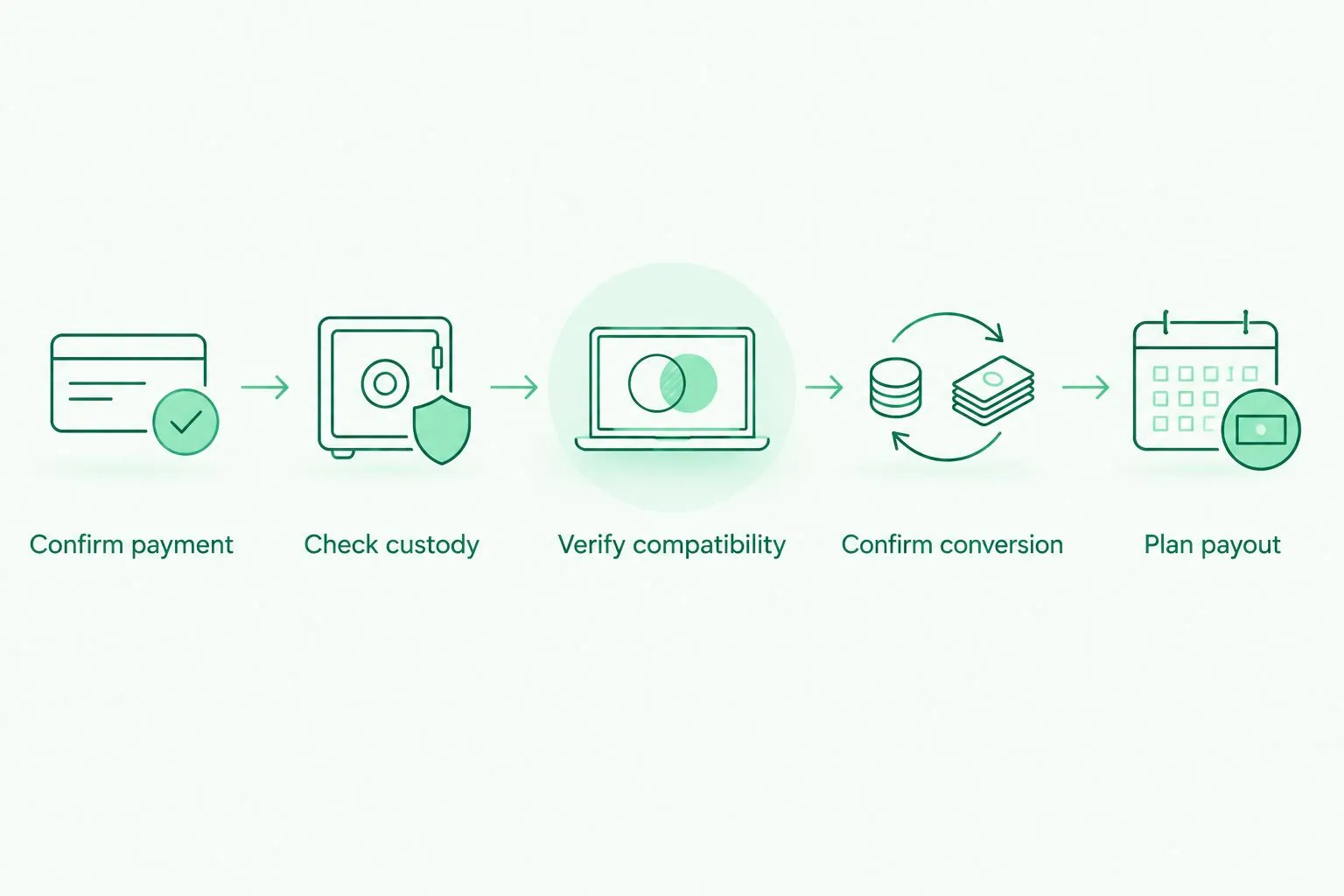
Check the complete route before giving a client your payment instructions.
Keep written instructions for repeat clients. If the token, network, receiving address, or conversion service changes, review the route again instead of reusing old instructions automatically.
Assess costs without confusing the token with cash
Don't judge a wallet only by whether downloading it carries a charge. Review every service involved in receiving, moving, converting, and withdrawing the payment.
Network charges and provider charges are different items. A wallet can display one while a separate conversion or payout service applies another. Compare the final usable amount and the work needed to obtain it, rather than comparing a single advertised fee.
Also separate price stability from access. Stablecoins aim to track a reference asset, but that aim doesn't eliminate depegging, issuer, custody, or network risks. A balance displayed in a wallet doesn't establish that you can redeem it directly with the issuer.
Use current terms for each service in the route. Don't assume a stablecoin's reference value tells you the amount your final recipient will receive after conversion and payout.
Where Moneyspace fits for USD and EUR payments
Moneyspace is best for freelancers and businesses that need their own USD and EUR account details for ACH, wire, and SEPA payments. It provides dedicated details in the customer's own name rather than a shared payment reference.
Moneyspace supports receiving payments, exchanging USD and EUR inside the account, and paying out through supported rails and destinations. Fees appear before confirmation, and payout status moves through Processing, On its way, and Completed.
For timing, Moneyspace lists incoming ACH as 1–3 business days, incoming wire and SEPA as usually within a business day, and payouts as usually 1–2 business days. These are usual timing expectations, not fixed delivery commitments. Check the full sequence when a client payment must fund a later supplier payment.
For teams, the service provides owner, admin, operator, and view-only roles. Every payout, new recipient, and team grant requires 2FA. Several companies and personal profiles can sit under one sign-in.
The boundaries matter as much as the capabilities. Moneyspace is not a bank, account details are provided through a licensed partner after verification, and country eligibility requires checking. USD and EUR account details aren't blockchain addresses; evaluate any stablecoin conversion route separately.
These service facts were supplied by the client on October 26, 2026. Check current transaction charges, applicable minimums, eligibility, and limits before deciding whether the service fits your payment flow.
Open an account
Get your own USD and EUR account details after verification. Check eligibility and supported payment routes.
Should I accept stablecoins from an overseas client?
Accept stablecoins when you've confirmed a usable receiving and exit route. Agree on the token and network, check compatibility, and decide how you'll obtain the currency needed for expenses.
If the client can pay through ACH, wire, or SEPA instead, compare that complete workflow. Don't accept an unfamiliar payment method merely to avoid discussing payment instructions before the invoice is due.
Do I need a wallet if I only want USD or EUR?
You don't need a stablecoin wallet merely to receive USD or EUR through ACH, wire, or SEPA. You need suitable account details and a supported payment arrangement.
A wallet becomes relevant when someone sends blockchain tokens. If your client holds stablecoins but you want a conventional payment, establish who handles conversion before agreeing to the invoice terms.
Is keeping business funds in a wallet a good idea?
Keep only funds that serve a defined business purpose in a wallet. Decide what the balance is for, who controls access, and how the business will pay expenses from it.
Don't treat payment convenience as a complete treasury policy. Review token exposure, custody, recovery, conversion access, and accounting requirements separately from the decision to accept a particular client payment.
FAQ
Is a stablecoin wallet worth it for freelancers in 2026?
A stablecoin wallet is worth it for freelancers who need to receive stablecoins and have confirmed how to use or convert them. If clients already pay through ACH, wire, or SEPA, a wallet isn't necessary for that payment.
What's better for stablecoins, self-custody or a custodial wallet?
Self-custody fits people who want direct key control; custody fits people who prefer provider-managed keys. Self-custody requires your own recovery process, while custody makes provider access and withdrawal rules part of the workflow.
Can I send stablecoins to USD or EUR account details?
USD and EUR account details aren't blockchain wallet addresses. Use a supported conversion and payout route rather than sending tokens to conventional payment details.
Can a stablecoin lose its reference value?
A stablecoin can trade away from its intended reference value. Assess the token's issuer, redemption arrangements, and market risks separately from the wallet holding it.
Does a stablecoin wallet automatically convert payments into cash?
A stablecoin wallet doesn't automatically provide conversion or conventional payouts. Check the specific service's supported functions, eligibility, and withdrawal terms before relying on that route.
Can I recover a stablecoin payment sent on the wrong network?
Recovery depends on the destination, network, and receiving service. Check compatibility before sending, because a mistaken transfer can be unrecoverable.
What should a business check before choosing a stablecoin wallet?
A business should check custody, permissions, recovery, supported tokens and networks, conversion access, and transaction records. Assign responsibility for each part before accepting client funds.
One last thing
Test the exit, not just the entrance. Before adopting a stablecoin wallet in 2026, write down how a client payment becomes a completed payment to your supplier or contractor.
If that explanation stops at receiving the token, the workflow isn't finished. Resolve conversion, eligibility, recipient requirements, and records first. The right payment setup is the one you can operate from beginning to end.