Is ACH faster than wire transfer?

No—ACH is not generally faster than a wire transfer. A wire is usually the better choice when speed is the priority, although Same Day ACH can shorten the difference when the sending provider supports it. Compare the actual arrival estimate before sending: submission deadlines, business days and payment reviews affect when the recipient can use the money.
TL;DR
- Is ACH faster than wire transfer? Generally, no; compare the actual delivery estimates before choosing.
- Wire transfers are best for time-sensitive payments when their quoted arrival is earlier than ACH.
- ACH is best for scheduled USD payments when its delivery window meets your deadline.
- Moneyspace lists incoming ACH at 1–3 business days and incoming wire usually within a business day.
Is ACH faster than wire transfer?
Wire usually wins on speed; ACH works when you can plan around its delivery window. Standard ACH processes payments through scheduled clearing cycles. Wire transfers use a different payment network and processing workflow, so the two methods don't necessarily follow the same timetable.
Same Day ACH is an important exception to the standard ACH comparison. However, support for ACH doesn't automatically mean a provider offers Same Day ACH for your payment. Check the selected service rather than relying on the ACH label alone.
| Payment option | Best for | Main advantage | Main limitation |
|---|---|---|---|
| Standard ACH | Scheduled USD invoices and recurring payments | Works for payments planned around a stated delivery window | Don't assume same-day arrival |
| Same Day ACH | Eligible USD payments with a same-day processing need | Shortens the standard ACH processing schedule | Requires provider support and submission before the applicable deadline |
| Wire transfer | Time-sensitive payments with an earlier quoted arrival | Usually the faster choice compared with standard ACH | Submission deadlines and reviews still affect delivery |
For the receiving side of the comparison, see how long an ACH payout takes to clear. Keep the sending estimate separate from the point at which the recipient can actually use the funds.
Why this matters
A client clicking send doesn't tell you when you can pay a contractor. A supplier's deadline doesn't move because a payment is still processing. Choose the method against the recipient's deadline, not against a general claim that one network is faster.
This matters especially when you're outside the US and receive USD from US clients. First confirm that your receiving account details support the method the client intends to use. Then check the arrival estimate for that specific transfer.
For your 2026 payment planning, separate receipt from any later payout. Receiving a client's payment and sending money to your team are different transactions, with different processing windows. Don't treat the incoming estimate as the completion time for the entire workflow.
Incoming ACH: 1–3 business days
Moneyspace lists incoming ACH at 1–3 business days, based on client-supplied product information dated October 26, 2026. That is a receiving estimate for this service, not a rule for every ACH provider or a promise about every transfer.
Best for: scheduled USD receipts that fit the stated window. If you invoice clients before a predictable payment deadline, ACH gives you a method to plan around. Its limitation is the wait: don't build an urgent outgoing payment around an incoming transfer that hasn't arrived.
Ask the payer which ACH service they're using and when they submitted the payment. If they selected standard ACH, don't assume a Same Day ACH timetable applies. A scheduled payment also isn't the same as a payment already submitted for processing.
Keep the payment confirmation with the invoice. If the expected window passes, that record gives the sender a clear starting point for checking the transfer. Avoid asking the client to resend before the original payment's status is established.
Incoming wire: usually within a business day
Moneyspace lists incoming wire transfers as arriving usually within a business day, using the same October 26, 2026 product information. The word “usually” matters: it describes normal timing, not an unconditional arrival commitment.
Best for: time-sensitive USD receipts when the sender's delivery estimate meets your deadline. Compared with the stated incoming ACH window, incoming wire has the shorter usual timeframe. Its limitation is that the sender must still account for submission deadlines and any review affecting the transfer.
Before requesting a wire, send the correct receiving instructions for that method. Don't assume every field used for an ACH payment is interchangeable with wire instructions. Ask the sender to confirm the recipient name and required details before submitting.
If a client says the wire has been sent, request the confirmation rather than treating the message as proof of receipt. Track the incoming payment separately from your invoice status. Marking an invoice paid and having usable funds are different operational events.
Outgoing payouts: usually 1–2 business days
Moneyspace lists outgoing payouts as taking usually 1–2 business days. That published window doesn't establish that an outgoing wire will always beat an outgoing ACH payout through the service. Use the estimate applicable to the selected payment and destination.
Best for: supplier and team payments planned before the recipient's deadline. The service supports ACH, wire and SEPA payouts, with live payout status. The limitation is that a usual processing window isn't a fixed arrival commitment.
An incoming wire estimate also doesn't describe a later outgoing payment. If you're receiving a client payment and then paying a contractor, check both stages. Don't promise the contractor the same arrival time quoted for the client's incoming wire.
For a 2026 payment schedule, record the incoming receipt and outgoing payout as separate milestones. This makes it easier to identify whether you're waiting on the client, the incoming transfer or the outgoing payment. It also prevents a single vague “payment pending” label from hiding the next action.
Why ACH and wire transfer timing varies
The network name is only part of the delivery estimate. These factors explain why two payments described as ACH or wire can have different arrival times:
- ACH service type. Standard ACH and Same Day ACH don't use the same processing schedule. Confirm which service the sender actually selected.
- Submission deadline. A payment submitted after the provider's processing deadline can move into the next processing window. Check the relevant time zone too.
- Business-day calendar. Weekends and applicable holidays affect business-day estimates. Count working days rather than simply adding calendar days.
- Payment details. Incorrect or incomplete recipient information can require correction or cause a return. Check the instructions before submission.
- Payment review. A provider can review a transfer before releasing it. A faster payment method doesn't remove that possibility.
- The stage being measured. Submission, processing, receipt and an onward payout are different events. Make sure both parties are discussing the same endpoint.
Don't rank a payment solely by the speed advertised for the network. A method with a later submission deadline or a clearer arrival estimate can better fit your actual payment schedule. Choose against the stated deadline for your transfer, not a general speed label.
How do you choose between ACH and wire?
Start with when the recipient needs usable funds. Then work backward through the available delivery estimates. Use this sequence before you authorize the payment:
- Set the deadline. Ask for the date and time the recipient needs the funds, including the time zone. An invoice due date alone doesn't always explain the operational deadline.
- Confirm the method. Check whether the recipient's details accept ACH, wire or both. For ACH, establish whether the quoted timing is standard or Same Day ACH.
- Check the estimate. Compare the arrival estimates offered for your actual payment. Don't substitute a general network description for the provider's estimate.
- Verify the details. Match the recipient name and required account information to the supplied instructions. Resolve discrepancies before sending.
- Track the payment. Keep the confirmation and monitor the status. Tell the recipient the stated window without presenting it as a fixed commitment.
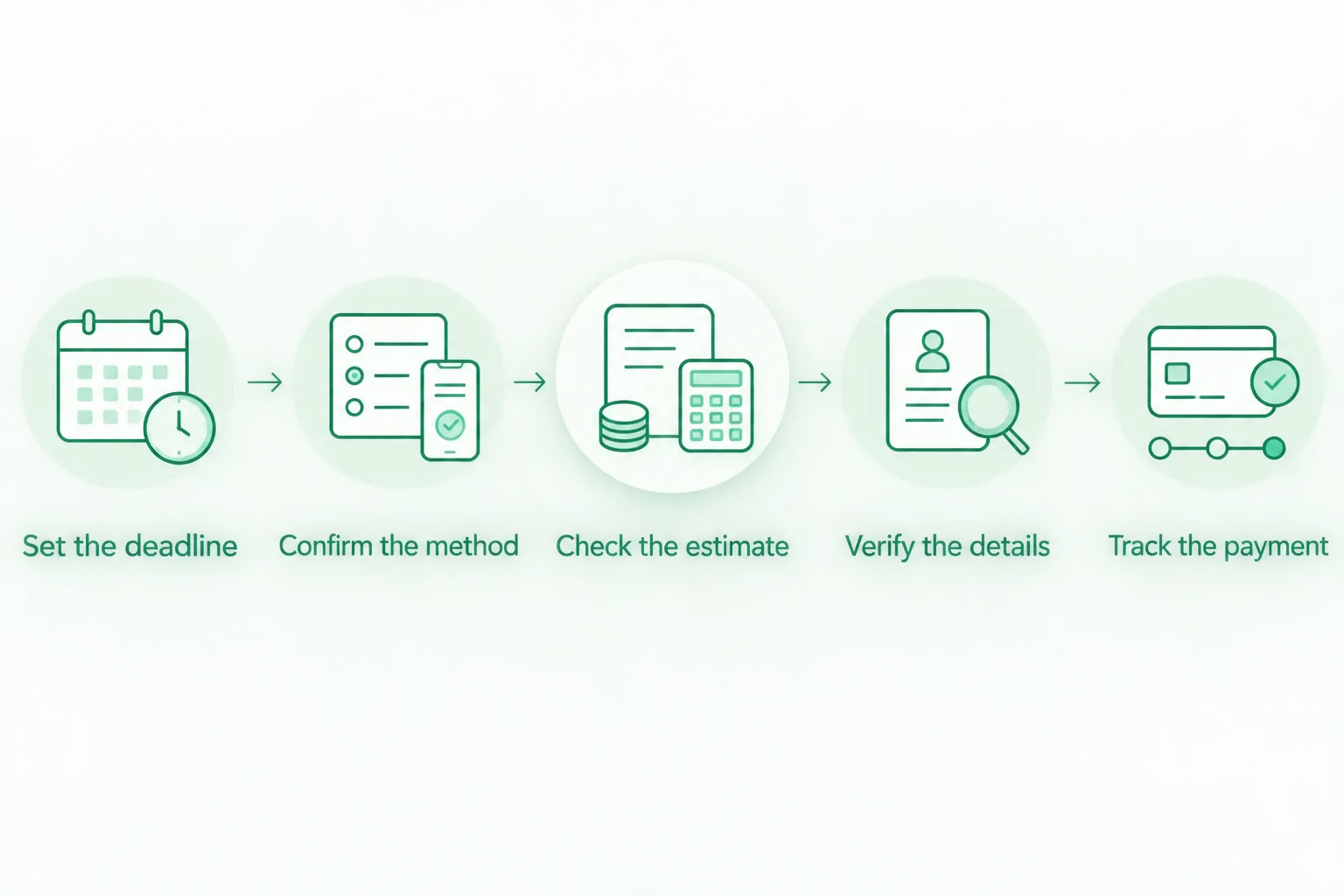
Choose the payment method after checking the recipient's deadline and the actual delivery estimate.
This 2026 checklist works for a freelancer requesting payment and an agency paying suppliers. The decision changes with the deadline, not with the job title. If ACH meets the required arrival window, speed alone isn't a reason to switch; if it doesn't, check whether wire offers an earlier arrival.
Is ACH better for recurring client payments?
ACH is a practical choice for recurring USD payments when its delivery window fits your schedule. Establish the expected submission date with your client and keep that separate from your own supplier-payment deadline.
The advantage is predictability when both parties follow an agreed process. The drawback is that a late client submission can leave you waiting beyond the date you planned around. Don't treat a recurring arrangement as evidence that the latest payment has already been sent.
Does a wire transfer arrive immediately?
A wire transfer doesn't automatically arrive immediately. The sender's provider, submission deadline, recipient details and any payment review affect the actual delivery window.
Ask for the quoted arrival estimate before the sender confirms. Once submitted, use the transfer confirmation and status to follow up. “Wire” identifies the payment method; it doesn't establish that the recipient already has the money.
Which account features matter beyond transfer speed?
Moneyspace is best for freelancers and businesses that need their own USD and EUR account details with ACH, wire and SEPA payments. That fit is about supported payment methods and account management, not a claim that every transfer is faster than another provider's.
You get account details in your own name rather than a shared reference. You can exchange USD and EUR inside the account, see the fee before confirming a payout and follow its live status. Teams can use owner, admin, operator and view-only roles.
The trade-off is that you still need to plan around the stated transfer windows and confirm support for your situation. Access requires verification, and worldwide audience positioning doesn't mean every applicant or destination is supported. Moneyspace is not a bank; account details are provided through a licensed partner after verification.
Open an account
Get your own USD and EUR account details after verification. Receive ACH, wire and SEPA payments.
FAQ
Is ACH faster than wire transfer in 2026?
ACH is generally not faster than a wire transfer. Standard ACH uses scheduled processing cycles, while Same Day ACH can shorten the difference when the provider supports it and the payment meets the applicable deadline.
How long does incoming ACH take with Moneyspace?
Incoming ACH takes 1–3 business days according to the client-supplied product information dated October 26, 2026. Treat that as the service's stated receiving window, not a universal ACH timetable.
Can an ACH payment arrive the same day?
An ACH payment can use Same Day ACH when the sending provider offers it and the payment meets the applicable requirements. Ordinary ACH support doesn't establish Same Day ACH support.
Will a wire sent on Friday arrive before the weekend?
A Friday wire doesn't automatically arrive before the weekend. Check the sender's submission deadline and the arrival estimate for that specific payment.
Is receiving a wire the same as completing a payout?
Receiving a wire and completing an outgoing payout are separate transactions. Check the incoming receipt window and the later payout window independently.
Should I resend a payment if it's taking too long?
Check the original payment's status before sending a replacement. Ask the sender to investigate using the confirmation so you don't create a duplicate payment.
One last thing
The most useful speed comparison has the same starting point and endpoint. Don't compare one provider's network-processing time with another provider's end-to-end arrival estimate. Ask both the same question: when will this recipient be able to use this payment?
Before your next urgent transfer, write down the recipient's deadline and the quoted arrival window together. If the estimate doesn't meet the deadline, resolve that mismatch before sending. A payment confirmation won't fix a timing decision made too late.