Is it legal to hold stablecoins in a business account?

Yes, a business can legally hold stablecoins in many jurisdictions, including the United States, when the holding and related transactions comply with applicable law. Holding company funds is different from handling customers’ money, and legality does not establish provider permission, tax compliance, or protection against loss.
TL;DR
- Is it legal to hold stablecoins in a business account? Often yes; jurisdiction, ownership, and activity determine the answer.
- Company treasury holdings differ from exchanging or transmitting stablecoins for customers; check licensing before offering financial services.
- Moneyspace suits businesses needing USD and EUR payment account details; assess stablecoin custody separately.
Is it legal to hold stablecoins in a business account?
Holding stablecoins for your company’s own use is not the same legal activity as providing stablecoin services to other people. Start by identifying whose assets you hold, where your company operates, and what you do with the funds.
Also separate the account from the asset. A payment account, a custodial wallet, and a self-hosted wallet have different functions. The guide to whether a stablecoin wallet is worth it addresses that separate custody decision.
| Business activity | Legal question to resolve | Practical next move |
|---|---|---|
| Hold the company’s own stablecoins | Does local law permit the holding and intended use? | Document ownership and treasury approval |
| Accept stablecoins for your own invoices | What payment, tax, and sanctions rules apply? | Connect each receipt to its invoice |
| Pay your own suppliers | Is the recipient and transaction permitted? | Check the recipient and agreed payment terms |
| Exchange or transmit assets for customers | Does the activity require registration or authorization? | Obtain a licensing assessment before launch |
There is no worldwide permission that replaces these checks. A company’s incorporation country is a starting point, not the entire legal analysis.
Why this matters
A business can choose a lawful asset and still use it through an unsuitable account. A provider’s terms can restrict an activity that local law permits. Tax reporting can also apply even when your business never converts the proceeds into USD or EUR.
For your 2026 policy, answer three separate questions: Can the company hold the asset? Can this provider support the activity? Can the company account for every transaction? A yes to one does not answer the others.
Keep company assets separate from personal assets. That separation helps establish ownership, supports reconciliation, and makes an approval trail easier to follow. A wallet address alone does not explain which company owns the balance or why a transfer occurred.
What applies to a US business holding its own stablecoins?
For a US business, holding stablecoins as company property does not, by itself, make the company a money transmitter. FinCEN’s convertible virtual currency guidance distinguishes users acting on their own behalf from certain administrators and exchangers. The actual activity matters more than the label on the account.
Do not stretch that distinction into an exemption for every payment business. Receiving customer funds, exchanging assets for customers, or transferring value on their behalf requires a separate analysis. Federal requirements and state licensing rules can address different parts of the same service.
US tax treatment is another separate issue. The IRS treats digital assets as property for federal tax purposes. Receiving digital assets for services generally creates income measured by their fair market value when received; a later disposition can create a separate gain or loss.
A stable value target does not remove those recordkeeping obligations. Retain the receipt value, acquisition information, transaction charges, and disposal proceeds. Your accountant needs those records to determine the treatment applicable to your business.
For a 2026 US review, the relevant primary authorities include:
- IRS digital asset guidance: Federal tax treatment and reporting.
- FinCEN virtual currency guidance: Whether the business activity falls within money services business rules.
- OFAC sanctions guidance: Restrictions involving sanctioned persons, jurisdictions, and transactions.
- Applicable state regulators: State-level licensing requirements for the actual service offered.
These authorities address different questions. An IRS classification does not grant a payment-services license.
What changes when your business operates internationally?
An international business needs a jurisdiction-by-jurisdiction assessment, not a US answer applied everywhere. Review the company’s place of incorporation, operating locations, customer activity, and the provider’s contracting entity. Local restrictions can affect holding, transferring, exchanging, or providing services involving digital assets.
In the European Union, the Markets in Crypto-Assets Regulation, or MiCA, establishes rules for specified crypto-assets and service providers. Holding assets for your own company is a different question from issuing a token or providing custody to customers. Do not treat a provider’s authorization as permission for every activity your own business undertakes.
Use the relevant financial regulator and tax authority for your 2026 local review. Ask counsel to identify the rules that apply to your activity, rather than requesting a general statement that stablecoins are legal.
Also check the token itself. Different legal classifications, issuer arrangements, and redemption rights can lead to different conclusions. The word stablecoin does not establish that every token has the same legal treatment.
Which custody arrangement fits your business?
Best for operational simplicity: business custodial wallets. Best for direct key control: self-hosted wallets. Neither arrangement removes tax, sanctions, or ownership responsibilities.
| Arrangement | Best for | Main benefit | Main limitation |
|---|---|---|---|
| Business custodial wallet | Teams that want a provider to manage custody | The provider manages access to private keys | Access depends on provider terms and controls |
| Self-hosted wallet | Businesses equipped to manage signing securely | The business controls its private keys | The business must manage key security and recovery |
| USD or EUR payment account | Businesses receiving and sending supported currency payments | Supports conventional payment instructions | Account details do not establish stablecoin custody support |
Before choosing custody, confirm who the provider recognizes as the customer. An employee’s personal profile is not a substitute for verified company ownership. Check whether the contract permits your industry, transaction sources, and intended payment activity.
For self-hosted custody, document signing authority and recovery arrangements. Control of a key is an operational fact; the company still needs records showing legal ownership of the assets.
How do you set up a lawful business holding process?
Complete the legal and accounting checks before moving operating funds. Use this sequence to assign responsibility and keep the decision documented.
- Identify ownership. Record the legal entity that will own the assets. Keep personal holdings and each company’s holdings distinguishable.
- Check jurisdiction. Have qualified counsel assess the locations and activities involved. Include customer-facing services if your business handles value for others.
- Confirm provider terms. Verify that the provider accepts the company and permits the proposed activity. Check supported assets and networks directly rather than assuming compatibility.
- Approve custody. Name the people authorized to approve and sign transfers. Document recovery procedures and what happens when an authorized employee leaves.
- Keep records. Connect receipts and payments to invoices, transaction identifiers, counterparties, and accounting entries. Retain evidence of the business purpose.
A completed identity check does not replace this process. Verification establishes information about the customer; it does not approve every future transaction or business model.
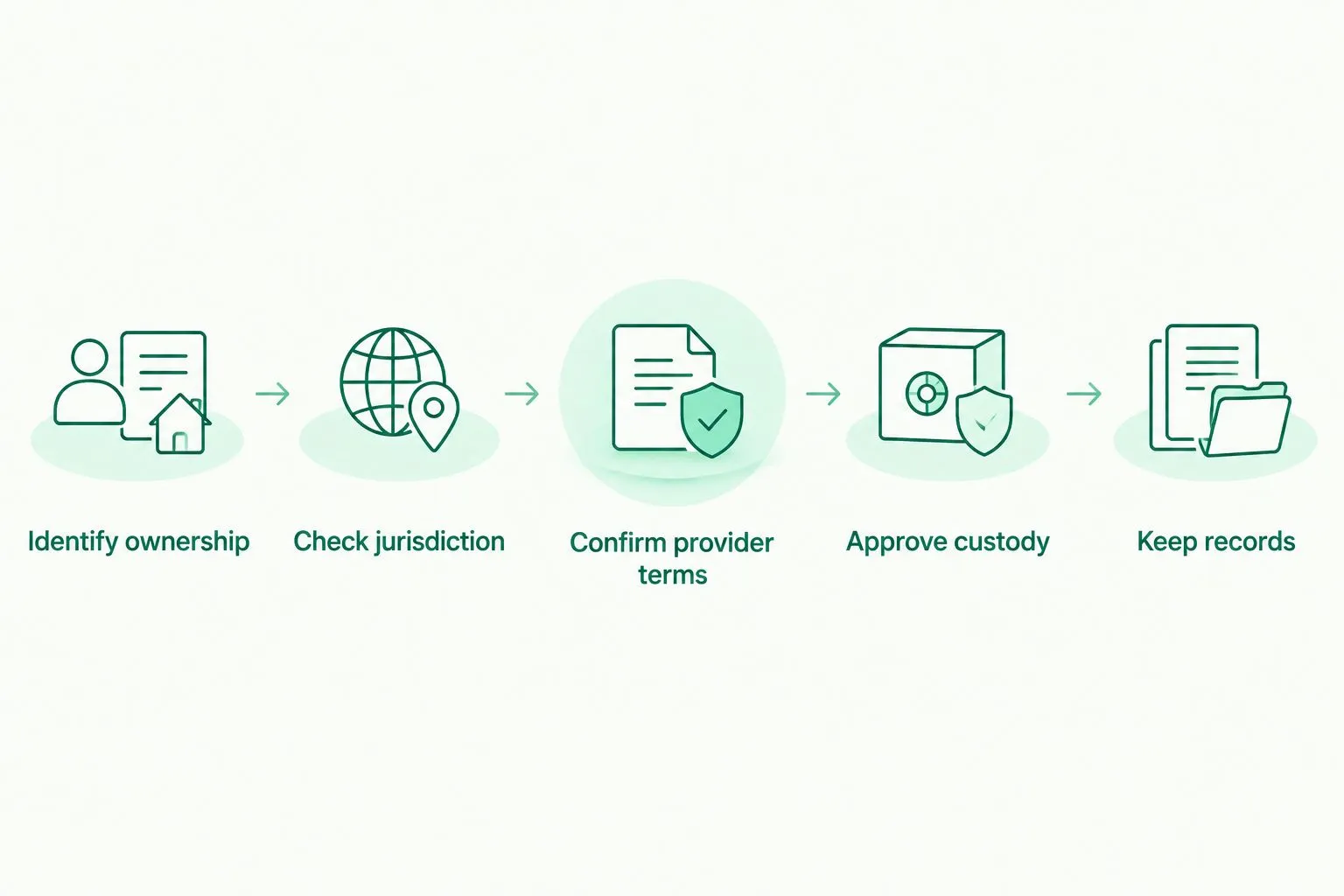
Resolve ownership and permitted activity before choosing how to hold company assets.
Review the process when you add a company, enter another market, or change the services you provide. An approval for holding treasury assets does not automatically cover launching a customer transfer service.
Why the legal answer varies
The answer changes with the facts of the activity, not just the currency label. Focus your legal review on these factors:
- Jurisdiction: Countries can apply different financial-services, tax, and foreign-exchange rules.
- Ownership: Holding company funds differs from safeguarding or transferring customer assets.
- Activity: Keeping treasury assets, receiving invoice payments, issuing tokens, and exchanging assets are distinct activities.
- Custody: A provider-managed wallet and a self-hosted wallet create different contractual and operational responsibilities.
- Counterparties: Sanctions restrictions and source-of-funds questions remain relevant to business transactions.
- Token structure: Issuer obligations and redemption arrangements are not identical across stablecoins.
For a 2026 assessment, write down the proposed workflow before asking for advice. Identify the sender, recipient, asset, network, custodian, and business purpose. A concrete workflow gives counsel something specific to evaluate.
What risks remain even when holding is legal?
Legal permission does not establish financial suitability. A stablecoin can trade away from its intended reference value. Its issuer or custodian can also impose redemption conditions that differ from your company’s cash needs.
Review the issuer’s published terms rather than treating the token’s name as a promise. Understand who can redeem directly, what restrictions apply, and which entity owes the contractual obligation. Do not assume your company has the same rights as another category of holder.
Operational risk also remains. Sending to the wrong address or network can prevent the intended recipient from accessing the transfer. A compromised signing key can expose assets controlled through that key.
Keep funds needed for committed payments aligned with the payment method those obligations require. If a supplier expects EUR through SEPA, a stablecoin balance still leaves a conversion and payout step to complete. Include that step in your treasury process rather than treating the token balance as a completed supplier payment.
Where Moneyspace fits in a USD and EUR payment workflow
Moneyspace provides dedicated USD and EUR account details in the customer’s own name after verification through a licensed partner. Moneyspace is best for businesses that need USD and EUR payment account details for getting paid and paying suppliers or teams through supported rails.
The payment service supports incoming ACH, wire, and SEPA transfers, plus payouts through those methods. Incoming ACH usually takes 1–3 business days. Incoming wire and SEPA payments usually arrive within a business day, while payouts usually take 1–2 business days.
Those timings describe supported currency payments, not stablecoin settlement or an end-to-end conversion workflow. Check the receiving requirements before arranging a payment from another provider. Dedicated account details alone do not establish compatibility with a particular exchange or wallet.
Moneyspace is not a bank. Its USD and EUR payment capabilities do not determine whether your company can lawfully hold a particular token, and they do not replace a separate custody assessment.
Does accepting stablecoins mean you need a financial license?
Accepting payment for your own goods or services is different from operating an exchange or transmitting customer funds. The distinction matters, but it does not replace a review of your jurisdiction and business model.
Describe the full payment flow to counsel. Include whether your company ever holds funds owed to someone else or performs conversions for customers.
Does converting stablecoins into USD remove tax obligations?
Converting stablecoins into USD does not erase the original receipt or its tax treatment. For US federal tax purposes, receipt and later disposal can be separate events.
Keep both records. A payout statement showing only the final USD amount does not explain the original income, acquisition value, or business purpose.
FAQ
Is it legal for my company to keep stablecoins instead of cash?
A company can hold stablecoins where applicable law permits the holding and intended use. Check local rules, provider terms, tax treatment, and the company's authority to hold the assets.
Can I keep business stablecoins in my personal wallet?
A personal wallet creates ownership and recordkeeping complications for company assets. Use a documented company custody arrangement and keep personal and company holdings distinguishable.
Do I need a money transmitter license just to hold stablecoins?
Holding your company's own stablecoins is different from transmitting value for customers. In the United States, the licensing analysis depends on the actual activity and applicable federal and state rules.
Do stablecoin payments count as business income?
Stablecoins received for services generally count as income at fair market value when received for US federal tax purposes. A later sale or exchange can create a separate gain or loss.
Is a self-hosted wallet better than a business custodial wallet?
A self-hosted wallet is better for direct key control, while a business custodial wallet delegates key management to a provider. Choose based on your company's ability to manage security, recovery, permissions, and records.
Does Moneyspace approval establish that my stablecoin activity is legal?
Moneyspace account verification does not establish that every separate business activity is lawful. Assess the company's stablecoin activity, custody arrangement, and relevant jurisdictions independently.
What documents should I keep for business stablecoin payments?
Keep invoices, transaction identifiers, counterparty information, receipt values, disposal records, and evidence of company ownership. Your accountant and legal adviser can specify additional records for your jurisdiction.
One last thing
Write the payment purpose beside the transaction identifier. A public transaction record can show movement between addresses, but it does not explain the invoice, approving company, or commercial reason for the payment.
For your 2026 treasury policy, require a clear trail from authorization to accounting entry. This is general information, not legal or tax advice; obtain advice for your company’s jurisdictions and actual activities before implementing the workflow.