Stablecoin wallets for crypto traders: complete 2026 guide
Crypto traders’ stablecoin wallet is a tool for holding and transferring stablecoins, with the aim of keeping trading funds accessible under a chosen custody model. Choosing a stablecoin wallet for crypto traders in 2026 starts with control, supported networks and recovery—not the number of assets listed.
TL;DR
- Choose a stablecoin wallet for crypto traders by custody, network compatibility and recovery—not asset count.
- Self-custody gives you key control but makes recovery and transaction checks your responsibility.
- Separate active trading funds from reserves; an exchange balance and a personal wallet serve different purposes.
- Moneyspace fits USD and EUR payment administration; don't assume it supports a particular stablecoin or network.
Why stablecoin wallets matter for crypto traders
Traders need to distinguish funds ready for an order from funds held outside a trading platform. A wallet adds another decision: who controls the credentials that authorize transfers, and what happens when access fails?
Your wallet choice also affects the route from a stablecoin balance to spending money. A blockchain transfer and an ACH, wire or SEPA payment are separate operations. A USD-denominated stablecoin is not the same thing as USD in a payment account.
For the payment-account side, Moneyspace provides dedicated USD and EUR account details in your own name. That capability does not establish support for deposits from a particular exchange, token or blockchain.
In 2026, build your process around those distinctions. Treat custody, trading access and fiat payments as separate checks, even when a service presents them together.
How to choose and use a stablecoin wallet
Define what your wallet must do
Start with a written list of actual transfers. Identify where funds originate, where they go next and whether you need to authorize transactions yourself. You can do this in a spreadsheet before opening another account or installing software.
A trader moving funds between exchanges has different requirements from a trader interacting with decentralized applications. The first workflow depends on compatible deposit and withdrawal routes. The second also involves transaction signatures and permissions granted to smart contracts.
Keep the scope narrow. A long feature list doesn't fix an unsupported destination, an unclear recovery process or a withdrawal route you haven't checked.
- List the exchanges and applications you actually use.
- Record the stablecoin and network for each transfer route.
- Separate active trading funds from funds held in reserve.
- Identify when you need USD or EUR rather than a token.
- Check destination restrictions before choosing a wallet.
Choose who controls the keys
Compare custody models before comparing interfaces. With self-custody, you control the credentials used to authorize transactions. With a custodial service, the provider controls the relevant keys and applies its access and withdrawal procedures.
Self-custody is best for traders who want direct control and can manage recovery securely. Its limitation is responsibility: losing the required recovery material can mean losing access. A custodial service removes some key-management work, but you depend on the provider to process withdrawals.
A hardware wallet stores signing keys on a separate device. It doesn't remove the need to inspect transaction details, protect recovery material or understand what you're signing. Choose the custody model you can operate correctly, not the one with the strongest slogan.
- Identify who can authorize a transfer.
- Read the recovery procedure before funding the wallet.
- Check how custodial withdrawals are reviewed or restricted.
- Confirm support for your chosen hardware device, if applicable.
- Keep recovery material away from routine trading activity.
Verify the token and network together
Check the receiving service's current deposit instructions manually. Match the asset, blockchain and token contract where the service provides one. A familiar ticker alone isn't enough to identify a compatible transfer route.
The same stablecoin name can appear on different networks. Wallet support for a network does not establish that your exchange accepts deposits on that network. Wrapped or bridged versions also require their own checks.
In 2026, repeat this check when a platform changes its deposit instructions or you use a new route. A previously saved address is not a substitute for checking current support.
- Asset: match the exact token the destination accepts.
- Network: match the sending and receiving blockchain.
- Destination: verify the address against a trusted source.
- Memo: include any destination-required tag or reference.
- Test transfer: confirm receipt before moving the remaining balance.
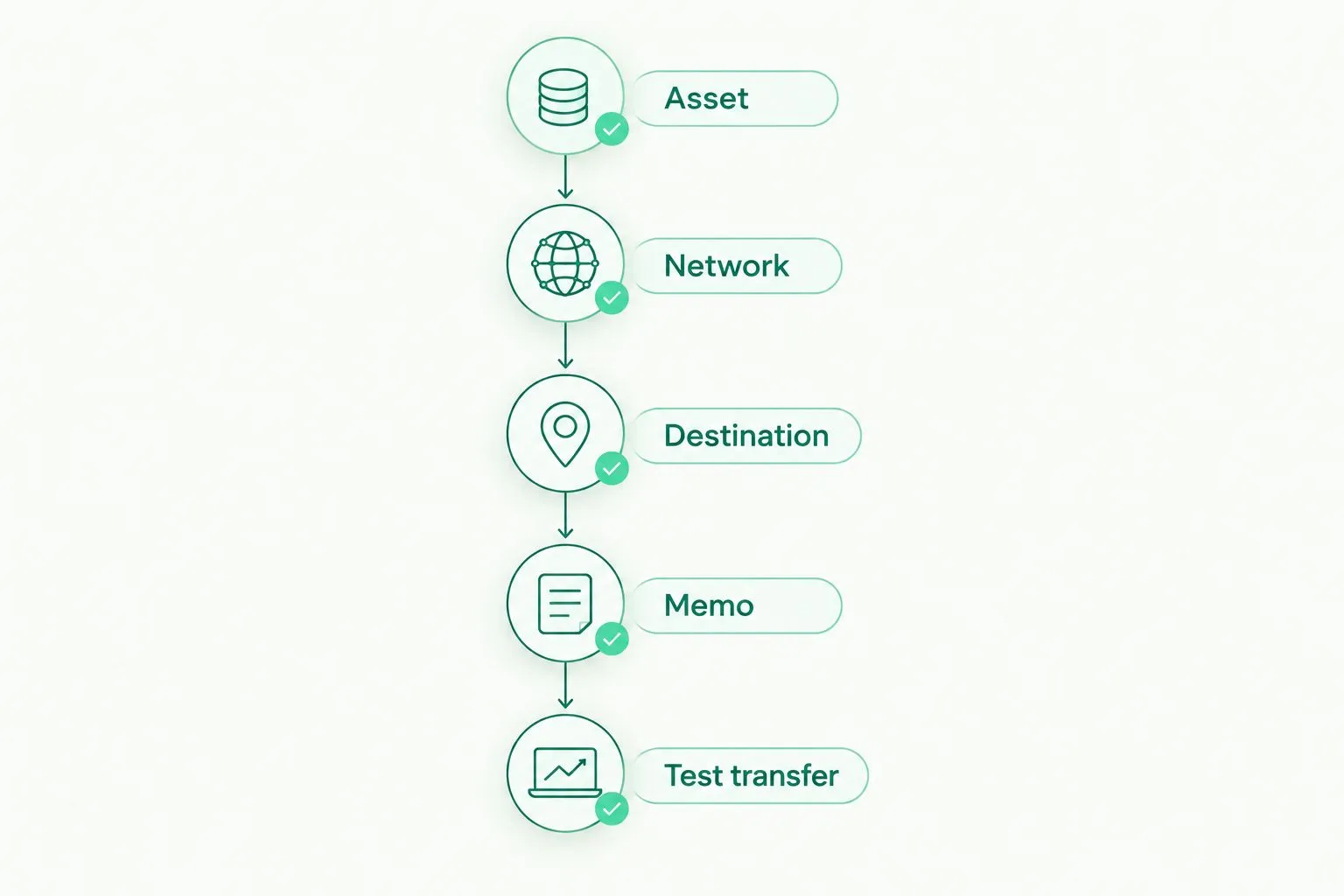
Check the complete transfer route, not just the token name.
Separate trading access from reserve custody
Assign each wallet a purpose before adding automation. An exchange balance supports trading on that venue. A wallet connected to decentralized applications supports signing activity. A reserve wallet serves a different purpose: holding funds without routine application interactions.
You can create this separation manually with distinct wallets and clear records. The benefit is operational clarity, not immunity from loss. More wallets also mean more recovery material, more addresses to verify and more opportunities for bookkeeping errors.
Application permissions deserve particular attention. A token approval can authorize a contract to spend tokens within the permission granted. Disconnecting a website from your wallet does not, by itself, revoke an on-chain token approval.
- Label wallets by purpose rather than by balance.
- Keep reserve custody separate from routine application signing.
- Review token approvals through a trusted interface.
- Remove permissions you no longer need.
- Record transfers between your own wallets for reconciliation.
Plan the USD and EUR exit separately
Write down the full route from stablecoin custody to a supported fiat destination. Confirm the conversion provider's rules, the receiving account's requirements and whose name must appear on the transfer. Don't assume an account accepts exchange-originated payments merely because it has account details.
Moneyspace is best for traders who need USD and EUR payment administration, not a substitute for verifying stablecoin custody. Its payment tools include ACH, wire and SEPA payouts, a fee shown before confirmation and live payout status. These are fiat payment capabilities, not evidence of a direct token conversion route.
The client-supplied Moneyspace facts dated October 26, 2026 describe incoming ACH as usually taking 1–3 business days and payouts as usually taking 1–2 business days. Those timings do not describe blockchain transfers or an exchange's withdrawal review.
For Moneyspace payment accounts, individual limits are $10,000 or €10,000 per payout and $50,000 or €50,000 per month. Business limits are $100,000 or €100,000 per payout, with no monthly limit. These limits describe payments—not permission to receive a particular source of funds.
Use the crypto-to-fiat off-ramp guide to structure your comparison, then check the current requirements of every service in your route.
- Confirm the conversion service supports your token and network.
- Check whether the receiving account accepts the payment source.
- Match the account holder details required by both services.
- Separate conversion time from fiat payout time.
- Retain transaction references and source-of-funds records.
Test recovery and reconcile transfers
Read the recovery instructions while the wallet is empty. Understand whether recovery depends on a recovery phrase, a device, account credentials or another documented mechanism. Don't expose recovery secrets to a website or support conversation to test them.
Next, test the transfer route with an amount you can afford to lose. Confirm the receiving balance and save the transaction reference. A successful test establishes that the tested route worked; it doesn't prove every future address or network choice is correct.
Reconciliation finishes the process. Match what left the source, what arrived at the destination and the transaction charges recorded by each service. Keep blockchain confirmation separate from a platform's internal crediting status.
- Follow the wallet provider's official recovery instructions.
- Confirm you can locate required recovery material securely.
- Test a new route before committing a larger balance.
- Record the asset, network, destination and transaction reference.
- Reconcile the received amount against the sending record.
Compare wallet options for crypto traders
The right 2026 setup depends on your task. These options aren't interchangeable, and using several does not remove the need to understand each one's custody model.
| Option | Best for | Main advantage | Key limitation |
|---|---|---|---|
| Custodial exchange balance | Trading on that exchange | Funds are held within the trading venue | Provider controls keys and withdrawal access |
| Self-custody software wallet | Regular on-chain transfers and application use | Direct transaction authorization | Recovery and signing checks are your responsibility |
| Hardware wallet | Reserve custody with deliberate signing | Keys are held on a separate device | Device use does not prevent signing a harmful transaction |
| Smart-contract wallet | Traders needing programmable authorization | Supports rules defined by its implementation | Contract design, recovery and network support require inspection |
| Moneyspace payment account | USD and EUR receipts and supported payouts | Own-name account details and live payout status | Not proof of stablecoin, blockchain or exchange compatibility |
Choose a wallet for custody and a payment account for fiat payments. A service that performs one function well does not automatically meet the requirements of the other.
Moneyspace is not a bank. Account details are provided through a licensed partner after verification. Access depends on verification and supported destinations; worldwide audience positioning does not establish eligibility in every country.
Common mistakes crypto traders make
Choosing by ticker instead of transfer route
A ticker is a label, not a complete transfer instruction. Check the destination's supported network and token requirements before sending. Keep those checks attached to the transfer record so you can repeat them accurately.
Treating stable value as absence of risk
A stablecoin's reference value does not remove issuer, reserve, redemption or market-price risks. Wallet security addresses a different problem: who can authorize transfers. Evaluate the asset and the custody arrangement separately.
Using reserve funds for routine application signing
Connecting reserve custody to every trading application defeats the purpose of separating it. Keep routine signing activity in the wallet assigned to that task. Review what a transaction authorizes before approving it.
Assuming an address can be reversed after sending
Don't build a recovery plan around asking a provider to reverse a blockchain transaction. Verify the destination before authorization. If a receiving platform requires a memo or tag, an address alone does not complete its deposit instructions.
Assuming a fiat payout proves the entire route is supported
ACH, wire and SEPA describe fiat payment methods. They don't establish support for stablecoin deposits, exchange withdrawals or a particular source of funds. Confirm acceptance at each handoff before moving your balance.
FAQ
What's the best stablecoin wallet for crypto traders?
The best stablecoin wallet for crypto traders matches their custody needs, networks and recovery process. Self-custody suits direct control; a custodial exchange balance suits trading on that venue but leaves withdrawal access with the provider.
Is a hardware wallet better than a software wallet for trading?
A hardware wallet is better suited to deliberate signing and reserve custody, while a software wallet supports frequent on-chain interactions. Neither removes the need to verify addresses, inspect permissions and protect recovery material.
Can I send the same stablecoin over any network?
No. The sender and destination must support the same token and network combination. Check current deposit instructions, including any required memo or tag, before transferring.
Do I need a separate wallet for every exchange?
Not necessarily. A wallet can interact with multiple compatible destinations, but every transfer still needs its own asset, network and address checks. Separate wallets are useful when they serve distinct custody or signing purposes.
Does disconnecting a trading application remove its token permissions?
No. Disconnecting a website does not automatically revoke an on-chain token approval. Review and revoke unwanted approvals through a trusted interface for the relevant network.
Can I withdraw stablecoins directly through ACH or SEPA?
No. ACH and SEPA move fiat funds, not blockchain tokens. You need a supported conversion route before using the resulting USD or EUR through an eligible payment account.
How should I test a new stablecoin transfer route?
Verify the asset, network, address and required reference, then send an amount you can afford to lose. Confirm that the destination credits it correctly before sending the remaining balance.
One last thing
Before your next transfer in 2026, write down what the destination actually receives: a specific token on a specific network, or USD or EUR through a named payment method. If you can't complete that sentence, don't send yet.
The destination's acceptance rules matter as much as the wallet's sending capabilities. That check belongs before authorization, not after a missing credit.