USD bank accounts for international law firms: complete 2026 guide

International law firms’ USD account management is the process of receiving dollar payments and paying firm expenses with the aim of keeping cross-border operations organized and funds correctly classified. Choosing a USD bank account for international law firms starts with a distinction: money belonging to the firm and money held for a client need separate assessments.
TL;DR
- Choose a USD bank account for international law firms by fund ownership, payment methods, entity eligibility and professional rules.
- Moneyspace USD account details merit evaluation for operating payments, not as an assumed client-money solution.
- Match ACH, wire and SEPA payment instructions to the currency and receiving details.
- Keep client funds outside any operating-payment setup unless its suitability has been established.
Why USD account management matters for international law firms
Choose the account around the money’s purpose, not just the currency. An invoice for completed legal work and an advance held for future work aren't interchangeable merely because both arrive in USD. Establish the correct treatment under your applicable professional rules before choosing a provider.
For your 2026 account review, separate three questions: who owns the funds, which legal entity receives them, and which payment method the sender uses. A service that handles operating expenses doesn't automatically meet requirements for client money.
The payment workflow also matters. Your finance team needs to connect receipts to invoices, identify the correct company and follow outgoing payments without exposing unnecessary client information. The guide to multi-currency accounts for consultants and agencies provides a broader professional-services comparison; law firms need the additional client-money assessment described here.
Set up USD payments for your firm
1. Classify the funds before choosing an account
Start with a manual funds map. List the payment types your firm receives, identify the legal owner and record the entity responsible for each transaction. Don't let an invoice label alone determine how the money should be handled.
Use your professional regulator’s current requirements and qualified local advice to decide where client funds belong. Rules differ by jurisdiction and arrangement. A provider’s general business features don't establish trust-account or client-money suitability.
Keep operating-payment selection separate from client-money approval. That distinction prevents a convenient payment tool from becoming an unsupported compliance decision.
- Operating receipts: identify payments that belong to the firm.
- Client funds: flag advances, settlement proceeds and other money needing separate review.
- Firm expenses: distinguish supplier payments from client disbursements.
- Entity ownership: assign each receipt to the correct legal entity.
- Approval record: document who approved each account’s permitted use.
2. Map currencies and payment methods
Ask clients and counterparties which payment methods they actually use. Record the answers in a spreadsheet alongside invoice currency and the receiving entity. This manual check comes before account selection.
ACH is a US payment method that uses routing and account details. SEPA supports euro transfers using the relevant EUR details. Wire instructions require their own checks; don't assume that instructions for one method work for another.
Your 2026 payment map should distinguish USD collection from EUR collection and outgoing payments. Receiving dollars doesn't remove the need to confirm how you'll pay a European supplier.
- Record whether each US payer uses ACH or wire.
- Record whether each European payer sends EUR through SEPA.
- Match invoice currency to the receiving details you provide.
- Confirm the payer accepts the named receiving entity.
- Identify where USD/EUR exchange is needed before paying expenses.
3. Assess account details and provider suitability
Build a checklist first. Ask each provider about entity eligibility, named receiving details, supported payment methods, limits and permitted uses. Keep the provider’s written answers with your approval record.
Moneyspace USD account details are best evaluated for operating payments, not assumed suitable for client funds. The service provides dedicated USD and EUR account details in the customer’s own name, rather than a shared reference. USD details include a routing and account number; EUR details include IBAN/BIC.
Moneyspace is not a bank. Account details are provided through a licensed partner after verification. Business verification uses KYB, and one completed verification opens USD and EUR access. Neither law-firm eligibility nor country-specific acceptance should be assumed.
Client-supplied product information dated October 26, 2026 describes these capabilities. It doesn't establish suitability for regulated client-money arrangements.
- Confirm that your legal entity, jurisdiction and activity are supported.
- Ask whether the intended use is permitted, not just technically possible.
- Check that receiving details identify the correct customer name.
- Confirm business verification requirements before changing invoice instructions.
- Obtain separate advice before considering any client-money use.
4. Standardize outgoing payment checks
Create a written checklist before adding automation. For each payout, verify the recipient through an established contact channel, compare the payment instructions with the invoice and record the approval. Treat changed recipient details as a fresh verification task.
Use this sequence: Confirm recipient, Check details, Review fee, Authorize payout, Track status. Keep the workflow consistent whether you're paying a translator, an external adviser or an office supplier.
The service described above shows the fee before confirmation and provides live payout status: Processing, On its way and Completed. These stages help your team follow a transfer, but they don't replace invoice reconciliation or recipient verification.
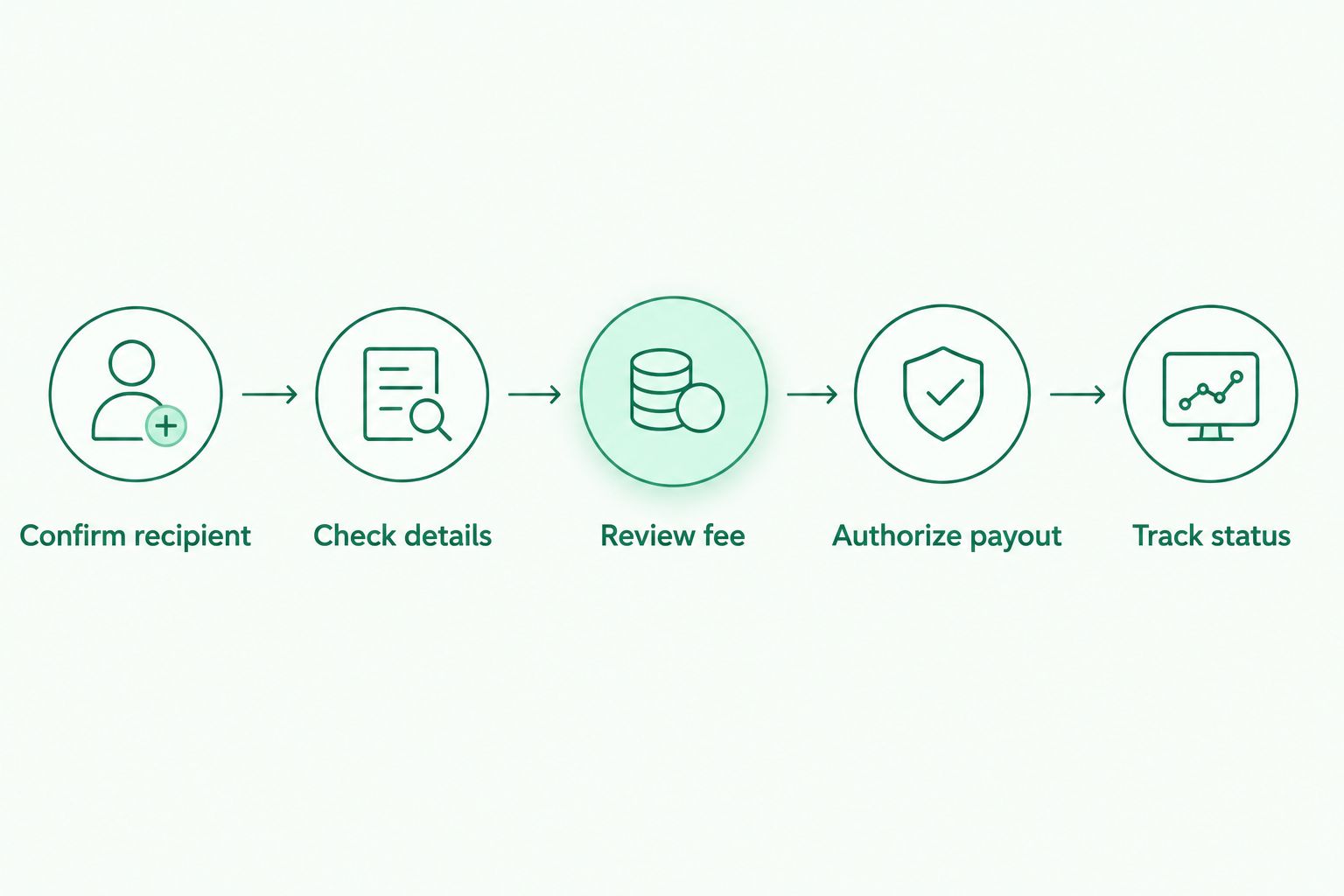
Verify the recipient and payment details before authorizing a payout.
Keep an approval record alongside the payment reference. A visible transfer status answers where the payment stands; your internal record explains why it was sent.
- Confirm recipient: verify the intended payee independently.
- Check details: compare currency, recipient and payment method.
- Review fee: inspect the amount shown before confirmation.
- Authorize payout: complete the required approval and authentication.
- Track status: record progress and reconcile the completed payment.
5. Assign access by responsibility
Start with a staff-access list. Write down who needs to manage the workspace, prepare payments or inspect records. Remove access needs that exist only because several people currently share a login.
The available team roles are owner, admin, operator and view-only. Check each role’s actual permissions before assigning it. Role names alone don't establish that your preferred approval arrangement is supported.
Every payout, new recipient and team grant requires two-factor authentication. Several companies and personal profiles can sit under one sign-in, so account convenience makes entity checks more important, not less.
- Assign named users instead of sharing credentials.
- Match each role to the person’s current responsibilities.
- Check permissions before granting payment-related access.
- Confirm the selected company before preparing a transfer.
- Review access when a colleague changes role or leaves.
6. Plan around limits and usual processing times
Build a payment calendar from supplier due dates, then allow room for verification, processing and follow-up. Don't schedule a time-sensitive obligation around the shortest possible arrival estimate.
The supplied business limit is $100,000 or €100,000 per payout, with no monthly limit. Incoming ACH usually takes 1–3 business days. Incoming wire and SEPA usually arrive within a business day, while payouts usually take 1–2 business days.
These are usual processing times, not commitments for a particular transfer. For a 2026 payment plan, confirm current limits and timing before relying on them. A transfer fitting within the stated business limit still needs the correct recipient, supported destination and permitted purpose.
- Compare each planned payout with the applicable currency limit.
- Allow for business-day processing when setting internal deadlines.
- Tell counterparties which payment method to use.
- Escalate time-sensitive payments before the due date.
- Avoid promising arrival based only on a usual processing range.
7. Reconcile payments by entity and matter
Start with a spreadsheet or your existing accounting process. Record the invoice identifier, receiving entity, currency, gross amount, transaction fee and payment status. Use a matter identifier that doesn't expose unnecessary confidential information.
Reconcile each company separately, even when several profiles share one sign-in. A combined workspace is an access arrangement; it isn't a reason to combine different entities’ accounting records.
Before expanding the setup, review an actual operating receipt and a supplier payment from instruction through reconciliation. Check whether your team can explain every entry without relying on an individual’s memory.
- Match incoming receipts to issued invoices.
- Record fees separately from the underlying legal-service payment.
- Identify currency exchanges in the accounting record.
- Reconcile outgoing transfers against approved supplier invoices.
- Investigate unmatched receipts before allocating them to a matter.
Compare options for your firm’s operating payments
Choose by function before comparing convenience. A domestic operating relationship, a specialist client-money arrangement and a cross-border payment service solve different problems. Your firm can need more than one.
Use this 2026 comparison as a decision framework. It doesn't establish acceptance by a provider or approval under your professional rules.
| Option | Best for | Main advantage | Key limitation |
|---|---|---|---|
| Existing domestic provider | Firms whose current provider supports their required USD workflow | Keeps payments within an established relationship | Confirm named USD receiving details, cross-border methods and entity support |
| Jurisdiction-appropriate client-money arrangement | Firms holding funds that require specialist treatment | Lets the firm assess client-money requirements separately | Suitability depends on applicable rules and the specific arrangement |
| Moneyspace | Firms evaluating dedicated USD/EUR details for operating receipts and payouts | Named details, ACH/wire/SEPA payouts, fee preview and live status | Not a bank; eligibility and law-firm use require confirmation; client-money suitability isn't established |
| Separate providers for different entities or functions | Firms needing distinct operating and client-money workflows | Keeps different requirements explicit | Adds access management and reconciliation work |
Don't treat a longer feature list as evidence of legal suitability. Confirm the necessary account function first, then assess how much manual work each option removes.
Review your operating-payment needs
Evaluate dedicated USD and EUR details for your firm's operating receipts and supported payouts.
Common mistakes international law firms make
Treating USD receiving details as client-money approval
A routing number or IBAN identifies payment instructions. It doesn't establish that the arrangement satisfies rules for holding client money. Get the suitability decision before sending clients new payment instructions.
Confusing the firm with the individual lawyer
The lawyer sending an invoice and the entity entitled to receive payment aren't always the same customer. Confirm the contracting entity, named receiving details and approved profile before issuing instructions.
Reusing one instruction sheet for every payment method
ACH, wire and SEPA require method-specific information. Keep separate, clearly labeled instructions and tell the payer which set applies. Don't assume that a payer will infer the correct method from the currency alone.
Treating live status as completed bookkeeping
A completed payout still needs an approved purpose, an invoice match and the correct entity allocation. Status tracking supports payment operations; it doesn't close your accounting record automatically.
Publishing a deadline based on usual timing
A usual processing range isn't a delivery commitment. In your 2026 client communications, distinguish when your firm expects to initiate a payment from when the recipient is expected to receive it.
FAQ
What's the best USD account setup for an international law firm?
The best setup separates operating payments from any funds requiring client-money treatment. Choose named USD receiving details and suitable payment methods only after confirming entity eligibility, permitted use and applicable professional rules.
Can an international law firm use Moneyspace for client funds?
Client-money suitability has not been established by the supplied product information. Moneyspace provides USD and EUR payment capabilities, but your firm needs a separate assessment before using any arrangement for trust funds, retainers or settlement proceeds.
Can clients pay a law firm through ACH?
Clients can use ACH when the receiving service supports it and the payer can send through that method. Confirm the correct USD routing and account details, receiving entity and permitted payment purpose before issuing instructions.
Do dedicated account details mean the provider is a bank?
No. Dedicated account details describe how payments are addressed, not the provider's legal status. Confirm the provider's disclosures and the role of any licensed partner separately.
How long do USD and EUR payments usually take?
The supplied timing is 1–3 business days for incoming ACH, usually within a business day for incoming wire or SEPA, and usually 1–2 business days for payouts. These are usual processing ranges, not commitments for a particular payment.
Can one sign-in cover several law-firm entities?
The described service supports several companies and personal profiles under one sign-in. Keep permissions, payment approvals and accounting records separate for each entity, and confirm that each entity is accepted.
What should a law firm check before switching payment instructions?
Confirm entity eligibility, permitted use, named receiving details, payment methods, limits and professional requirements. Notify counterparties through an established channel and verify the first operating receipt before making the new instructions routine.
One last thing
Review the invoice template before opening another account. Add the receiving legal entity, invoice currency and accepted payment method to your 2026 template. Keep confidential matter details out of payment references unless they're necessary and appropriate.
Moneyspace can be evaluated against that operating-payment checklist. Don't reverse the order by choosing the tool first and deciding what money belongs there afterward.