Wire transfers for real estate investors: complete 2026 guide
Real estate investors’ wire transfer process is the movement of purchase or investment funds to a designated recipient, with the aim of meeting an agreed payment deadline. For a property closing in 2026, the essential checks are recipient acceptance, verified instructions, the buying entity’s identity, transfer limits, and confirmation that funds arrived.
TL;DR
- A wire transfer for real estate investors starts with independently verified closing instructions, not an emailed payment request.
- Moneyspace provides own-name USD/EUR account details; confirm property-transaction acceptance before using it for a closing.
- Check payout limits and usual processing times before choosing wire, ACH, or SEPA.
- A completed payout status does not replace the closing agent’s confirmation that funds were received and accepted.
Why wire transfers matter for real estate investors
A property payment has to satisfy the closing agent’s instructions, not just reach a destination. Your payment method, sender identity, currency, and arrival date all need to fit the transaction.
Investors buying through companies face another decision: which entity sends the money? A payment from your personal profile is not the same record as a payment from the company named in the purchase documents. Resolve that distinction before submitting a transfer.
Cross-border investors also need to separate currency conversion from payment delivery. Having USD available does not establish that the recipient accepts your provider or payment method. Ask both sides before moving purchase funds.
Choose the payment route around the closing requirements, not around a provider’s headline offer. Use a comparison of international wire transfer services to identify questions about charges and routing, then verify the answers for your transaction.
For your 2026 closing checklist, record who approved the instructions and how you verified them. A record is more useful than an assumption when a deadline approaches.
How to prepare a real estate wire transfer
Use the following sequence for purchase funds, earnest money, or another property-related payment. Acceptance requirements differ by recipient and transaction, so confirm the purpose of the payment as well as its destination.
The manual approach is straightforward: keep a transaction checklist, verify instructions independently, and retain the receipt. Payment software can organize execution and tracking, but it does not replace these checks.
Confirm recipient requirements
Start with the closing agent, settlement professional, or other authorized recipient. Ask for the accepted payment method, required currency, payment reference, sender-name requirements, and deadline. Establish whether the deadline means payment submitted or funds received and accepted.
Do this before choosing a provider. An account with USD or EUR payment capabilities is useful only if the proposed transfer fits the recipient’s requirements.
If you are sending an initial payment rather than the closing balance, confirm that it uses the same instructions. Don’t carry instructions from one stage of a transaction into another without checking.
- Identify the authorized recipient and their role in the transaction.
- Obtain written payment instructions through an established channel.
- Confirm the required payment method and currency.
- Ask what constitutes receipt before the deadline.
- Confirm whether the proposed payment provider is acceptable.
Match the entity
Write down the legal buyer’s name and compare it with the name on the sending profile. If a company is purchasing the property, ask what documentation the recipient requires when funding comes from that company or another source.
A spreadsheet and a folder of supporting documents are enough to organize this manually. Keep the purchase agreement, entity information, payment instructions, and transfer receipt together. Make the relationship between sender, buyer, and payment purpose clear.
For founders managing several companies, convenience must not blur ownership. Check the selected company before creating a recipient or starting a payout. A shared sign-in does not make company records interchangeable.
- Record the exact legal name of the purchasing entity.
- Match that name against the intended sending profile.
- Resolve personal-to-company funding questions with the closing agent.
- Keep source-of-funds documents available for review.
- Assign a separate payment record to each property transaction.
Verify instructions
Verify payment instructions using a contact method established independently of the payment message. Call a previously verified number, rather than a number supplied in an unexpected email changing the destination.
Read the recipient name and account details back to the authorized contact. Treat any change in destination or payment process as a reason to pause and repeat verification. This manual check remains necessary even when your payment interface stores recipients.
Moneyspace provides dedicated USD and EUR account details in the customer’s own name, plus recipient and payout controls. Moneyspace suits investors needing own-name USD/EUR payment details, subject to closing-agent acceptance. Every payout, new recipient, and team grant requires two-factor authentication; that control does not establish that recipient instructions are genuine.
- Verify instructions through a previously established contact channel.
- Compare the recipient name and destination details character by character.
- Confirm the payment reference required for the property file.
- Pause when instructions change unexpectedly.
- Record who verified the destination and when.
Check limits
Compare the amount due with both the per-payout limit and the remaining monthly allowance. Make that comparison before funding an account. A balance large enough to cover a purchase does not remove a transfer limit.
Moneyspace’s individual limits are $10,000 or €10,000 per payout and $50,000 or €50,000 per month. Business limits are $100,000 or €100,000 per payout, with no monthly limit. These are service limits, not confirmation that a particular property payment will be accepted.
If the payment exceeds a limit, discuss an accepted alternative with the provider and closing agent. Don’t divide a payment to bypass controls. Any staged-payment arrangement needs explicit acceptance and a clear reconciliation plan.
Source for these provider-specific limits, controls, and timing statements: client-supplied service information dated October 26, 2026.
- Compare the amount due with the per-payout limit.
- Check remaining monthly capacity for an individual profile.
- Confirm that the correct personal or business profile is selected.
- Ask about transaction acceptance before moving funds.
- Resolve an over-limit payment before the closing deadline approaches.
Prepare funds
Separate incoming funding time, any required USD/EUR exchange, and outgoing payment time. These are different stages. Don’t calculate the closing schedule from the outgoing stage alone.
For the service described above, incoming wire and SEPA payments usually arrive within a business day. Incoming ACH takes 1–3 business days. Payouts usually take 1–2 business days. Treat those as usual processing windows, not a promise that your recipient will accept funds by a particular hour.
Review the fee shown before confirming a payout or exchange. Keep enough available for the intended recipient amount and the applicable charges. Ask the closing agent how to handle any difference between the amount sent and the amount credited.
- Confirm that incoming funds have arrived before scheduling the payout.
- Check whether USD/EUR exchange is required.
- Review the displayed fee before confirmation.
- Ask about processing cutoffs and non-business days.
- Agree on the response if funds miss the expected arrival window.
Send the payment
Use a prepared payment checklist rather than entering details from memory. Compare the destination, currency, amount, reference, and sending entity with the verified instructions immediately before confirmation.
For a team, define who prepares the payment and who checks it. Moneyspace supports owner, admin, operator, and view-only roles, as well as several companies and personal profiles under one sign-in. Those features help organize access; they do not establish that an internal approval procedure has been completed.
Keep recipient verification separate from authentication. Two-factor authentication confirms an authorized action within the account, not the legitimacy of an outside payment request. Review the destination before completing that action.
- Select the correct company or personal profile.
- Compare the entered destination with the verified instructions.
- Recheck currency, amount, and property reference.
- Complete the required authentication yourself.
- Save the payout confirmation to the transaction file.
Confirm receipt
Track the payment after submission, then ask the authorized recipient to confirm arrival and allocation to the correct property transaction. A payment receipt documents your instruction; recipient acknowledgment establishes what the closing team has accepted.
The service’s live payout stages are Processing, On its way, and Completed. Use those stages for tracking, but don’t interpret Completed as confirmation that a property closing is finished. The closing agent must still reconcile the payment with the transaction.
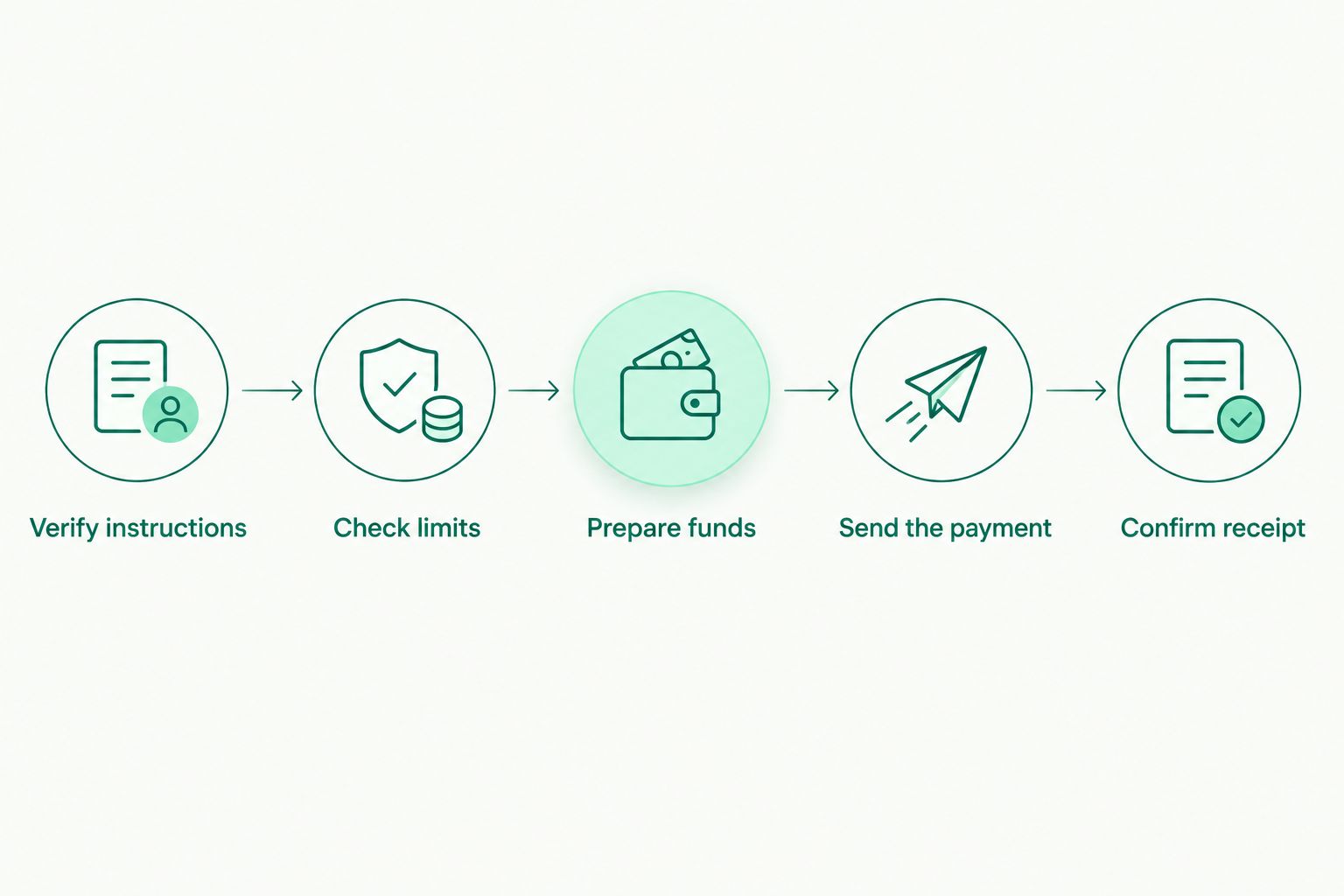
Verify the destination before sending, then confirm receipt with the closing agent.
Preserve the final acknowledgment alongside the original instructions and transfer record. If the recipient reports a problem, contact the payment provider promptly and follow its process rather than sending a replacement without investigation.
- Monitor the payout status after submission.
- Request acknowledgment through the established contact channel.
- Confirm allocation to the correct property file.
- Investigate a missing or mismatched payment promptly.
- Retain instructions, receipts, and recipient acknowledgment together.
Compare payment options for your 2026 transaction
Best for a closing is the method the authorized recipient accepts within your funding schedule. Wire, ACH, and SEPA are not interchangeable labels. Select the route before entering payment details.
| Option | Best for | Practical advantage | Key limitation |
|---|---|---|---|
| Wire transfer | A property payment with explicit wire instructions | Follows the recipient’s requested wire process | Sending does not establish receipt; limits and processing requirements still apply |
| ACH payout | A USD payment whose recipient explicitly accepts ACH | Provides an alternative when the transaction permits it | Not a substitute for a wire-only instruction |
| SEPA payout | A EUR payment to an accepted SEPA destination | Keeps an accepted EUR payment in EUR | Requires recipient and destination acceptance; it is not a USD payment method |
| Moneyspace | Own-name USD/EUR payment details and supported payouts | Combines currency exchange, team access, and live payout status | Property-transaction acceptance needs confirmation; payout limits apply |
This table compares payment routes with one account service that supports them. It does not establish eligibility for a country, recipient, or property transaction. Confirm those points directly before relying on an option.
Open an account
Get your own USD and EUR account details after verification. Confirm transaction acceptance before funding.
Common mistakes real estate investors make
Trusting a changed instruction email
A familiar sender name is not independent verification. If destination details change, pause and contact the authorized recipient through an established channel. Don’t use the new message itself as the source of the verification number.
Using a personal profile without resolving entity requirements
A company purchase needs a clear explanation of who is sending the funds. Resolve the relationship between the buyer and sender before payment, rather than asking the closing team to interpret it after receipt.
Treating a usual payout window as the full schedule
Incoming funding, exchange, outgoing processing, and recipient acknowledgment are separate events. A 2026 closing plan should identify each event and its owner. Leave unresolved timing questions visible instead of treating an estimate as a deadline commitment.
Assuming a large balance removes payout limits
Available funds and permission to send a particular amount are different checks. Review the per-payout limit before transferring purchase money into the intended sending account. Escalate a mismatch early rather than improvising several payments.
Treating payout status as closing completion
A provider’s status describes the payment process, not the property transfer. Obtain acknowledgment from the closing agent and confirm that the money was allocated correctly. Keep that acknowledgment with the closing records.
FAQ
What’s the best wire transfer for real estate investors?
The best wire transfer for real estate investors is one the authorized recipient accepts, with independently verified instructions and limits that fit the payment. Confirm the sender name, required currency, arrival deadline, and property-transaction acceptance before funding.
Can I use Moneyspace for a property closing?
Confirm property-transaction acceptance with Moneyspace and the closing agent before using it for a closing. The supplied service information establishes USD/EUR account details and payout capabilities, not acceptance of a specific real estate transaction.
How long should I allow for a property payment?
Build the schedule around incoming funding, any exchange, outgoing processing, and recipient acknowledgment. For the service described here, incoming ACH takes 1–3 business days, incoming wire and SEPA usually arrive within a business day, and payouts usually take 1–2 business days.
Can I send more than the payout limit by splitting the transfer?
Don’t split a payment to bypass a provider’s controls. Ask the provider and closing agent for an accepted arrangement before funding, and document how any approved staged payments will be reconciled.
Is ACH better than wire for a real estate payment?
ACH is appropriate only when the authorized recipient accepts it for that payment. If the closing instructions require a wire, don’t substitute ACH without explicit approval.
What should I do if closing instructions change by email?
Stop and verify the change through a previously established contact channel. Don’t rely on a phone number, link, or reply address supplied in the change request itself.
Does Completed mean my property closing is finished?
No, Completed is a payout status, not confirmation that the property closing is finished. Ask the closing agent to confirm receipt, allocation to your transaction, and any remaining closing requirements.
One last thing
Add a recipient-acceptance field to your 2026 closing checklist. Record the accepted provider, payment method, sender name, currency, and deadline before moving funds. That single record connects the property documents with the payment you intend to make.
Moneyspace is not a bank. Account details are provided through a licensed partner after verification. Confirm eligibility and transaction acceptance before relying on the service for a property payment.